
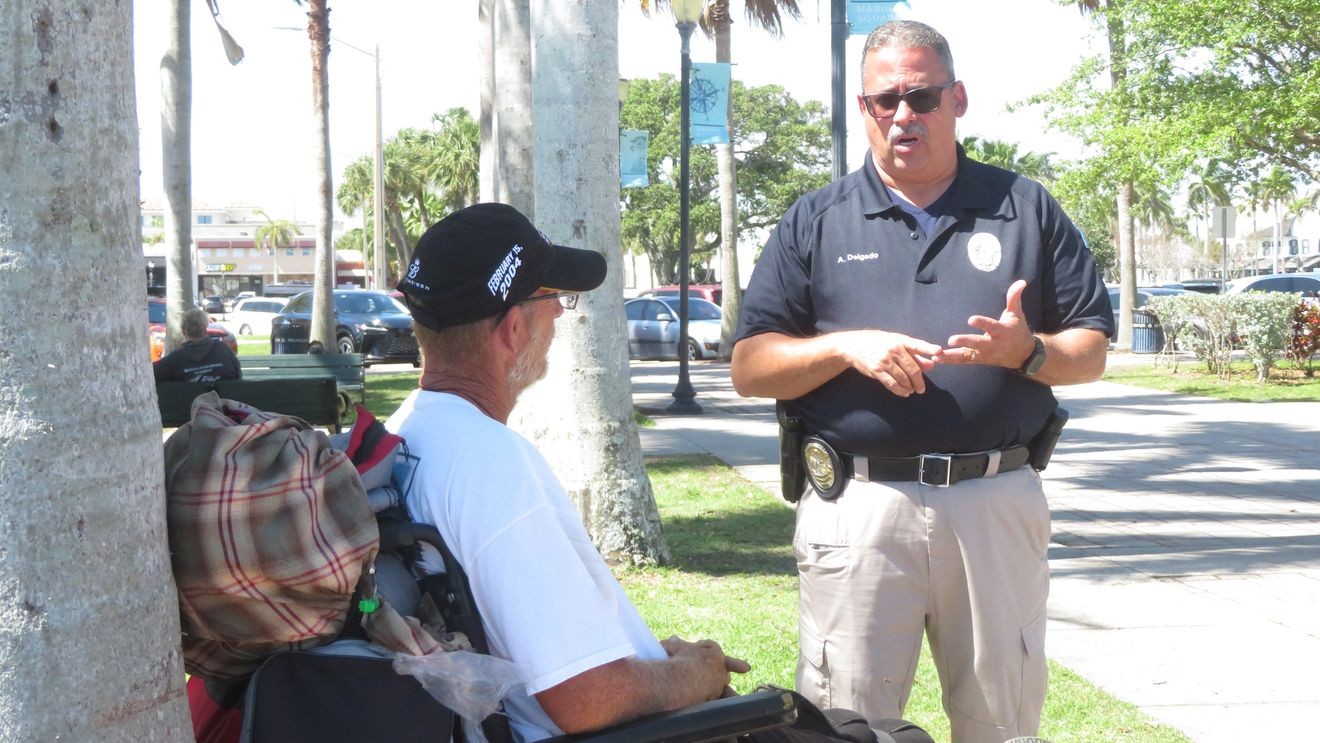
FORT PIERCE, Fla. (CBS12) — Officer Alberto “Al” Delgado thought his career in public service was over.
After serving as an Army captain and spending more than two decades in law enforcement, he retired and moved to St. Lucie County. But just 30 days later, a former supervisor called with a new mission — one that would bring him back into uniform in a very different role.
Today, Delgado serves with the Fort Pierce Police Department‘s Community Engagement Unit as the department’s homeless and veteran liaison, connecting people experiencing homelessness with housing, medical care and other resources to help them get back on their feet.
“I will do anything and everything within my power to be able to bring a homeless veteran into a better environment,” Delgado said.
Born in Okinawa, Japan, where his father was stationed in the U.S. Army, and raised in Puerto Rico in a military family, Delgado says service has always been part of who he is. He graduated from the University of Puerto Rico with a bachelor’s degree in Human Resources Management and was part of the Army ROTC program. He later served as an Army captain before pursuing a career in the private sector.
See also: DeSantis announces Florida’s first terrorist organization designations under new law
Following the September 11 terrorist attacks, Delgado felt called to serve again. He became a police officer with the Lauderhill Police Department, where he spent 22 years before retiring.
That retirement didn’t last long.
Just one month later, the Fort Pierce Police Department asked him to return to public service — this time in a role focused on helping some of the community’s most vulnerable residents.
“You can’t judge a book by its cover,” Delgado said. “Just because you see a person who’s having a difficult time, there is a story. There are reasons why this person ended up on the streets.”
Each day, Delgado conducts homeless outreach, building relationships with people living on the streets and connecting them with wraparound services, including housing assistance, health care, identification documents and other resources designed to help them rebuild their lives.
As a military veteran, Delgado says helping homeless veterans is especially meaningful.
“It’s totally unacceptable to have somebody that has served their country to be out on the streets,” he said.
For Delgado, success isn’t measured by statistics.
It’s measured by seeing fewer people living on the streets — and knowing someone has been given another chance.
“Whenever I see that there are less people out on the street, I know that something good is going on,” Delgado said. “We’re doing our job.”
His work continues to embody a lifetime of service — proving that for some, retirement isn’t the end of serving others.