
As the United States prepares to mark America’s 250th birthday this July 4th, some University of North Florida students said they are exhausted by the political climate, but are pushing the importance of civic duty.
UNF students said recent politics have infiltrated campus, such as UNF’s agreement with ICE, and the way they connect with peers of different political backgrounds.
An Instagram poll conducted by Spinnaker asked UNF students, “As America turns 250, how would you describe the current political climate on campus?” Of the 51 students who responded, 35% said the climate feels “divided and tense,” 27% said it’s “worse online than in person,” 20% said they try to avoid politics altogether, and only 18% described it as “respectful despite disagreements.”
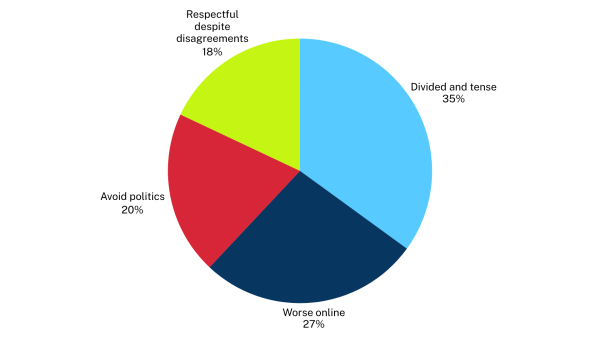 In a poll conducted by UNF Spinnaker via Instagram. 35% of students reported feeling divided and tense, while a fifth of students reported ignoring politics altogether. Over a fourth reported seeing worse divisive political content online, and only 18% said they try to respectfully debate.
Alyssa Schneider, a junior English major at UNF, has been eligible to vote for the last few years but has yet to go to the polls. Schneider said politics were “very controversial,” steering clear of the topic with school and family, because it always turns into a fight. She said she hopes to vote in the next election.
Schneider is like many other young voters. In the 2024 presidential election, only 47% of eligible voters ages 18-19 went to the polls, according to the Center for Information and Research and Civil Learning and Engagement (CIRCLE).
For some students, the Fourth of July evokes patriotism. For others, like Rhett McClure, a sociology major and Air Force veteran, the controversy surrounding Freedom 250 and America 250 proves the “propaganda” of the holiday.
McClure identifies as an anarchist. “I’m okay with celebrating history,” he said, “but I don’t believe in borders, I don’t believe in countries, I don’t believe in flags.”
Schneider said the holiday never carried a heavy political correlation for her.
“It was just a thing that happened. Fireworks, a burger, a popsicle, maybe a pool. Not very much patriotism,” Schneider said.
A common theme among students was their personal choice to preserve relationships regardless of political beliefs, even if it means staying silent.
Daylee Nolan, a nursing major who transferred to UNF from the University of Florida, said organizations like UF’s Young Republicans were “probably one of the only places” she felt comfortable speaking openly about politics.
“I’ve definitely lost some friends because of it,” Nolan said, “because a lot of people feel like it goes to a moral level with some of the things I’ve voted on.”
Nolan said the idea that political disagreement shouldn’t end a friendship. “We’re all just people… there are things way bigger than politics,” she said.
Alec Kielbasa, a UNF political science student, said he’s dealt with opposing views among classmates, agreeing with one peer on economic issues but not abortion.
“We’re both adults about it,” Kielbasa said, calling it a mutual agreement to prioritize the relationship over the argument.
McClure said his time in the Air Force felt like “brainwashing” around patriotic duty.
“I was convinced the flag stood for freedom, that this country stands for freedom,” McClure said.
McClure now sees the flag as a symbol of unfairness, citing the effects of Manifest Destiny on Indigenous populations, calling it a symbol “for the rich and the elite.”
Sarita Riley, a leadership communication major at UNF and a registered Democrat, has yet to vote, saying she prefers candidates based on viewpoints and morals.
“I’m a big ethics person,” Riley said.
Riley cited 2025’s politically motivated congressional gerrymandering as a reason she questions politicians’ moral compass, though she added, “I think the ones who really want to see the change are being ignored.”
Elizabeth Singleton, a secondary education major, voted for the first time in 2024 for Harris. She thinks campaign tactics played a role in the loss
“They were painting themselves as the victim instead of being the right choice… They want someone that’s gonna advocate,” Singleton said.
Some students pointed to social media algorithms for aiding in polarization, known as the silo effect, where users mostly see content they already agree with, according to Northeastern Global News.
“They only show you what you want to see,” said Riley.
Singleton said with social media and politics merging, performative posting has become prevalent.
“It gets to a point now where they come off as annoying, and nobody actually reads them,” Singleton said, due to the high amount of content.
“Going out into the community and actually interacting with people, I think that actually does make an impact,” said Singleton.
Kielbasa said that he gets a lot of his information from X, formerly known as Twitter.
“I know it’s not the place to get my news,” Kielbasa said, “but that’s where I always find it first.”
Kielbasa pointed to New York City mayoral candidate Zohran Mamdani, whose campaign model strongly utilized social media to seem approachable rather than chase engagement, according to the Harvard Political Review. Mamdani won 75% of the youth vote in that race, his strongest age bracket, according to CIRCLE.
Kielbasa has been involved with the Jacksonville Democratic Party since freshman year and now interns for Rachel Grage, a congressional candidate in Florida’s 5th Congressional District.
“I’m getting paid for it, so it’s not entirely altruistic,” said Kielbasa, though he wants a career that helps “make the world a better place, hopefully.”
Kielbasa recruited Singleton, his girlfriend, to canvass for Grage in St. Johns County this past summer, where voters often reacted with surprise at her age.
“Everyone said something about it. It’s nice to know that we’re still respected even when we are so young,” said Singleton.
Congress created the bipartisan America 250 commission a decade ago to coordinate the anniversary. This July 4th, a Trump-backed group called Freedom 250, created by executive order, has taken center stage instead, staging events like a UFC cage match on the White House South Lawn, described by the New York Times as a “towering, claw-like structure where men beat each other to a pulp”. Several performers withdrew after learning of Freedom 250’s ties to the administration.
Funding has also drawn scrutiny. Freedom 250 promised $50 million to America 250 but delivered only $25 million, according to CNN. Democratic committee staff have alleged donors were misled into redirecting funds, an accusation CNN said would constitute wire and charitable solicitation fraud.
Crowd size has also sparked debate, with Fox News hosts insisting on packed crowds despite empty live shots, described elsewhere as a “ghost town”.Trump said on Truth Social his Wednesday speech drew 45,000 people “packed to the brim”.
Kielbasa said the gap between Freedom 250’s promises and its delivery is laughable.
“It gives me the same vibe of the Willy Wonka Chocolate Experience in Glasgow. It kind of felt like there wasn’t a ton of respect put into it,” Kielbasa said.
___
For more information or news tips, or if you see an error in this story or have any compliments or concerns, contact [email protected].