
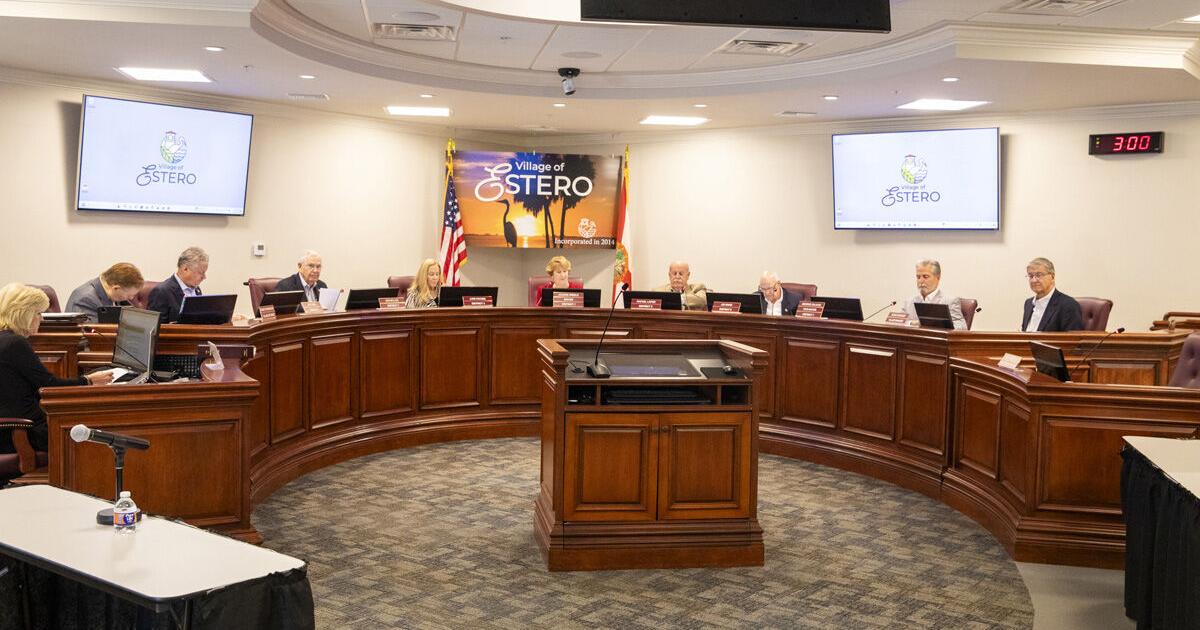

Village of Estero staff proposed keeping the property tax rate unchanged while presenting a $90.8 million budget for fiscal year 2026-27.
Evan Williams
Village of Estero staff proposed keeping the property tax rate unchanged for fiscal year 2026-27 while approving an annual budget with major investments in parks and recreation projects.
The proposal would keep the village’s millage rate at 0.73, or 73 cents for every $1,000 of taxable property value, one of the lowest rates in the region. It is slightly below the 0.7336 rolled-back rate that would generate the same amount of property tax revenue as last year.
The village’s proposed $90.8 million budget for 2026-27 represents a significant increase from recent years because of a plan to borrow $69 million through bonds for generational parks projects. It remains in line with the village’s plan to use most of its revenue on capital projects.
“What’s significant about our budget, because we operate on a government-lite approach, most of our money is in the capital improvement program,” Village Manager Steven Sarkozy said while introducing the draft budget during a June 30 workshop.
As required by state law, Village Council plans to adopt a final millage rate and annual budget at public hearings before the fiscal year begins Oct. 1. The first hearing is scheduled for Sept. 9 at 5:05 p.m., with a final adoption hearing set for Sept. 23 at 5:05 p.m.
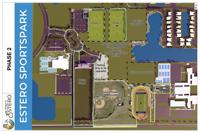
A site plan shows proposed Phase 2 improvements to Estero Sports Park, one of the largest projects included in the village’s proposed $90.8 million budget for fiscal year 2026-27.
Estero government
The draft budget allocates $75.9 million for capital projects, funded largely through the $69 million bond issuance along with general fund revenue, including property taxes, gas tax revenue and impact fees.
Village planners earmarked $43.6 million for parks and recreation projects, including $26.9 million for Phase 2 of the 80-acre Estero Sports Park. The village also plans improvements at Estero RiverPark and the Happehatchee Center.
Another $19 million is budgeted for Estero’s share of a potential acquisition of an 11.4-mile railway corridor in partnership with Bonita Springs and Collier County. The governments plan to convert the corridor into the Bonita Estero Rail Trail, or BERT, although the purchase has not yet been finalized. The three governments and Seminole Gulf Railway are in the due diligence process, with closing expected this fall.
Other capital projects include $5.5 million for utilities, $5.3 million for intersections, $1.8 million for roads, $350,000 for stormwater improvements and $300,000 for bicycle and pedestrian projects.
The draft budget also includes $14.9 million for general government services, transportation, public safety, debt service and other expenditures.
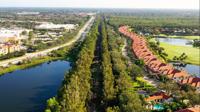
An aerial view of a corridor route near Coconut Point Mall shows the railroad corridor targeted for the proposed Bonita Estero Rail Trail, a planned mixed-use path linking Estero, Bonita Springs and Collier County. The project would connect to a broader regional trail system.
Friends of BERT
Like many Florida cities and counties, the village is waiting to see whether voters approve a proposed expansion of the homestead property tax exemption on the November general election ballot. The measure’s primary provision would increase the nonschool homestead exemption to $150,000 in 2027 and $250,000 after that, potentially reducing the village’s annual property tax revenue by millions of dollars.
“What we’re estimating is our impact would be significantly higher than a lot of cities because we do have a lot of homesteaded property,” Sarkozy said. “We think that the initial cut would be about $2.5 million year one, which then could have an impact on our capital improvement program.
“The amount that we have available on an annual basis for the capital improvement program is somewhere, anywhere from $6.5 million up to $9 million depending upon the year and other expenditures. A cut of $2.5 million would be significant, no doubt, and we’ll just have to monitor that. We’ll have more information in the fall.”