
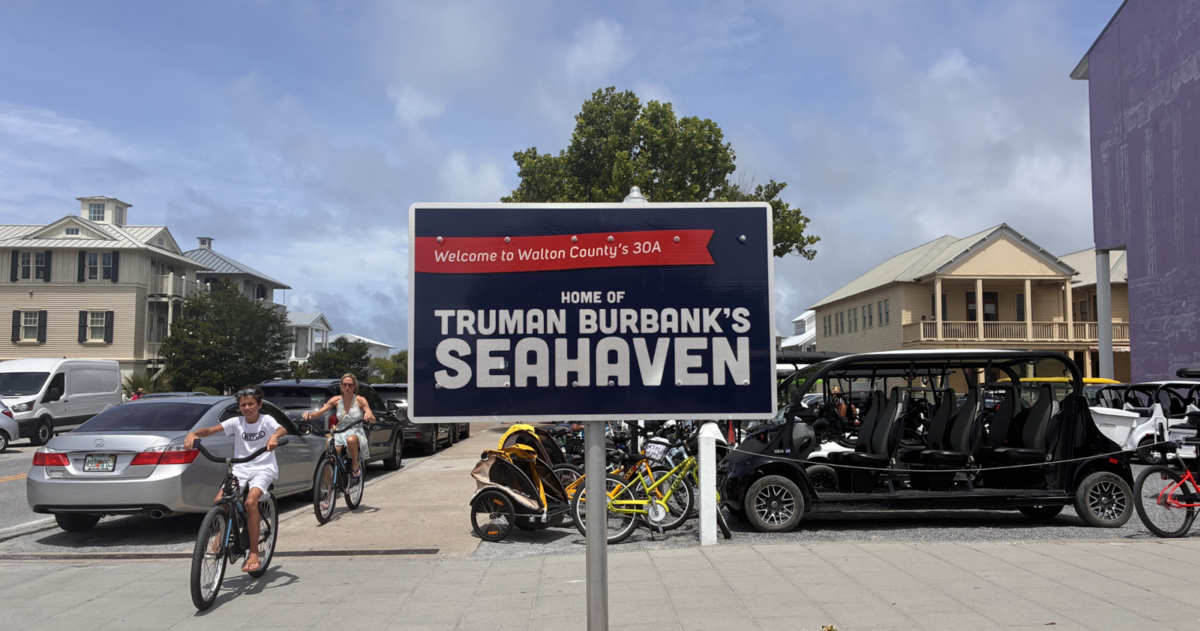
Tanned cyclists recently pedaled along East County Highway in Seaside, Florida, passing pastel cottages, white picket fences and lush flower beds on brick streets faded by years of sunshine.
Some rode down to the town square, where the line between everyday life and vacation seems to blur. Window shoppers peeked at mannequins dressed in linen and polos. Goldendoodles tugged at leashes as people huddled beneath palm trees for lunch and coffee before returning to the beach for another few hours.
If the sun-bleached hair and swimsuits didn’t already make it clear this is a beach town, the pun-filled signs hanging outside homes and driveways did: “Parking Is All That Smathers,” “Sandity” and “Here Comes the Sun.”
Every place has its own ethos. For New Orleans, it’s resilience; for Philadelphia, grit; for New York City, ambition. For Seaside, it’s escapism — an escape from life’s hardships into a pastel bubble of Gulf waters, bike rides and manicured homes, where summer never seems to end.
That’s what its founder, Robert Davis, intended after an era of futurism deduced the American dream could be found in speed, technology and progress. Davis countered that philosophy, instead embracing new urbanism when he transformed 80 acres of land inherited from his grandfather into Seaside in 1981.
Inspired by his childhood vacations along Florida’s Gulf Coast, he painted a portrait of small-town America, where neighbors knew one another, where residents strolled through the town square instead of navigating winding cul-de-sacs and rarely reached for their car keys.
“This was a vision of personal mobility, isolated in comfort,” Davis said, “And escape from the city to a bucolic suburb where everyone would have a garden and live in a kind of splendid isolation.”
His vision is the reason why Seaside was chosen as the setting for the 1998 film “The Truman Show,” directed by Peter Weir and starring Jim Carrey as Truman Burbank, who discovers his seemingly ordinary life is a reality television show that’s chronicled his every move from the time he was a fetus to, presumably, his demise.
The ones he loves most — his mother, wife, friend and neighbors — are paid actors, while the town he resides in, Seahaven, is a colossal soundstage. Beneath its idyllic facade and saccharine faces lies a world of control, surveillance and illusion, where every relationship and conversation is carefully engineered for the audience’s amusement.

The house in Seaside, Florida, where Truman Burbank lives in the 1998 film “The Truman Show.”
Poet Wolfe
The script, Davis said, originally envisioned a neighborhood in New York City, until Weir’s wife read a magazine article about Seaside while scouting locations for the film. Davis obliged, he said, adding that the community “was so un-busy at the time that we were happy to have some activity.”
But he did have some concerns. Aside from the army of production crews that would descend on Seaside, he worried about “the reaction of the greater world.”
The community had already been dismissed as a “lab-like place” by some architectural critics. Davis was concerned the film would reinforce that image — an oasis engineered to unreachable perfection — and he wasn’t wrong.
But when “The Truman Show” was released in theaters, he didn’t take offense to how his town was portrayed. He knew that like anywhere else, Seaside had flaws of its own.
“Anybody who was inspired by the movie to visit Seaside would realize that it wasn’t just a stage set,” he said, “It wasn’t nearly as polished or perfect as it was shown to be in the movie.”
Yet on a recent weekday afternoon, its flaws faded into the background, with only the sun-bleached streets revealing the passage of time.
Signs of imperfection remained undetectable turning onto a palm-shaded Natchez Street and approaching “The Truman House” — the words painted in navy blue on the white picket fence. With a butter-yellow facade, coral trim and a lime green door, the home where Truman lives in the film was far more vibrant in real life than how it appeared onscreen.
The rows of pastel cottages dwindled approaching the town square, where cream-colored commercial buildings and Airstream trailers converted into food stands circle around a grass field.
In one corner sits Modica Market, a family-owned store operating in Seaside since 1989. Inside, Charlie Modica stood at the cash register, ringing up groceries as the lunch rush steadily grew closer to noon. At least three times a day, a shopper approaches him about his brief appearance in “The Truman Show.”
Modica stepped away from the register and stood beside the wooden ladder where he was perched during his scene in the film. Across from him was a framed movie poster of a grinning Truman Burbank, hanging above black and white photos of his family’s gourmet grocery store from decades ago.
Charlie Modica and his sister run Modica Market, a gourmet grocery store in Seaside, Florida. Modica, 64, arrived in Seaside as a young adult and has seen the region transform as more newcomers and tourists arrive.
Staff photo by Hannah Levitan
He recalled what Seaside was before it transformed into Seahaven for the film — “a sleepy village” where Modica Market was accompanied by a bookstore and an ice cream shop.
“Seaside’s changed since the movie,” he said. “There’s a lot of businesses, and they finished off a lot of what Robert (Davis) wanted to have. A lot of this wasn’t here.”
Some of those longtime fixtures remain.
At Sundog Books, customers leaf through Southern fiction books — Cormac McCarthy, Eudora Welty, Ernest Gaines — surrounded by shelves that resemble high walls made up of paperbacks and hardcovers. Overlooking the room is a portrait of Flannery O’Connor beside her quote about life’s absurdities: “Possibly the Lord just thinks all of this is funny. It is funny if you can stand it.”
Upstairs, at Central Square Records, the atmosphere shifts from nostalgic to alternative, where teenagers fresh off the beach sift through records beneath string lights as Radiohead plays in the background.
Poet Wolfe
The shops filled with books and vinyls were a reminder that character does exist in a town that lures travelers with its picture-postcard beach, boutiques and cottages. Davis thinks families feel connected with Seaside because it brings back a free-range childhood — a return to the days working parents sent their kids to school with house keys strung around their necks.
“It’s been a while since Americans were comfortable just letting their kids run free,” he said. “But this is a place where that feels pretty comfortable.”
It appeared that way along the smooth-paved roads and into the town square, where kids biked and teenagers wandered, where parents bumped into other parents in moments of serendipity. It was a place where everyone seemed comfortable forgetting, if only for a while, about the world beyond Seaside.
For Truman, however, that illusion is no longer enough. At the end of the film, when he discovers his fabricated reality, he chooses to leave it behind, accepting the discomfort of real life — the heartbreak, fear and uncertainty. But the creator of the television show believes the real world is simply too broken, unlike his version of paradise.
“The world is the sick place,” he said. “Seahaven is the way the world should be.”