
My 77-year-old mother clearly remembers the day in June 1980 when a Sisters of Mercy nun in full habit called her into her office at Stella Maris Catholic School in Georgetown, Guyana. My mother was a young, energetic primary school teacher with a two-year old son to protect in a dictatorship where the renowned historian Walter Rodney, a powerful critic of Forbes Burnham’s authoritarian government, had just been assassinated. As Burnham consolidated power, teachers were expected to introduce “cooperative socialist” instruction in their classrooms, regardless of whether they understood or believed in it. My mother knew that if she wanted to keep her job she would have to comply; she and my father left Guyana two years later.
I am a Ph.D. student at the University of Miami. As I study the Caribbean, I find myself returning to my mother’s stories, particularly now that U.S. universities are facing mounting pressure over curricular content, classroom discussion, faculty governance and research funding. What happened in that Guyanese school in 1980 was not identical to our current trajectory, but it offers a cautionary tale.
Across the U.S., entire academic disciplines have been reduced to political caricatures. Critics have collapsed fields into political shorthand, transforming scholarship into a target for institutional regulation and displaying little respect for gradually developed methodologies.
Florida has been hit hard: The state’s Stop WOKE Act, signed into law in 2022, restricts how public universities can teach and discuss topics such as race, gender and American history. In March, state universities voted to remove sociology from general education requirements. When fields like sociology, critical race theory, postcolonial studies, gender and sexuality studies, and even literary criticism are dismissed through slogan rather than good-faith engagement, the result is not democratic scrutiny; it is a culture mistaking simplification for understanding.
A 2026 PEN America report found that 93 higher-education censorship bills were introduced last year across 32 states, with 21 enacted into law. The atmosphere these policies produce matters as much as the policies themselves. I’ve seen professors remove texts from their syllabi that they feared might provoke scrutiny before anyone explicitly asked them to. In 2023, while I was teaching composition at a community college in Orlando, a respected English professor with a young family wondered aloud whether assigning Alice Walker could place him at professional risk.
The danger is not merely anticipatory self-censorship. It is the erosion of a culture open to nuance and capable of understanding disciplines on their own terms. The term “Critical Race Theory” points toward intellectual complexity: “critical” invites interrogation, “theory” signals ongoing analysis rather than a doctrine demanding assent. But critics have reduced it to an acronym — CRT — uttered with a sneer.
Protecting the slow, often uncomfortable labor of intellectual inquiry may seem modest, but those habits are precisely what encouraged courageous African American professors like Derrick Bell 50 years ago to challenge legal orthodoxies masking hypocrisy. In a recent essay in The Nation, Columbia University professor Jafari Sinclaire Allen argues that Black Studies is not simply a collection of opinions but “practices and habits of mind” formed through generations of methodological labor.
My mother speaks with deep sadness about those final years in Guyana when intellectual courage became increasingly costly. By the late 1980s, Guyana had one of the world’s highest emigration rates; a large contingent ended up in Florida. Guyana’s “brain drain” was not just a loss of talent; it was a loss of voices that might have helped a young nation imagine itself into being.
Societies do not lose freedom only through dramatic acts. Sometimes they lose it gradually. Teachers burn out. We slowly agree to return to models of “western civilization” that put my ancestors’ stories in their “proper” place. “Our voices were stilled before we realized they were,” my mother recently told me. Florida, home to so many like my family who fled repression in search of freedom, must not let that happen.
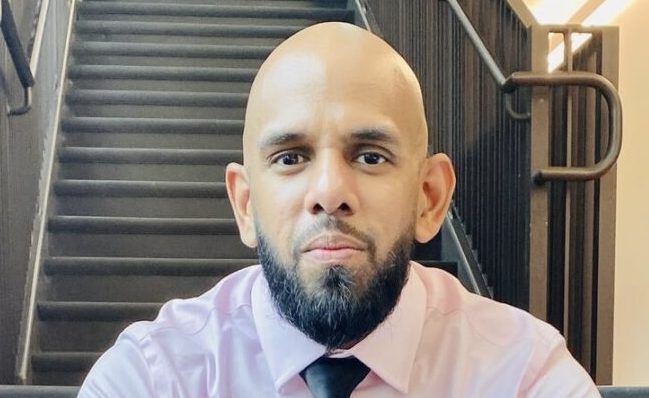
Stephen Narain is pursuing a Ph.D. in English and Creative Writing with a concentration in Caribbean Studies at the University of Miami. He is a P.D. Soros Fellow and a Public Voices Fellow of The OpEd Project.