
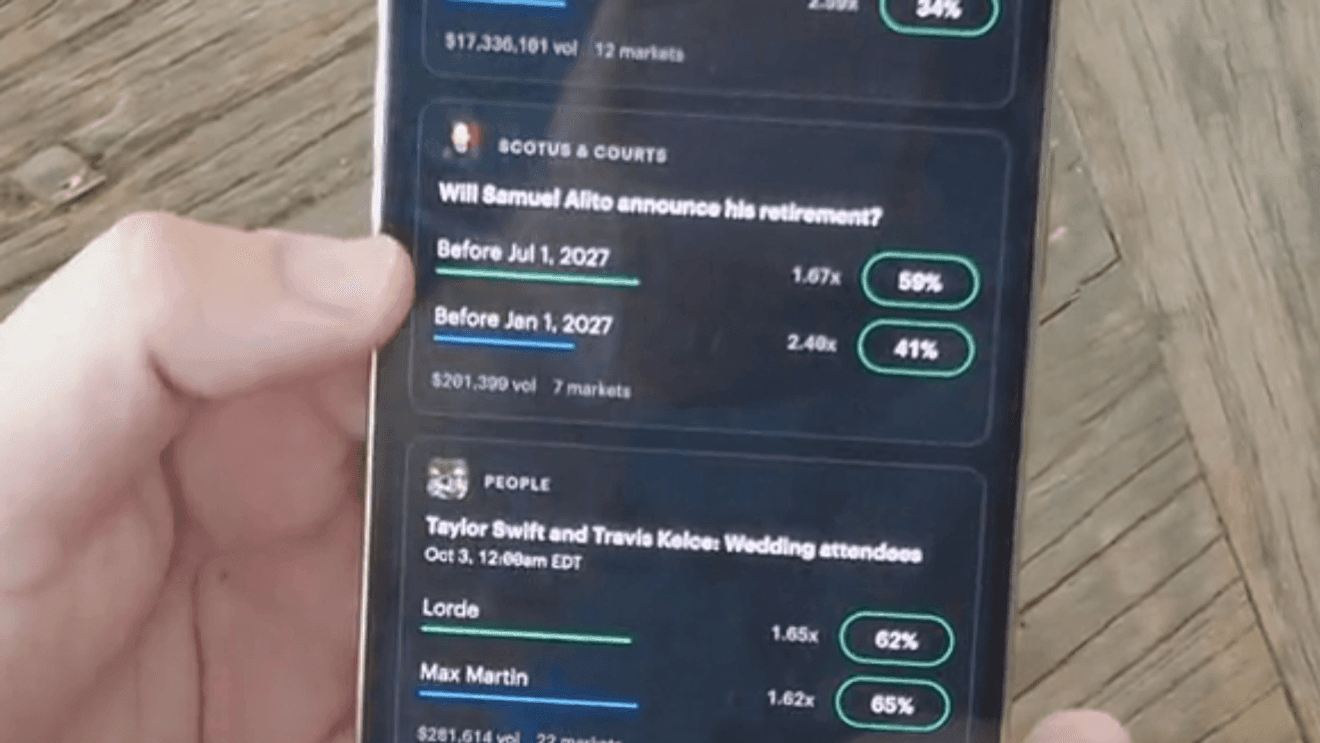
WEST PALM BEACH, Fla (CBS12) — Betting on the future is no longer limited to sports.
A growing number of people are putting money behind predictions on everything from election outcomes and interest rate decisions to reality television competitions. Known as prediction markets, these online platforms allow users to buy and sell contracts tied to future events, creating a fast-growing industry that sits at the intersection of finance, gambling and politics.
For years, Hard Rock Bet has dominated Florida’s legal online sports betting market through an agreement between the state and the Seminole Tribe, which operates casinos on tribal land. But prediction markets are emerging as a new player in the digital wagering space — one that could have implications far beyond gambling.
“It’s like a stock market,” said West Palm Beach resident Alex Lundgren, who regularly uses prediction market platforms. “There’s buying pressure and selling pressure. Some things become undervalued. It’s super live and super accurate.”
See also: California fire department condemns retired employee after viral racial slur video
Platforms such as Kalshi and Polymarket allow users to trade contracts based on whether they believe a specific event will happen. Unlike traditional sportsbooks, where odds are set by a bookmaker, prediction markets function more like financial exchanges, with prices determined by participants buying and selling contracts in real time.
For Lundgren and his friend, Gabe Guidetti, checking the markets has become part of their daily routine.
“$50 or $100 bet just to get the blood flowing — I live for that,” Guidetti said.
Part of the appeal is the constant movement. Users can watch odds shift minute by minute as traders react to breaking news, economic data and public sentiment.
Companies operating these platforms argue they are fundamentally different from sportsbooks because they function as event-contract exchanges. Kalshi says it operates under the oversight of the Commodity Futures Trading Commission, the federal agency that regulates derivatives markets.
“It’s supply and demand,” Lundgren said. “You’re actually buying shares. Different people have different opinions, and that drives the buying and selling pressure.”
As prediction markets grow in popularity, so do questions about their impact.
Aubrey Jewett, a political science professor at the University of Central Florida, said prediction markets occupy a unique space between investing and betting.
“These future contracts are somewhat different,” Jewett said. “They are regulated at the federal level and treated like future contracts in the stock market.”
The debate is particularly relevant in Florida, where prediction markets are already taking odds on political races, including the state’s next gubernatorial election.
Supporters argue the markets provide a real-time snapshot of public expectations. Critics worry they could influence voter behavior, campaign fundraising and public perception.
“Maybe that begins to influence not just somebody’s vote eventually, but maybe it influences how much money people are willing to donate to campaigns,” Jewett said. “It may even influence how candidates talk about issues.”
Unlike public opinion polls, which ask voters whom they support, prediction markets ask participants whom they believe will win.
“Prediction markets do have a pretty good track record because people are putting up and risking their own money,” Jewett said.
Still, experts say the markets are not immune to outside influence. Large bets can quickly move odds and potentially alter perceptions about a candidate’s chances.
“If somebody comes in with big money bets, or a group of people come in with a big money bet, they can change the odds online,” Jewett said.
Even some users acknowledge the risks.
“There’s actually a lot of emotional stress that has overtaken me in my deep, dark days of gambling,” Lundgren said. “I got to a point where I had to limit my account and how much I could deposit because weeks and weeks of betting the wrong thing gets to you.”
Florida lawmakers could soon be asked to weigh in.
Gov. Ron DeSantis has suggested lawmakers examine prediction markets and determine whether additional oversight or changes to state law may be needed.
For now, prediction markets remain a rapidly expanding corner of the online wagering world, where finance, politics and speculation increasingly overlap — and where more people are betting not on a game, but on what the future holds.