
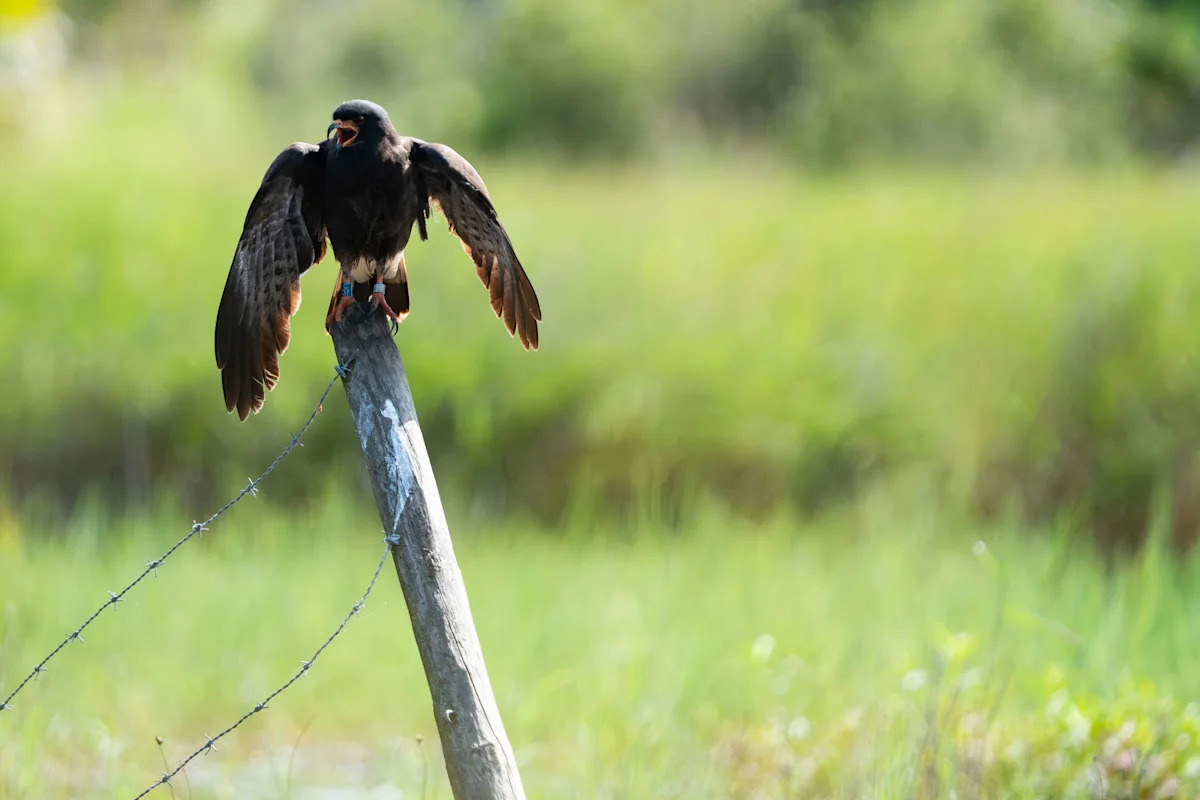
PORT ST. LUCIE — An Everglades snail kite flaps and stretches its wings and calls out to its fledgling, urging it to make its first flight.
The little bird climbs out on a branch and timidly screeches back, seemingly afraid to take the leap out of the tree. The father continues to encourage the fledgling, to no avail.
“That’s what they do all day long. Talk back and forth,” said Debbie Falzarano, Audubon Society of St. Lucie County chapter president. “This is what I do all day. I watch them in the morning with coffee and I watch them at night with wine.”
Florida preserve becomes wildlife sanctuary
Three baby snail kites were born to three separate mating pairs in nests in three sable palm trees in a small section of wetlands in a preserve set aside behind Falzarano’s home in the recently built Del Webb community in Tradition. The mating pairs started nesting there about two months ago and the fledglings started emerging from the nests two to three weeks ago.
The small preserve has become a gathering spot for herons, sandhill cranes, wood storks, green herons, tri-colored herons, anhingas and at least one rosette spoonbill. Deer and wild hogs also have been known to traverse the wetlands.
Falzarano has been monitoring the birds with her spotting scope for months, since moving into the home. She and her husband had lived down the street, but purchased their current home in December to be closer to the preserve, as did her neighbor.
“This is the whole reason we bought here,” said Falzarano’s neighbor, Rosemary Franks. “My husband was obsessed with it. It is a bird fiesta all day and sounds like a rainforest at night. Debbie and I text all day long about the birds.”
The three mating snail kite pairs and their fledglings are wonderful examples of why Florida’s preserves are so important, Falzarano said. Preserves are not just protected areas on a map. They are thriving habitats that support endangered species and help ensure their survival, she said.
“Seeing these magnificent birds raise their young right here in Del Webb Tradition is an inspiring reminder that conservation efforts truly work,” Falzarano said.
The wetlands behind Falzarano’s home is part of a larger roughly 30-acre conservation area that was set aside as part of the Southern Grove Community Development District when the area was developed.
“It was set up to give people a taste of what old Florida was like,” said John Gallagher, development coordinator with Special District Services Inc., which oversees and maintains the property. “We love seeing these types of successes.”
Florida researchers tag Everglades snail kite babies
Debbie Falzarano, Audubon Society St. Lucie County chapter president, looks for endangered nesting Everglade snail kites in a small wetlands preserve just steps from her home at the Del Webb Tradition neighborhood, July 1, 2026.
Researchers from the University of Florida Snail Kite Lab have banded the three fledglings so they can track them. In 2021, researchers banded one of the fathers, whom Del Webb residents affectionately call “Roger,” at the C-44 Reservoir and Stormwater Treatment Area in western Martin County.
Roger has traveled throughout important South Florida wetland habitats. In 2023 and 2025, he was documented spending time around Lake Okeechobee, one of the most critical habitats for snail kites in the state, Falzarano said.
“Roger serves as a wonderful reminder of how important habitat conservation, wetland restoration, and ongoing monitoring are to the future of the endangered snail kite population in Florida,” Falzarano said.

An endangered juvenile Everglade snail kite is seen in a small wetlands preserve at the Del Webb community in Tradition, July 1, 2026. According to Florida Fish and Wildlife Conservation Commission, the main threat to the snail kite is the loss and degradation of wetlands in Florida.
Falzarano encourages people to report sightings of banded snail kites, as it helps researchers better understand how these birds survive and adapt across the Everglades ecosystem, she said.
The snail kite peak nesting season is March through June. Snail kite courtship behavior consists of males bringing food and nesting material to potential mates. Their aerial displays include roller-coaster flights while carrying a stick in their bill and calling to females, according to the Florida Fish and Wildlife Conservation Commission. Males select the nest site and do most of the building.
Snail kites used to feed almost exclusively on Florida native apple snails. Now, they also eat invasive apple snails since that species’ introduction and expansion across wetlands, according to the FWC. The invasives have made snail kites, including juveniles, grow larger. The birds’ slender, curved bill is designed for taking snails out of their shells.
Snail kites threats:

A small wetlands preserve at the Del Webb community in Tradition has become a nesting spot for the Everglade snail kite. Herons, sandhill cranes, wood storks, green herons, tri-colored herons and anhingas gather in the preserve as well. Deer and wild hogs have also been known to traverse the wetlands.
Wetland loss and degradation, including draining and channelizing
Less foraging and nesting habitats
Degraded water quality and disrupted natural cycles of flooding and drying
Agriculture and urban runoff changed vegetation growth, limiting ability to find food and nesting material
Overgrowth of invasive plants, which allows predators to access nests.
How you can help
A banded (C37) endangered male Everglade snail kite calls to a juvenile and flaps its wings in a small wetlands preserve at the Del Webb community in Tradition, July 1, 2026. In 2021, the snail kite was banded at the C-44 Reservoir and Stormwater Treatment Area impoundments in western Martin County. In 2023 and 2025 the snail kite was documented spending time around Lake Okeechobee. According to Florida Fish and Wildlife Conservation Commission, the main threat to the snail kite is the loss and degradation of wetlands in Florida.
Tim O’Hara is TCPalm’s St. Lucie watchdog, environment and fisheries reporter. Contact him at tim.ohara@tcpalm.com.
This article originally appeared on Marco Eagle: Surprise! Florida Everglades snail kites thrive in Del Webb development