
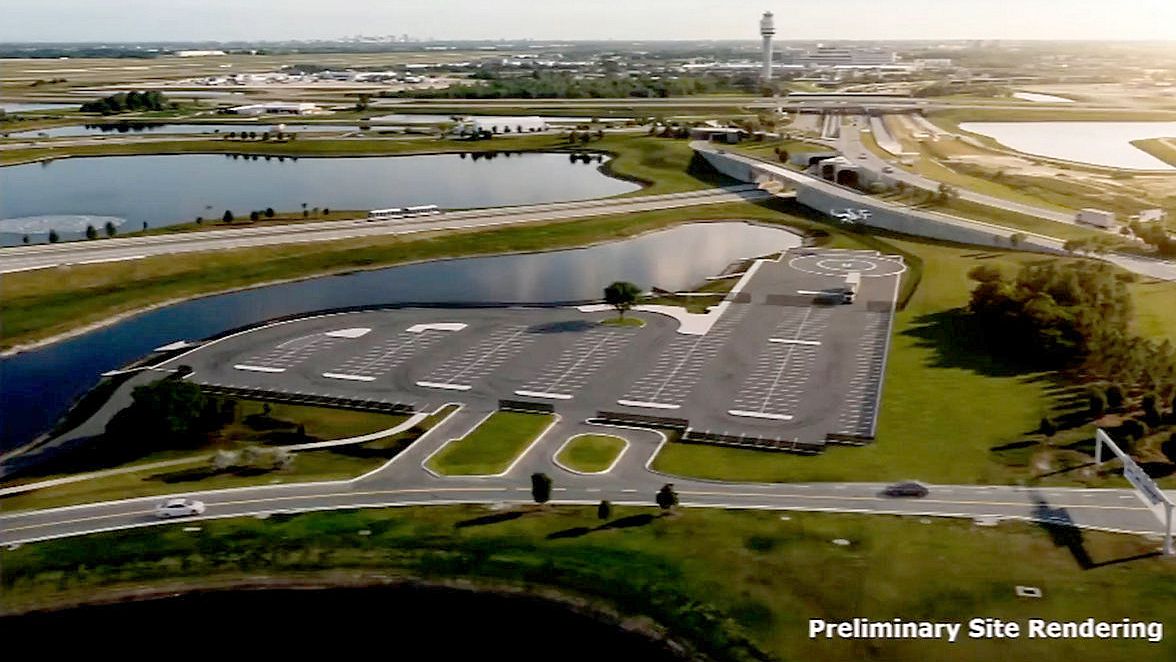
ORLANDO, Fla. — The Greater Orlando Aviation Authority has approved plans to build what officials describe as the country’s first vertistop at Orlando International Airport, taking an early step toward bringing electric vertical takeoff and landing aircraft to Central Florida.
The vertistop is planned for Surface Lot Atlantis, next to the train station at Terminal C.
Construction is expected to begin once the Federal Aviation Administration signs off, with a goal of finishing the project by the end of October.
The aircraft, known as eVTOLs (electric vertical take-off and landing), is not yet certified for commercial operations. Airport officials said the site could be used for demonstrations later this year.
“I think it is going to be a slow start,” said Kevin Thompson, the assistant vice president of planning at MCO. “There is a crawl, walk, run to this process, and so we are looking to potentially have demonstrations here later this year.”
A vertistop is similar to a helicopter pad, and Bob Thomas, an associate professor of aeronautical science at Embry-Riddle Aeronautical University, said the easiest way to describe the concept is “just like you would see a helicopter.”
The project is not expected to affect normal airport operations, according to officials. It will take up about 80 parking spaces in what the airport officials say is the least-used parking lot.
Thompson said airport leaders see the project as part of the evolution of air transportation.
“This new technology is going to provide passengers more connection opportunities and more seamless experience in our airport,” Thompson said.
Airport officials said the initial vertistop is only the first step. As the technology develops, more sites could be built across the region to create another way for passengers to connect. The airport eventually plans to build a vertiport at MCO, which would include a terminal and other amenities for commercial travel. Officials said the goal is to have that facility built by 2030.
Some travelers said they were open to the idea if it saved time.
“If it is a lot quicker, yeah, absolutely,” traveler Denise Chiaravalle said.
Others said they had questions about cost and whether other transportation investments would be more efficient.
“I guess it could be better for avoiding traffic and for safety reasons, but I worry about the cost of that as well as the inefficiencies,” traveler Rory Renzy said. “Might as well just build public transit at that point.”
Experts said having infrastructure in place could help move the process forward while the industry waits for the aircraft to be certified.
“I think it is just a little of a waiting game to see how everything folds out,” Thomas said. “But having infrastructure in place, I think kind of helps push that momentum forward in the process.”
He said Orlando could be a strong market for the aircraft as people look for ways to avoid traffic on I-4, and it’s a central location with lots of short trips from Orlando to the attractions area, Tampa or Cape Canaveral that make it an ideal spot to start integrating eVTOLs.