
City of St. Petersburg leaders want to help religious organizations transform underutilized land into affordable housing. The municipality has officially launched the Yes in God’s Backyard program.
In December 2025, the City became the first local government in the state to adopt the Yes in God’s Backyard ordinance. The provision, which is in relation to Senate Bill 1730, gives Florida municipalities the ability to authorize affordable housing on property owned by a religious institution that contains, or is contiguous to, a house of worship.
The City’s Office of Community Impact will oversee the program in partnership with the Florida Housing Coalition. According to the organization’s website, the nonprofit provides “guidance, knowledge, tools and support” to advance affordable housing solutions.
An information session will be held July 28 at the Foundation for a Healthy St. Petersburg’s Center for Health Equity, at 2333 34th Street S., at 10 a.m.
“We know for a fact that many of our houses of worship have property that could be developed for affordable housing,” the City’s faith and community justice liaison Rev. Kenny Irby told the Catalyst. “The legislation now offers some support. The best way to describe it is to be able to fast-track some of the permitting obligations and needs.”
Through the Yes in God’s Backyard program, the Office of Community Impact and the Florida Housing Coalition will provide technical assistance to congregations. The organizations will help assess site feasibility, navigate funding options and provide other support services.
“Those faith-based entities still need to understand the nuances and the inner workings of property development, architecture and all those kinds of things that most faith-based organizations are not experts at,” he continued. “The greater good is a clear reality.”
Religious institutions could also create affordable residential developments for veterans or young people who have aged-out of foster care, Irby added.
Prior to the approval of the Yes in God’s Backyard ordinance, a St. Petersburg religious organization began to develop an affordable housing project on church property.
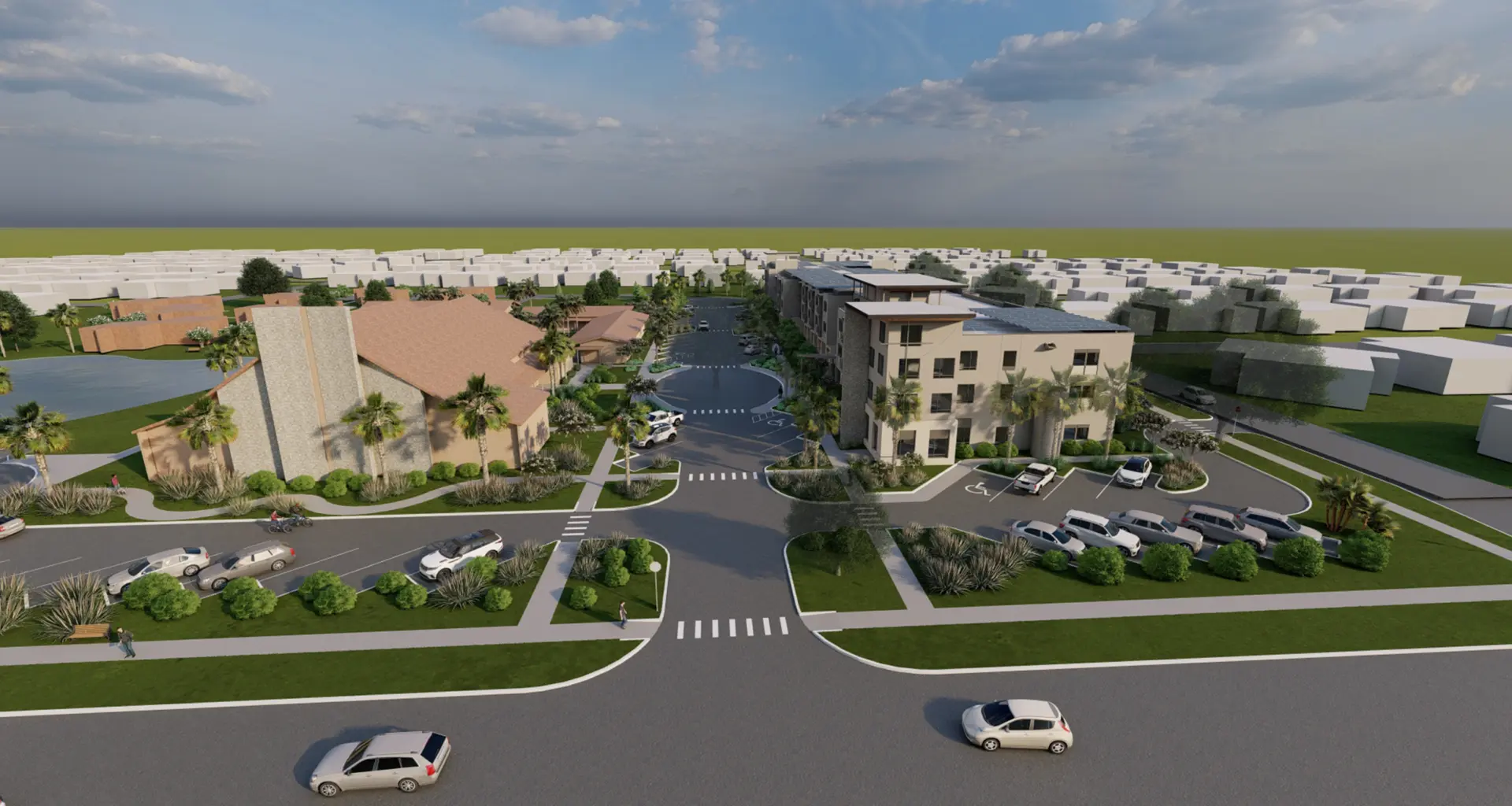
In 2025, the Pinellas County Housing Authority and Palm Lake Christian Church, in partnership with Newstar Development, LLC, began construction on the Palm Lake Urban Sanctuary (PLUS) project in the Disston Heights neighborhood.
The four-story building, located adjacent to the church, will include 86 affordable housing units; 15% of the apartments will be reserved for households earning 30% of the Area Median Income. The remainder will be for individuals who earn up to 80% of the AMI.
PLUS was the first project approved under City Ordinance No. 485-H, which was created in relation to Florida House Bill 1339 (2020). The law gave local governments the ability to approve affordable housing projects on any residential, commercial and industrial-zoned land.
Passed in 2023, the Live Local Act (Senate Bill 102) was designed to increase the availability of affordable housing through state funding, tax incentives and zoning rule changes, according to the Florida Housing Coalition.
However, the legislation did not specifically address whether land owned by religious institutions could benefit from its zoning provisions. This created uncertainty about how affordable housing proposals on these properties would be evaluated. Senate Bill 1730 later clarified the issue.
According to a prepared statement, the Florida Housing Coalition estimates that the Yes in God’s Backyard ordinance can help “unlock more than 30,000 parcels for affordable housing development statewide.” Irby added that more sessions are scheduled, including one in September.
“St. Petersburg led the way in adopting YIGBY, and now we’re building the program that will help our congregations put it to work,” said Mayor Ken Welch in a prepared statement. “Houses of worship are trusted anchors in every neighborhood, and many sit on land that could help close our affordable housing gap. This partnership with the Florida Housing Coalition ensures congregations have an expert at the table as they consider what’s possible on their property.”