
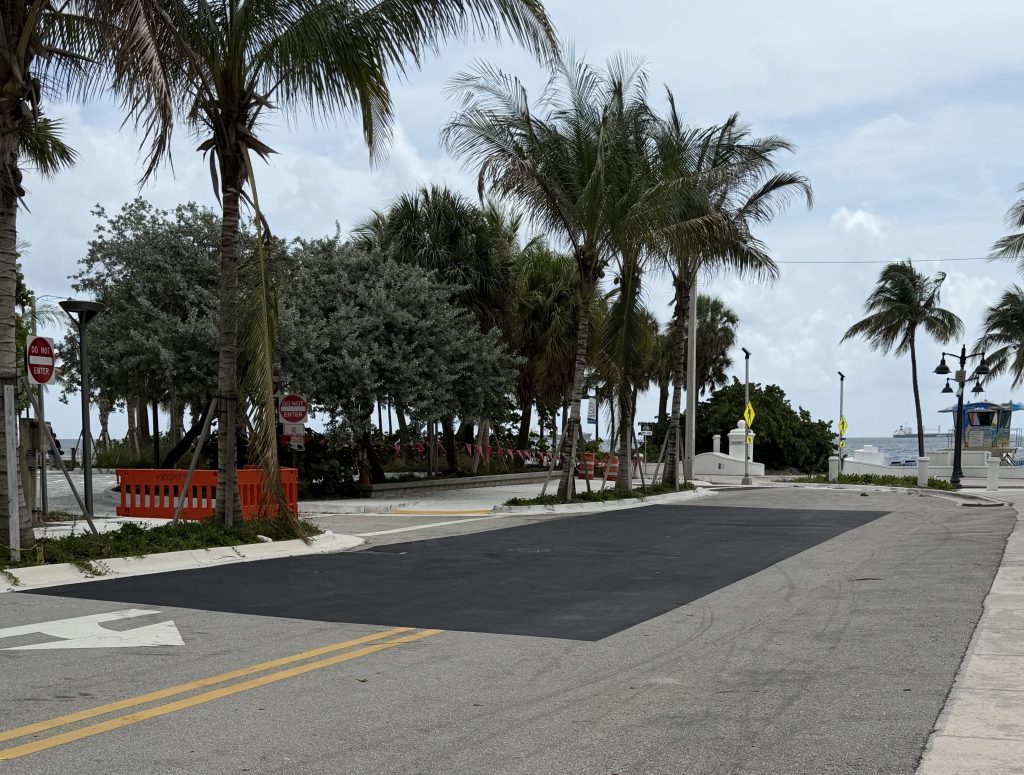
Much of Fort Lauderdale’s street art — including its rainbow pride flag — had disappeared by Saturday morning as state workers began covering it over following a settlement agreement with the city.
The pride flag painted along Sebastian Street was among the first to go, according to City Commissioner Steve Glassman, while the painted intersections on Breakers Avenue are also now covered in blacktop. Soon, the decorative work along the Las Olas corridor will need to be removed as well, a project that could require shutting down the street entirely. The state is paying for the removals, city officials said.
Unlike some of the other street art removals around the state, the disappearance of Fort Lauderdale’s art did not come as a complete surprise. Rather, the removals were agreed upon as part of a settlement city officials reached with the state last month, concluding a lengthy legal battle. Fort Lauderdale had been the last remaining city to resist the Florida Department of Transportation’s efforts to remove rainbow crosswalks and other decorative street art throughout the state, including Key West, Delray Beach and outside of the Pulse nightclub in Orlando.
State officials previously said the decision was made for safety reasons, but critics said the removals originated as an attack on the LGBTQ community.
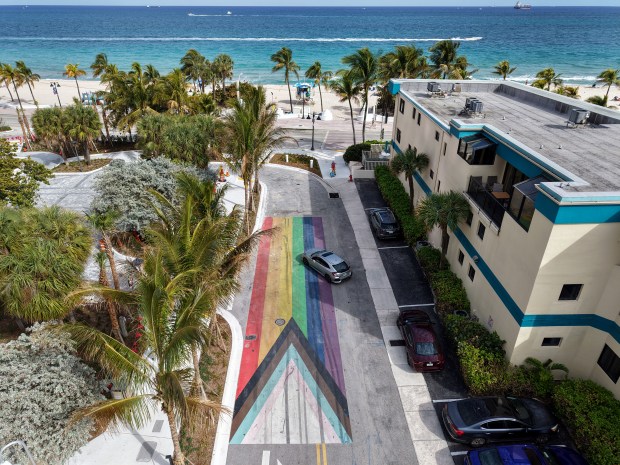 A rainbow street art mural remains visible on Wednesday, Feb. 11, 2026 on Sebastian Street near Fort Lauderdale beach because the city took a stand against a statewide directive ordering all street art to be removed. (Mike Stocker/South Florida Sun Sentinel)
City officials had announced their intentions to resolve the lawsuits last month at the same time as they unveiled a “circle of love” rainbow installation near Sebastian Street, which is home to the city’s popular LGBTQ beach, as part of an alternative solution on private land.
Fort Lauderdale Mayor Dean Trantalis told the South Florida Sun Sentinel on Saturday that he had not known about the removals because he is currently in Orlando, but that he was satisfied with the circle of love as an alternative.
“The flag on Sebastian Street was never intended to be permanent anyway,” he said. “We knew it was a roadway. We designated that section in that particular year with a street covering that we knew we were going to have to replace at some point. Now, creating a circle of love is a more permanent installation, and accomplishes the same thing we’ve always tried to accomplish: show a presence of the LGBTQ community there in Sebastian Street. In the end, it all worked out for the better.”
Glassman, whose district includes nearly all of the street art, said he had “mixed feelings.”
“It is what it is,” he said Saturday. “We have to move on. It’s not our number one concern; we did the best we could, stated our case, stood up for ourselves in terms of home rule. We were the last city in the state to keep this alive in terms of trying to protect these decisions happening in our city.”
FDOT had argued that the street art removals were for safety reasons. But traffic studies have shown that street art, including the art that has now been removed, reduced accidents by making drivers pay more attention to streets and crosswalks.
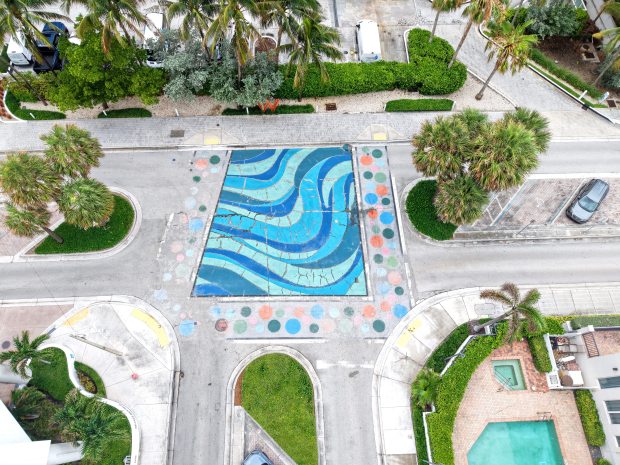 Street art on Breakers Avenue and Riomar Street in Fort Lauderdale on Wednesday, June 3, 2026. (Carline Jean/South Florida Sun Sentinel)
Bill Brown, a community activist and LGBTQ advocate, said he learned about the removals Saturday. The flag on Sebastian Street “never hurt anything,” he said, adding that he thought that the removals had originally targeted LGBTQ-themed art before the state expanded its ban to include all street art.
That expansion also meant the removal of the Breakers Ave intersections, which were originally approved by the state, according to Robin Haines Merrill, the artist who designed them. Haines Merrill said she found out her art was gone after a friend texted her on Saturday.
“I am pretty devastated,” she said.
Haines Merrill, who serves as executive director of the Christian Cultural Development Foundation and Upper Room Art Gallery, takes issue with the idea that the street art was removed for safety reasons.
She said she originally set out to design the murals specifically because she had become disturbed by the number of car accidents, especially those involving pedestrians, in downtown Fort Lauderdale. The street art was originally commissioned as part of the FDOT’s Vision Zero project, she said, which was designed to eradicate traffic deaths and injuries in the state. A national study on traffic safety later included the Breakers Ave artwork as an example of crosswalks that reduced accidents.
“That art was sanctioned,” Haines Merrill said. “FDOT was there at my event, handing out T-shirts.”
The Las Olas street art, set to be covered over, was also originally approved by FDOT, Glassman said. As of Saturday afternoon, Glassman said the state had not begun the removal process.
A spokesperson for FDOT did not return calls or emails Saturday.