
Old apples might possess positive traits modern fruit lacks; ‘It’s like communing with history’
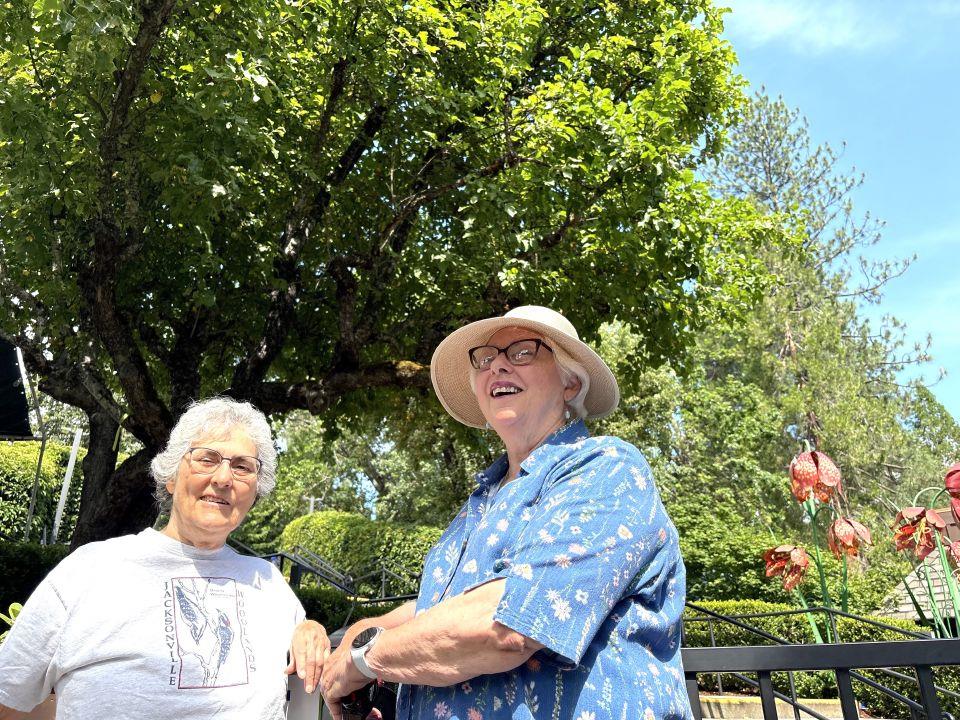
JACKSONVILLE — Carol Knapp and Gayle Lewis stood underneath an apple tree at the Britt Festival grounds and scanned branches for fruit.
The tree produces yellow apples with crisp flesh and is a long keeper, holding its bounty into January.
No one knows the variety.
Peter Britt, an early Southern Oregon horticulturalist and photographer, planted fruit trees and the state’s first vineyard at his property, which is now home to a music festival and an adjacent city park.
Residents have gleaned fruit at the wooded hillside for decades, and Knapp always wondered what varieties she used for applesauce.
One recent year, Lewis mentioned an article she had read about the Lost Apple Project.
Email newsletter signup

With the help of that organization and DNA testing at Washington State University, locals discovered four unknown apple trees at the Britt property.
Lewis said identifying the apples will preserve part of the past.
“It’s like communing with history. You’re tasting the same apples they tasted,” Knapp added.
The Lost Apple Project is one of a handful of Pacific Northwest organizations searching for forgotten varieties to ensure they survive.
The groups aim to save history as well as genetics that could help the apple industry’s future.
Work includes promoting tree health, establishing rare varieties in orchards, providing scionwood to growers and posting a wealth of information online.
Apple preservation efforts also are catching on in other unexpected ways.
In the fall, WSU ag student Tayettin Brodzinski took a study break and strolled through Lawson Gardens, a park in Pullman, Wash.
She needed a leaf from an apple tree she didn’t know the variety of for a genetics class and noticed an apple tree in a nearby lawn.
Her sample matched those found in other states and turned out to be the lost but once renowned Walbridge variety.
“We assumed that, due to its historical popularity, it must still exist, waiting to be rediscovered,” said Professor Cameron Peace, who helps search efforts with DNA testing.
Retired investigator creates the Lost Apple Project
North America once had more than 17,000 named apples, but only about 5,000 remain, said David Benscoter of Spokane, Wash., the Lost Apple Project’s founder.
Benscoter, retired from federal law enforcement, discovered the East Coast was filled with apple hunters, but no one was looking for “extinct” fruit in the Northwest.
So he became an apple detective, scouring for clues in nursery pamphlets, old USDA paintings, plat maps and other documents.
“I’m very comfortable looking for evidence in old records and just gathering evidence in general,” Benscoter said.
In 2013, while searching for lost apples near Colfax, Wash., Benscoter spotted a lonely tree leaning over a water pump station.
He had rediscovered the Fall Jeneting, an apple with odd, sharp ridges that was considered great for cooking and canning but disappeared in the early 1900s.
Benscoter stressed apples were extremely valuable to pioneers who grew their own food.
With different varieties, homesteaders could eat fresh apples off the tree from July through October and cellar fruit until April or May.
Settlers also could dry and preserve apples.
By the end of this year, the Lost Apple Project will have recovered more than 30 varieties.
It works closely with the Temperate Orchard Conservancy, which grows rare apples near Molalla, Ore.
“If we don’t find these varieties, nobody will and that’s history lost,” said Benscoter, co-author of “Lost Apples: The search for rare and heritage apples in the Pacific Northwest.”
Central Oregon’s Heritage Apple Corps
Besides historical sleuthing, apple preservation groups thrive on tips.
“People will email us and say, ‘I saw this old orchard when I was out hunting north of La Grande,’” said Peter LoVerso, project lead for the Heritage Apple Corps near Bend, Ore.
That organization formed to improve the health of old orchards and fruit trees through pruning and education.
In recent years, its focus shifted to include finding forgotten apples east of the Oregon Cascades.
LoVerso said apples have experienced a loss of genetic diversity.
Commercial growers gradually concentrated on fewer varieties for eating that look great, have firm texture, high production and store well.
Older varieties that fell out of favor and in some cases disappeared might be ugly, small, have low yields, unappealing texture or not store well.
Rediscovered historic apples likely won’t go back into wider production, but their traits can bring advantages for breeding programs, especially if they reduce the cost of interventions, said Jon DeVaney, Washington State Tree Fruit Association president.
Historic apples might possess characteristics modern fruit lacks, including drought tolerance, or resistance to specific diseases or pests.
The increased interest in saving heirloom apples comes as advancements such as rapid cycle breeding have made it possible to introduce traits in fruit much more quickly.
Not every unknown apple is noteworthy, however.
Apples don’t seed true — that’s why orchards are full of grafted clones.
Fruit that tests unique could be from a common apple that fell to the ground and seeded, so preservation groups must concentrate on top candidates.
“If two genetically identical unknown trees exist, one on San Juan Island, one in Central Oregon, it’s highly likely someone planted those intentionally,” LoVerso said.
That connection actually occurred.
Kwiáht preserves apple trees in the San Juan Islands
Many apple trees in Washington’s San Juan Islands were planted in the 1890s, often by families with Coast Salish matriarchs, said Madrona Murphy, botanist and laboratory manager for Kwiáht, a conservation research group.
The nonprofit preserves the area’s historical environment, including fruit trees.
Unirrigated commercial orchards briefly flourished here, but many were abandoned.
“We definitely have some lost varieties,” Murphy said.
Food security is a concern on the islands, where most produce arrives by ferry.
The local apple trees, though old, still produce fantastically, and Murphy works with agencies and landowners to forage fruit for schools and food banks.
Some unidentified trees are hybrids with crabapples, while others simply thrived in an environment with excess winter precipitation and nearly no summer rain.
Identifying apples is key for local growers with rare varieties, experts said.
“It’s a lot easier for farmers to sell their apples if they have a name,” Murphy said.
People seek out ancient apples at farm stands, but customers need to know if fruit is best for eating or cooking and canning, Murphy said.
The novelty factor is strong with rare apples.
Deborah Nelson, an apple enthusiast and consultant in Southern Oregon’s Applegate Valley, collects heirloom trees she mainly uses to make hard cider.
“I have an apple in my orchard with a history that goes back more than 500 years. I have some in my orchard that were Thomas Jefferson’s favorite apples,” she said.
The former marine biologist loves their history and diverse flavors, which taste nothing like apples at grocery stores.
Ancient apples great for cideries and distillers
Heritage apples often have complex characteristics that produce great alcohol, and adult beverage businesses have become part of the effort to save rare varieties.
Oregon Spirit Distillers makes apple brandy and has used rare apples supplied by the Heritage Apple Corps for years, said owner Brad Irwin,
Purchasing from the nonprofit helps fund preservation work, which in turn provides more unique apples for brandy.
As part of their partnership, the organization will plant about 90 rare apple trees at the distillery’s orchard north of Bend, Ore.
Irwin will harvest that fruit for free and in return he’ll ensure the Heritage Apple Corps has more space to preserve and propagate rare trees.
A similar effort is taking place at Troon Vineyard in Southern Oregon’s Applegate Valley.
The organic and biodynamic certified winery has added 12 trees cloned from the Britt hillside — three from each unknown apple.
Troon is branching out into hard cider and hopes to release its first batches in 2027 or 2028.
Its orchard includes more than 40 cider apple varieties and most are French, said winemaker Nate Wall.
Some Britt hillside apples are great for eating but they look weird, so they’re especially viable for cidermaking, Wall said.
“We’re also making apple cider vinegar. When you use these interesting apples, these vinegars can have all kinds of flavors and textures,” he added.
Jacksonville considers naming contest for rare apples
As the Britt trees at Troon get larger, pruning material will be used to graft rootstock for new plantings, perhaps at the site of the music festival, the city park or another public space.
The apple trees standing at the Britt hillside are in poor shape, partly due to age, but also because they are overshadowed by other vegetation.
Locals are considering holding a naming contest for the unknown apples as a fundraiser.
Jacksonville Mayor Donna Bowen said she’s excited about the rare varieties — especially an apple that tastes slightly of strawberries.
“Everybody is going to want to try that one, including me,” Bowen said.