
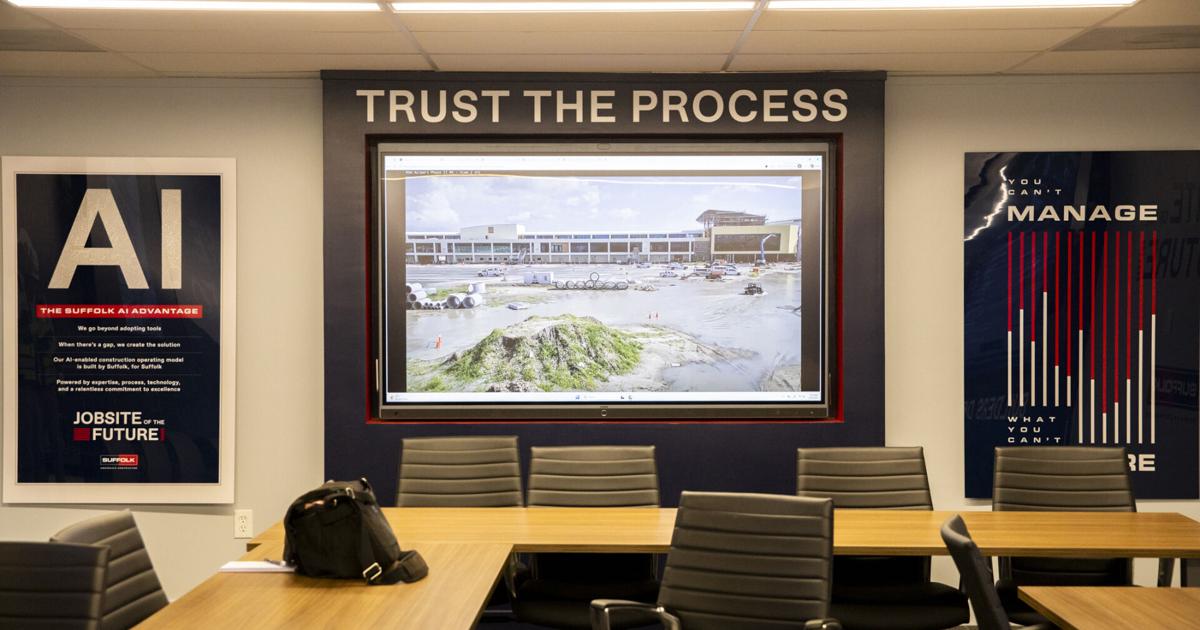
Suffolk Construction is using artificial intelligence to streamline workflows, improve safety and speed decision-making as it builds RSW’s new terminal expansion.
David Dorsey
The temporary construction trailer looks like just that from the outside, across a service road from the most expensive municipal project in Lee County history.
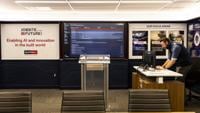
Inside, though, Suffolk Construction’s Trailer No. 3 looks like something out of a science fiction movie. The conference room features two big-screen video monitors, signage and branding, setting the scene for an artificial intelligence hub geared toward construction.
Suffolk calls its AI initiative Jobsite of the Future, or JOF, as employees commonly refer to it.
At Southwest Florida International Airport, Phase Two of the Terminal Expansion project includes a new 14-gate terminal and additional concourse space at a cost of about $1.2 billion. The project broke ground in October 2024, topped out in December 2025 and remains on track for completion in October 2027.

Digital dashboards display real-time construction data inside Suffolk Construction’s Jobsite of the Future trailer at the RSW terminal expansion project. The AI platform helps analyze RFIs, schedules and project performance.
Evan Williams
Phase One of the Terminal Expansion, which will reconfigure the main terminal and add concessions, also is under construction, with Manhattan Construction serving as lead contractor.
By implementing AI tools, Suffolk — a Boston-headquartered company with a sizable Southwest Florida presence — can optimize workflow, assistant project manager Dwight Moe and site AI engineer Cary Greenwood said. The tools don’t eliminate jobs, Moe said. They allow workers to be more efficient.
In addition to RSW, Suffolk is working on Legacy Point (formerly Southward Village) in Fort Myers; Tampa General Hospital Urgent Care Center in Babcock Ranch; Alva High School; Estero Sports Park; and, in the Naples area, the Collier County Veterans’ Nursing Home, Moorings Park Grande Lake, Ritz-Carlton Residences and Avra at Metropolitan, a condominium tower.
Cary Greenwood, left, Suffolk Construction’s site AI engineer, and Dwight Moe, assistant project manager, work together to develop artificial intelligence tools that improve efficiency, scheduling and safety during construction at RSW.
Evan Williams
Data from those projects is collected and analyzed, along with data from every Suffolk job site over the past 10 years.
Suffolk’s Jobsite of the Future program launched this year, and RSW is one of just eight of the company’s 275 active construction sites nationwide designated as a JOF site.
Data funnels into Suffolk’s customized AI platforms for analysis in three areas: design, where the goal is to reduce RFIs and minimize rework; scheduling, which uses historical data to create, update and simulate project timelines; and process, which focuses on improving team efficiency and productivity.
In construction, RFI stands for request for information. When construction crews have questions or concerns about blueprints, they submit an RFI. Those requests are logged and become data points for current and future projects, Greenwood said.
Inside the conference room, Greenwood meets with project managers to create on-site efficiencies.
“It’s an ongoing process,” said Greenwood, who joined the project in February. His arrival and the AI implementation transformed the site, Moe said.
Suffolk Construction’s Jobsite of the Future conference room serves as the hub for artificial intelligence tools used during construction of Southwest Florida International Airport’s $1.2 billion terminal expansion.
Evan Williams
“There was a pretty noticeable difference when Cary got here,” Moe said. Before Greenwood joined the project, preparing an RFI could take six to eight hours. With custom AI tools now in place, the process can take as little as 10 to 15 minutes, giving project teams more time to focus on day-to-day operations and improving overall efficiency.
The AI tools also can help make job sites safer. Moe said Greenwood has helped build custom safety tools that connect with project schedules, allowing teams to identify potential hazards in advance and address risks before crews reach those stages of construction.
Site superintendents also have been using voice-activated AI software, Greenwood said.
“The one where superintendents use a voice-driven piece of software … allows them to essentially track activities taking place on-site while they’re out there walking their normal routes,” Greenwood said. “They’re able to give voice updates that then derive the updates themselves to the schedule. So, this transfers essentially the superintendent’s knowledge to our P6 software. It allows us to quickly optimize and update the schedule so that we’re more aware as we’re planning the project.”
Cary Greenwood, Suffolk Construction’s site AI engineer, develops custom artificial intelligence tools that help improve construction workflows, scheduling and decision-making at the RSW terminal expansion.
Evan Williams
The site is at its peak, with about 500 construction workers and 15 to 20 subcontractors there each day. Suffolk itself has about 50 employees on-site daily.
“Having a data platform and collecting data from the sites, we go through these processes,” Greenwood said. “They’re paperwork heavy and email heavy.”
“There’s thousands of documents we have to sift through,” Moe said. “Looking at our past projects helps us prepare for the next one.”
Greenwood comes from a software engineering background rather than a construction one. He previously worked as a data architect for NV5, performing government contracting work for the Army Corps of Engineers and NASA. Before that, he worked at Raytheon as a senior software engineer.
“The project teams and myself work closely together in order to really find the best solutions for the project,” Greenwood said. “The company overall is focused on finding those synergies to work together for our company’s benefit and all future projects, too.
“It’s a large amount of data — definitely gigabytes of data. There are a lot of data points, from RFIs to submittals and different back-end data silos that get integrated. We essentially mine it. We built it into customized AI solutions.”