
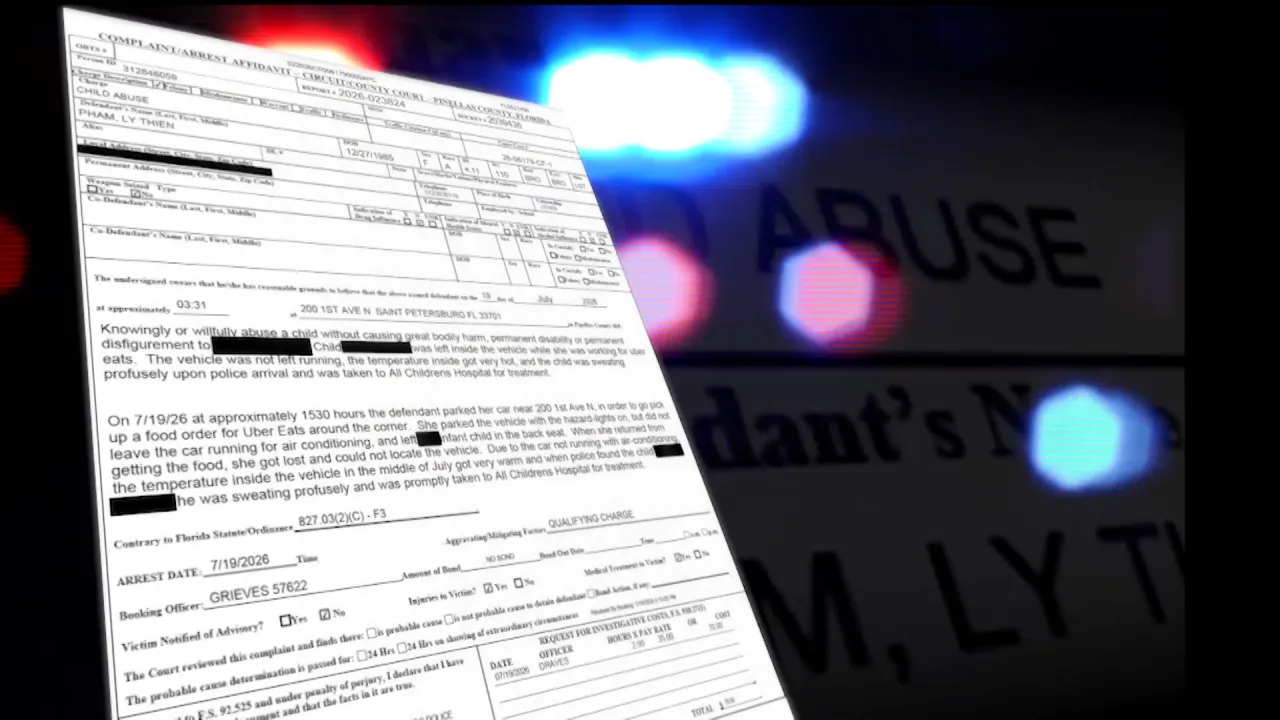
ST. PETERSBURG, Fla. (WFLA) — A woman is facing criminal charges after St. Pete police said a toddler was left in a hot car for nearly half an hour Sunday.
“These are child abuse charges,” said Yolanda Fernandez, spokesperson for the St. Petersburg Police Department. “These are very serious charges, very serious for her to have to deal with this. Even though she claims that she didn’t mean to do it, that she thought she was just going to run in and out, pick up the food delivery and go.”
St. Pete man charged with causing $96,000 in damage to downtown luxury condo tower: SPPD
Arrest documents show that on Sunday, at around 3:30 p.m., Ly Thien Pham went into a restaurant to pick up an Uber Eats order. When she left the establishment, she said she forgot where her car was parked. It wasn’t until law enforcement showed up that the vehicle and the 1-year-old boy inside it were found — nearly 30 minutes later.
“A child’s temperature can rise three to five times quicker than an adult, and the inside temperature of a car can rise up to 20 degrees higher than what the ambient temperature is,” said Albert Madruga, firefighter and paramedic for St. Petersburg Fire Rescue.
The boy was taken to Johns Hopkins All Children’s Hospital for treatment. Monday, their staff told 8 On Your Side why babies and toddlers such as the one they treated are the most vulnerable when it comes to heatstroke.
“Children are especially vulnerable because of their small size. They get overwhelmed by the heat very quickly, and obviously younger children can’t let themselves out of the car,” said Dr. Joseph Perno, chief medical officer for Johns Hopkins All Children’s Hospital.
The symptoms for heat exhaustion vary but can ultimately lead to a child’s death.
“It’s a spectrum. So heat exhaustion starts with some confusion, lack of sweating, not peeing, that sort of stuff. But then it can go to total confusion, unconsciousness, seizures and death when the body just gets overwhelmed by that external heat,” Perno said
With back to school approaching, paramedics want to remind families to always check the backseat of the car and never leave unattended children inside a vehicle.
“Even if we’re thinking 1 minute, we’re going to run into the store to grab something really quick. Never. That should never be an excuse. You should never leave your child locked in a vehicle. Never leave your child behind. 1 minute can turn into a tragedy,” said firefighter Albert Madruga.
Experts recommend leaving something valuable in the backseat of a car that you can’t leave without, like a shoe or a phone, to avoid forgetting to look.