
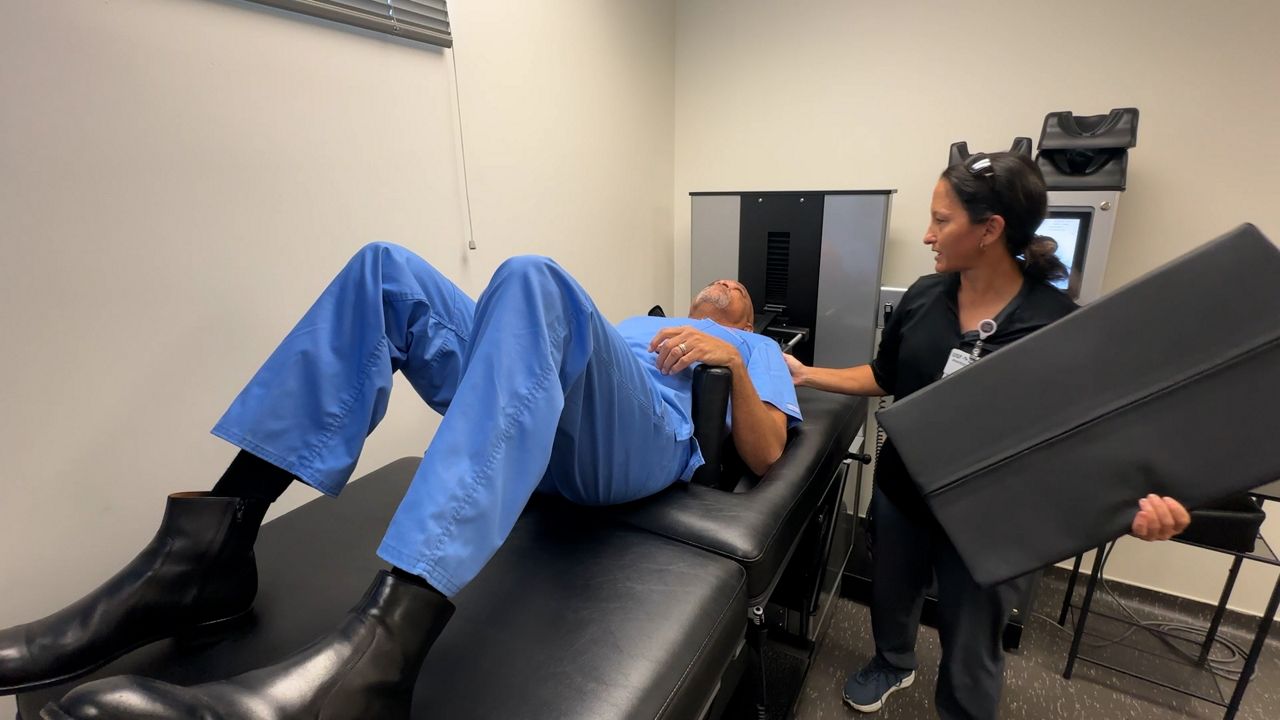
TAMPA — USF Health researchers in Tampa are studying a nonsurgical procedure for people with slipped disks.
The treatment involves patients being strapped to a table and stretched during 30-minute sessions. Researchers are studying the procedure as a less invasive option for people with injured or bulging cervical disks.
Lennox Hoyte, a patient and robotic surgeon, said he began treatment after experiencing tingling in his arms and hands and neck.
“I started noticing tingling in my arms, hands, neck, and some shoulder pain,” Hoyte said.
Hoyte said his symptoms would flare while he was performing operations. He has undergone more than 20 sessions and said many of his symptoms have improved.
“I feel complete relief of the arm tingling and numbness. The hand numbness is gone. The shoulder pain is pretty much resolved, and the neck tingling is pretty much resolved as well,” Hoyte said.
Nathan Schilaty, a professor of neurosurgery, said the procedure is being studied as a noninvasive option for people suffering from slipped disks. He said one long-term goal is to reduce the number of surgeries needed for the injuries.
“We know that surgery is sometimes important and necessary, but we want to go less invasive and really try to get an effect before we go to that extreme,” Schilaty said.
Schilaty said researchers have studied the procedure for more than two years, with pain reduction as a key focus. He said the study has shown positive results so far.
“Usually, about 90% of patients have a lot of improvement,” Schilaty said. “Usually, a decrease in pain is the first thing you see, and patients are excited about that for sure. But what we also see is improved function.”
Hoyte said he did not feel much difference after his first few sessions, but his symptoms began to dissipate around his sixth session. Most patients go through 20 to 24 sessions.
“It really does feel good. It’s like coming alive again. It’s invigorating,” Hoyte said.
Schilaty said the treatment option is much cheaper than surgical alternatives. He said he hopes more research will allow the procedure to be used for more patients with disk herniations.