
By Arielle Stevenson, University Communications and Marketing
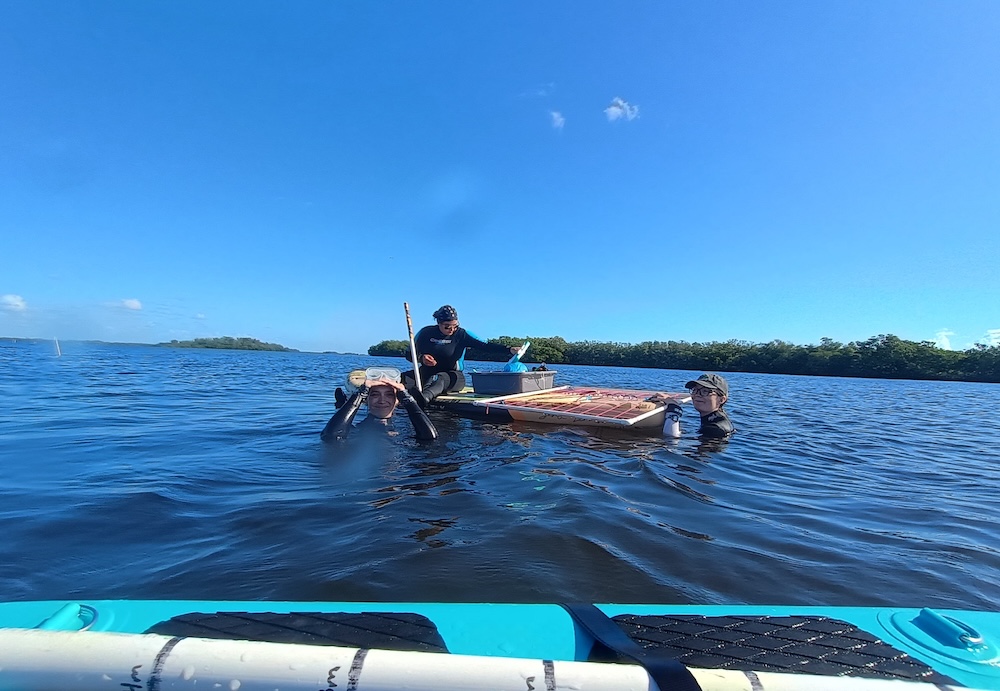
For Olivia “Olive” Smith, a day at her internship often begins in the waters of the
Indian River Lagoon, where she’s helping researchers survey and restore seagrass ecosystems.
Smith wades through the water alongside researchers, collecting samples and assisting
with field work. Other days, she works in the lab, where she checks seeds for germination
and runs nutrient tests. Some days, she reads research papers and prepares reports
or presentations.
Overall, she’s getting a firsthand look behind all that is involved with coastal restoration.
Smith is a senior in the USF Department of Environmental Science, Policy and Geography, majoring in environmental science and policy with a minor in biology.
Over the summer at Florida Atlantic University’s Harbor Branch Oceanographic Institute, she’s putting that background into practice as an undergraduate research intern
in the Seagrass Ecosystems and Ecology Laboratory.
“I have worked the past year in USF’s Ocean Circulation lab, which really helped me get experience in the field and explore what career options
there are in marine science,” Smith said.
She credits mentors such as Jay Law, a research scientist in the USF College of Marine Science Ocean Circulation Lab, who wrote her recommendation letter and helped her gain field
experience. Participating in the Environmental Field Methods course taught by James “Jim” Ivey, an associate professor of instruction in the School of Geosciences, also helped
her gain research experience that prepared her for her internship.
“Having the College of Marine Science and the Florida Fish and Wildlife Conservation
Commission next door to campus is huge for marine biology and environmental science
students,” she said.
For other students looking for internships, Smith recommends taking advantage of their
network and being open to experiences that may lead somewhere unexpected.
“Don’t be afraid to apply for things or reach out to people or send a cold email,”
Smith said. “The worst you can hear is no and you can try again.”
Now, whether she’s checking seeds for germination in the lab or wading into the Indian
River Lagoon for fieldwork, Smith is gaining experiences to help her see what a future
in marine science could look like.