

As the World Cup entered its final week, Major League Soccer — which had been, on a national level, almost entirely invisible up to that point of the event — launched its national advertising blitz off the summer’s tournament.
The campaign, billed as the greatest effort in league history, centered on a tagline: Thanks, world, we’ll take it from here.
It was meant to signal that MLS was restarting after its World Cup break, and also that the league was ready to accept any new fans of the game. But the campaign also raised a critical question: Is MLS actually ready to “take it from here?”
The league, including Orlando City SC, has fully returned to action. The Lions, for example, have won their first two matches since coming back from the break. Interest in the club, which had a poor start to the season, has been reignited with the arrival of French superstar Antoine Griezmann.
In addition, the MLS All-Star Game is Wednesday in Charlotte. World Cup standouts like Orlando City keeper Maxime Crepeau will face the stars of Mexico’s Liga MX. The league has been heavily promoting the event and its attached skills challenge, which is Tuesday.
Evolution of a league
MLS was created as a direct result of the 1994 World Cup, hosted by the United States. It spent the next 32 years first surviving, then building permanence in the American sports landscape via billions in soccer-specific stadiums and training facilities. That foundation now exists for the league to take its next step.
Yet, despite an eight-year runway since North America was awarded the 2026 World Cup, the league will not be coming out of what has been an enormously popular summer for soccer with major changes. Instead, its big shifts — a new summer-to-spring calendar and a new competition format — will not launch until at least 2027. And the biggest change, revamping how teams spend on rosters, has yet to be decided.
Don Garber, the league’s commissioner, said MLS was focused on building out infrastructure since the World Cup bid was won in 2018, which included adding eight new teams and several new stadiums. Others counter that the league took too long to begin weighing its evolution on a parallel path. It was not until Lionel Messi’s arrival in 2023 that MLS took up the discussions in earnest.
 MLS Commissioner Don Garber, right, leads a discussion at Major League Soccer’s “The Next Chapter” press conference July 16 in New York City. The league is trying to increase its presence and capitalize on the successful World Cup that was co-hosted by the U.S., Canada and Mexico. (Caleb Bowlin/Getty Images)
Now, the changes are coming at a time when the league is going through its first major leadership change in nearly three decades — Garber’s contract ends in 2027, and league owners are expected to vote soon on his replacement — and also in the midst of collective bargaining negotiations with the MLS Players Association.
Interviews with key stakeholders in the league, including Garber, Orlando City owner Mark Wilf, New York City FC chief executive Brad Sims and three-time MLS Cup-winning general manager Garth Lagerwey, yield an optimistic picture of the league’s future. But all acknowledged that the major decisions ahead will require a more aggressive stance that carries more risk.
“The uniqueness, the fun and the excitement of Major League Soccer is it’s always been going through a period of reinvention to capture the opportunity,” Garber said recently. “We needed to capture the opportunity of developing players. We needed to capture the opportunity of having some global superstars. We needed to have cathedrals for our sport that were public-private partnerships when MLS wasn’t really even able to ask about that belief in the early 2000s.
“And now it is about what ways do we need to perhaps invest differently in the product on the field so that we can capture more attention ultimately from a global media market.”
‘Time to lean in’
Lagerwey put it more bluntly.
“If you want it, it feels like the time is now or never,” he said. “We’ve had this wave. We’ve had all this investment. We’ve leveraged the infrastructure.”
He continued: “Is this the time to lean in? Yeah, it is.”
There is agreement on one thing: Change must come. It’s what that change looks like that remains unclear.
“It’s a must-do; it’s not a maybe-do,” Garber said. “And it’s going to take time to figure out the way to get it right, because everything that MLS is today, in comparison to many leagues around the world, is about the steady growth based on thoughtful strategy and partnership engagement on figuring out what we need to do to move to the next level. And that’s not ripping everything up that got us here. It’s evolving it. It’s making a couple of bold steps.”
There is certainly disagreement about whether ripping up everything is the way forward.
“Take it down to the studs,” Inter Miami owner Jorge Mas said. “Down. To. The. Studs.”
League owners and executives stand on both sides of the issue. It’s proof of a boardroom that has evolved and grown to 30 ownership groups, all with different levels of financial commitment, investment horizons and ambition. Consensus is increasingly rare. And that is what makes the pick for commissioner so important. The person must be able to navigate through that room and find solutions without the sort of unanimity MLS has long preferred.
What is inarguable is that the MLS system is convoluted, Frankensteined together over years to satisfy owners’ requests and whims. Many of the rules served a purpose or solved a problem at a specific time, namely to try to keep player costs down and maintain competitive balance. But as MLS teams started to spend more money, the rules have increasingly inhibited teams from competing at a higher level.
Roster construction rules are complex
Current rules, for example, essentially prohibit teams from signing any player with a total cap hit — salary, acquisition cost and bonuses — of more than $1.8 million unless they use a designated player spot. That eliminates enormous swaths of players in their prime around the world, many of whom are squad players in other leagues. The league’s level has plateaued as a result.
Lagerwey said that MLS too often puts caps on things like player development with rules that restrict recruitment in other teams’ “homegrown territories,” which gives teams monopolies on youth talent in their market and disincentivizes youth scouting.
The way the league splits up spending into different pots — general allocation, targeted allocation, under-22 initiative, designated players, homegrown players, senior roster and reserve roster — makes balanced rosters difficult to construct while also making it tough for both casual and devoted fans to keep up.
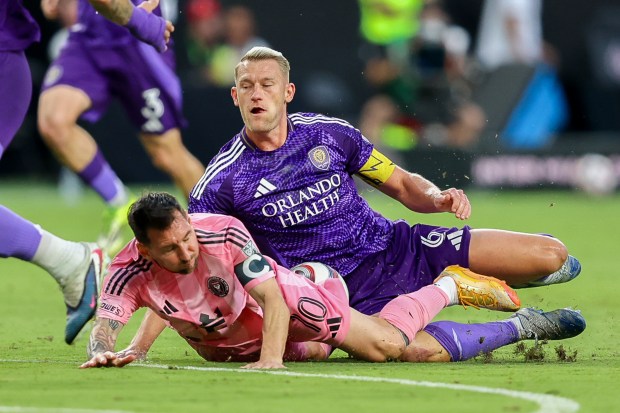 Inter Miami forward Lionel Messi, on the ground, and Orlando City defender Robin Jansson battle for the ball in a May MLS match in Miami. Owners and officials are working to increase the league’s profile coming out of the popular World Cup hosted by North America. (Chris Arjoon/AP)
Sporting directors in the league almost unanimously agree that a salary cap ceiling and floor, with no restrictions and bolstered by designated player spots carved out for Messi-type players, would improve MLS without even adding any expenditure. Right now, the vast majority of money is focused on a handful of players.
Such a system would encourage some teams to lean into different strategies. Some would prioritize domestic player development, into which league owners have poured hundreds of millions of investment and which ultimately affects the U.S. men’s national team. Others might invest in bigger-name foreign players. Both strategies would benefit from an overall higher-quality on-field product, which in turn sets the ceiling for elite player development.
It would also simply allow more teams to sign more good players at the standard global prices.
“We have the opportunity here because a lot of top talent is going to want to come here, but there’s still going to be a price to it,” Wilf said. “There might be some discounting to the fact that we have such a great market and great opportunity, but let’s not kid ourselves: It’s a global market, and we’ve got to be competitive.”
Lagerwey said that optionality would also create better story lines away from the field, from the different roster-building strategies to teams in different phases in their roster-build cycles, which leads to a more robust trade and internal transfer market, like in Major League Baseball when some teams are buyers and others sellers at the trade deadline.
Transparency means fewer constraints
It all ties into another key benefit of a system with fewer constraints: an easier, more transparent rule book that would allow fans more ways to interact with the league and salary cap, much as they do around the other major North American sports.
Garber acknowledged that transparency is an important step to increased fan engagement. But as the league finalizes its MLS 3.0 plans around the last arm of a three-tiered change strategy — calendar flip, competition structure and roster rules — he insisted the approach should continue to be patient and deliberate.
“Now that we have the hardware, how do we ensure that as the hardware has become best in class, that we have software that can also be best in class,” Garber said. “I think that will happen over time. I will say that it is called MLS 3.0 for a reason, because it is a transformation of the way we’re going to think about going about our business. But it is not a flipping of the switch.”
As the league emerges from this summer of soccer, there is a strong belief that missing the immediate moment should not mean missing the bigger picture.
“We can make this thing much, much bigger,” Lagerwey said. “Now it’s time to work together and to seize this moment and to see what MLS can be. Because I think there’s such potential and such a great opportunity right now.”