

Residents line up to speak about a planned development for eastern Charlotte County during Tuesday’s commission meeting.
SUN PHOTO BY NICOLE DROEGER
MURDOCK — A divided Charlotte County Commission approved a future rural development on Bermont Road this week, telling a crowd of opponents that the county cannot not legally reject the plan.
“It appears the applicant was able to work within that framework of the rules the way they’re currently written,” Board Chairman Joe Tiseo sadi. “If I’m going to ding somebody, I want to see a clear violation of the rules.”
Charlotte County commissioners voted 3-2 Tuesday to approve the Waterside residential plan in eastern Charlotte County.
CHARLOTTE COUNTY
Commissioners Christopher Constance and Stephen R. Deutsch opposed the approval of the Waterside residential project. Commissioners Tiseo, Bill Truex and Ken Doherty voted in favor.
Residents in opposition accused the developer of merely seeking a route to a profitable excavation site under the guise of a residential development. The developer denied this saying they would possibly not sell any excavation off site if it comes down to that.
“We don’t have any say in this special mining permit that we don’t have any experience with,” said Constance, who was the only commissioner to vote against the original proposal in 2023.
Deutsch said he voted against the project Tuesday, because there was too much confusion in determining whether the land was being used as a mine for fill dirt or not, and what permits would be required.
All agreed that the county needs to improve its procedures and review of excavation and mining. No changes will be possible, however, Truex and Doherty noted, until 2027, because state legislators blocked local municipalities from enacting stricter regulations during hurricane recovery.
County Commissioner Christopher Constance voted against the Waterside residential project at Tuesday’s meeting.
SUN PHOTO BY NICOLE DROEGER
For the second time in a month, more than a dozen residents from many parts of the county testified that the Waterside project is really just a developer ruse to build a Florida-stye surface mine to make money accepting and selling fill. This is a site that has been floating before the county as early as 2008 in earlier phases.
“They knowingly misled you about the depleted soil… This, of course, is a mine … It’s a mine but it doesn’t have the right zoning for a mine,” said environmental lawyer Percy Angelo, of Placida. “Waterside has admitted to the state that it’s a waste disposal facility, but it doesn’t have zoning for waste disposal — and it doesn’t want to ask for it.”
Commissioners already approved the general site plan in 2023, making it harder to reject the final site plan.
In the end, representatives for the developer, Southwest Engineering and Design, said they might not move any material off site if it became too much of an issue. They have made money so far by accepting hurricane debris in federal funded programs.
They had reserved the right to sell sand and shell that they excavate for the construction industry in Florida, which often requires tons of fill dirt under new buildings.
The developer and engineer Gary Bayne insisted that the project is truly meant to be a special type of development using a new zone that the county adopted mostly for the rural eastern part of the county. That rural mixed use requires large areas to be set aside for natural development, not to be fulfilled by the standard excavation pond seen in suburban developments.
Instead, the plan is to plant a Florida landscape on 63 acres with cypress, oak, pine and meadow, according to the plan.
The public will have to wait a long time, however, to find out if this happens. The developer has asked for 10 years to realize the plan, its lawyer Rob Berntsson told The Daily Sun. This allows time to grow the new trees in an onsite plant nursery, and to excavate the abandoned citrus grove.
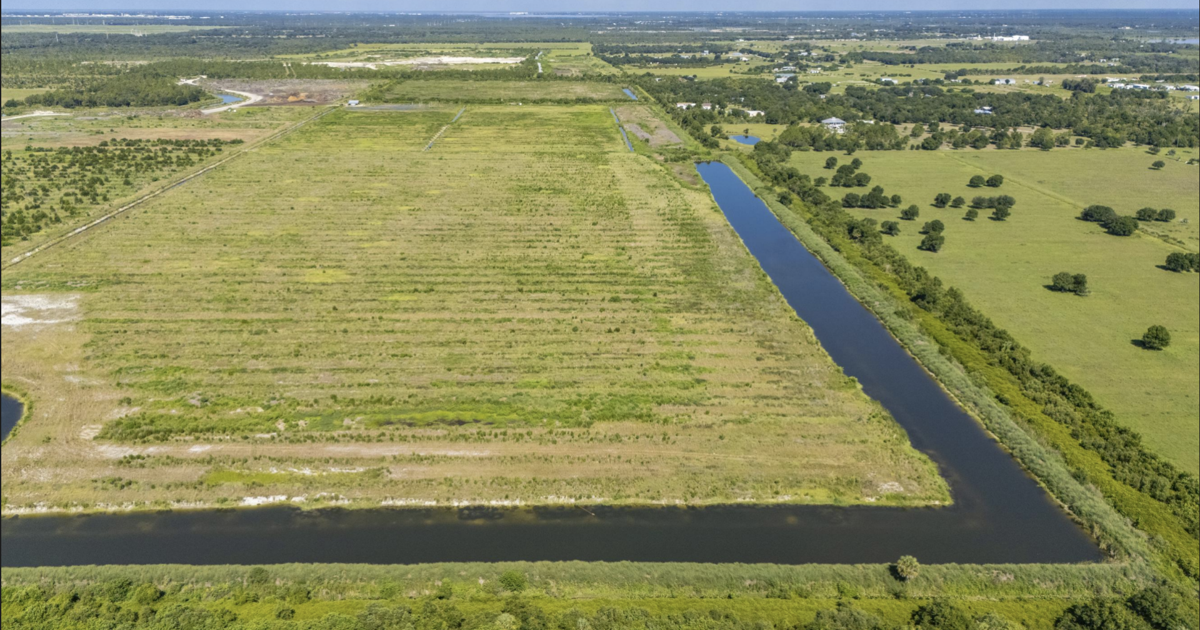
Land planned for a development in eastern Charlotte County has been used to process vegetative debris from hurricanes.
CHARLOTTE COUNTY
There has been no presentation on what the housing will be, as the current stage is only for remediating 63 acres of the 283-acre abandoned orange grove.
Initial illustrations suggest potentially 1,400 units will be clustered on the 730-acre site to leave room for the open space.
Residents tried to find legal ways for the board to reject the proposal. Arguments ranged from suggesting that there would be radon excavated from the soil to noting that there was no contamination found on the site, making the request for excavation fraudulent.
A geologist representing the developer noted they found low levels of radioactivity found at more than 30 feet down, which is common in the phosphate deposits of South Florida.
The planned excavation is 13 feet. Rather than contaminated, the soil is depleted, due to agricultural use, and would not support a natural landscape without remediation, according to the developer’s experts.
Residents accused the developer of falsely claiming the site was contaminated to justify mining, and then reporting no contamination.
But the developer never said the soil was contaminated back in 2023, Berntsson said.
Rather, they offered to check the soil for contamination at the suggestion of objections in 2023.
Plans for a new development in eastern Charlotte County show the site in its current state.
CHARLOTTE COUNTY
A resident and retired geologist, Diane Heck, argued that the hurricane debris that the developer has been collecting on site does not qualify as clean fill, as required.
The developer’s lawyer, however, noted that the vegetative material will be sitting for 3-5 years at which time, it becomes inert and meets the requirement for clean fill.
Truex noted that mining is a necessary operation.
“Mining is always a problem with people, but it’s also a need,” he said.