
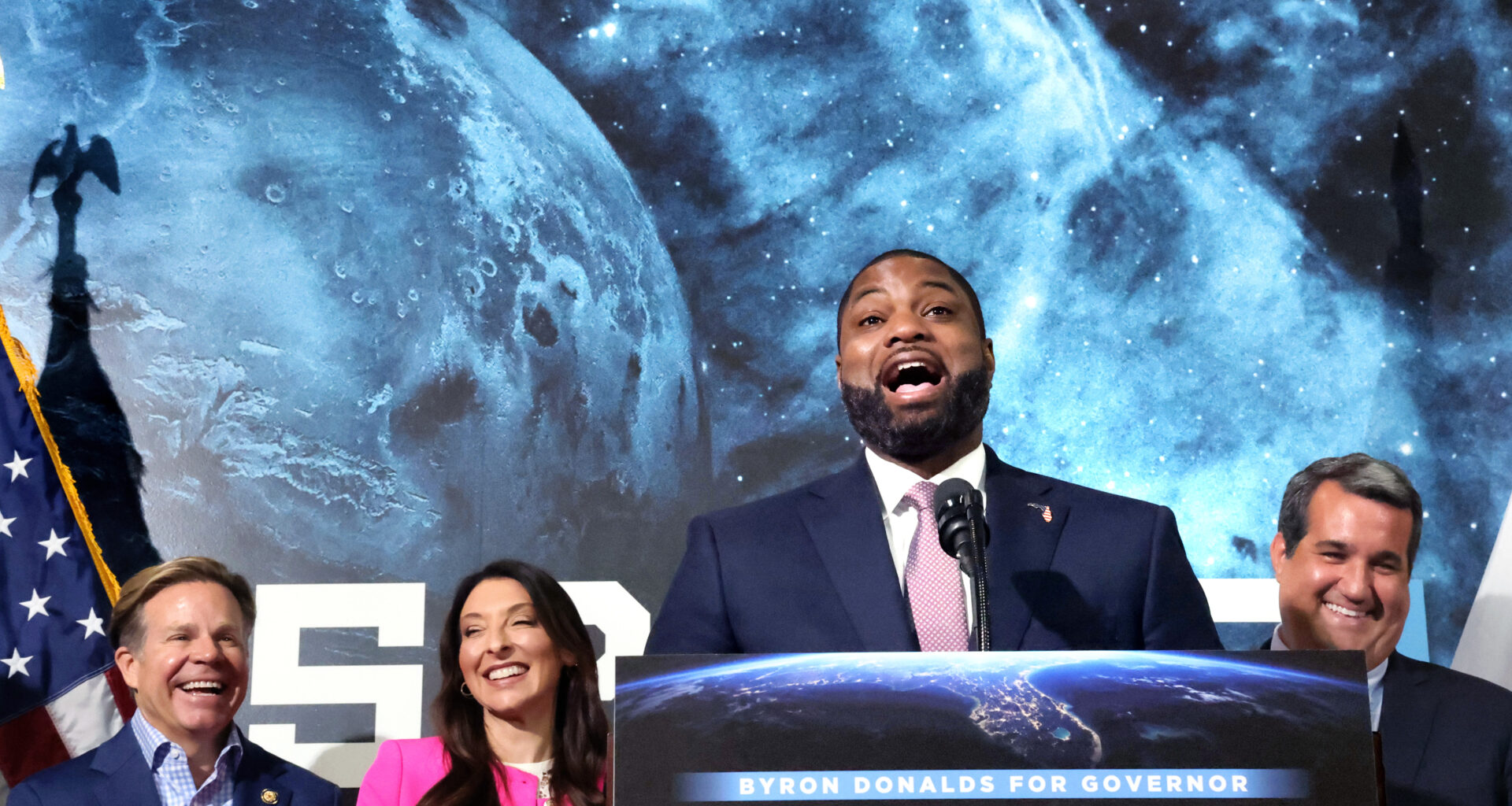
U.S. Rep. Byron Donalds, the Republican front-runner for governor, unveiled his plans for the state’s space industry Friday, pledging that if elected he would fast-track permitting for aerospace projects, expand training in space-related trades and lobby the federal government to move NASA’s headquarters to Florida.
Donalds, 47, of Naples, has led the GOP primary field by double digits since entering the race in early 2025 with President Donald Trump’s endorsement. The primary is Aug. 18.
He rolled out his plan at the University of Central Florida after a tour of its Florida Space Institute lab, which is developing simulated lunar soil. Donalds said his plan would create high-wage jobs, which in turn would help make the state more affordable and address “the number one issue impacting Florida today.”
The event drew a slate of Republican officials, including Rep. Tyler Sirois, R-Merritt Island, who called the plan “a slam dunk for Florida.”
Lynda Weatherman, president and CEO of the Space Coast Economic Development Commission, joined Donalds, too, and praised such efforts. A recent study found the region needed about 7,000 more aerospace employees across a dozen skill areas, she said.

Florida Republican gubernatorial candidate U.S. Rep. Byron Donalds delivers remarks on the future of Florida’s space industry during a visit to the Florida Space Institute Exolith Lab in Oviedo, Fla., Friday, July 31, 2026. The lab creates simulated planetary geological materials for research and education use worldwide. (Joe Burbank/Orlando Sentinel)

Florida Republican gubernatorial candidate U.S. Rep. Byron Donalds delivers remarks on the future of Florida’s space industry during a visit to the Florida Space Institute Exolith Lab in Oviedo, Fla., Friday, July 31, 2026. The lab creates simulated planetary geological materials for research and education use worldwide. Looking on, from left, state Rep. Mike Haridopolos, Mrs. Erika Donalds and Florida House majority leader Tyler Sirois. (Joe Burbank/Orlando Sentinel)

Florida Republican gubernatorial candidate U.S. Rep. Byron Donalds greets former Florida House speaker and U.S. congressman Tom Feeney, right, with state Rep. Mike Haridopolos, left, during a visit to the Florida Space Institute Exolith Lab in Oviedo, Fla., Friday, July 31, 2026. The lab creates simulated planetary geological materials for research and education use worldwide. (Joe Burbank/Orlando Sentinel)

Florida Republican gubernatorial candidate U.S. Rep. Byron Donalds jokes with his spouse, Mrs. Erika Donalds, while delivering remarks on the future of Florida’s space industry during a visit to the Florida Space Institute Exolith Lab in Oviedo, Fla., Friday, July 31, 2026. The lab creates simulated planetary geological materials for research and education use worldwide. (Joe Burbank/Orlando Sentinel)

Florida Republican gubernatorial candidate U.S. Rep. Byron Donalds delivers remarks on the future of Florida’s space industry during a visit to the Florida Space Institute Exolith Lab in Oviedo, Fla., Friday, July 31, 2026. The lab creates simulated planetary geological materials for research and education use worldwide. Looking on, Florida House majority leader Tyler Sirois. (Joe Burbank/Orlando Sentinel)

Florida Republican gubernatorial candidate U.S. Rep. Byron Donalds delivers remarks on the future of Florida’s space industry during a visit to the Florida Space Institute Exolith Lab in Oviedo, Fla., Friday, July 31, 2026. The lab creates simulated planetary geological materials for research and education use worldwide. (Joe Burbank/Orlando Sentinel)

Florida Republican gubernatorial candidate Byron Donalds tours the Florida Space Institute Exolith Lab in Orlando, Friday, July 31, 2026. The lab creates simulated planetary geological materials for research and education use worldwide. (Joe Burbank/Orlando Sentinel)

Florida Republican gubernatorial candidate Byron Donalds chats with employee Max Kuehn while touring the Florida Space Institute Exolith Lab in Orlando, Friday, July 31, 2026. The lab creates simulated planetary geological materials for research and education use worldwide. (Joe Burbank/Orlando Sentinel)
Show Caption
1 of 8
Florida Republican gubernatorial candidate U.S. Rep. Byron Donalds delivers remarks on the future of Florida’s space industry during a visit to the Florida Space Institute Exolith Lab in Oviedo, Fla., Friday, July 31, 2026. The lab creates simulated planetary geological materials for research and education use worldwide. (Joe Burbank/Orlando Sentinel)
Donalds pledged, as he has in the past, to press Washington to relocate NASA’s headquarters to Florida and to build what he called a “world-class space force military academy” in the state – proposals that would require federal cooperation.
“If all the action is here, then why is NASA sitting in Washington, to do what exactly?” he said.
The idea of moving NASA’s headquarters is not new. Florida officials, including U.S. Sen. Ashley Moody, have pushed for the relocation since Trump took office, arguing the agency’s Washington building sits largely empty. Texas, Alabama, Ohio and other states are seeking the same prize.
Asked whether Congress would go along, Donalds acknowledged the fight, saying rival state delegations “love to compete” but that Florida’s launch record gives it the edge. Donalds has only had one brief conversation with Trump on the issue, but he expects to “have a lot more,” he said.
Florida launched more than 100 rockets last year and that tally could reach 1,000 or more annually “over the next few years,” he said.
If elected, Donalds said he would speed up government approval for aerospace projects and introduce expedited permitting legislation. Anticipating pushback from environmental groups that faster permitting would mean weaker protections for Florida’s coastlines and wildlife, he insisted “expedited and permitting changes the timeline, not the standard,” and projects would still meet state environmental requirements.
In his first year, he also wants a new office for the space industry inside the governor’s office, and an annual “space race summit” convening private companies, federal agencies and universities.
In year two, Donalds said, he would expand the state’s Space Florida Academy. Launched by Space Florida, the state’s aerospace development authority, the academy creates an aerospace track for existing high school career and technical education courses.
Asked how he would keep NASA and other government programs at the forefront as private firms capture a growing share of contracts and land, Donalds defended reliance on commercial companies, arguing they had revived U.S. capabilities after the space shuttle’s final retirement during the Obama Administration.
He said the government has long partnered with private companies in areas such as defense and health care, and the same strategy makes sense for the space industry. Government agencies “want to do the right thing,” he said, but “they’re not pushing the envelope when it comes to innovation.”
Donalds said his plans would not require new taxpayer spending, instead relying on and coordinating existing state programs. The state budget signed by Gov. Ron DeSantis this year allocated about $25 million to Space Florida.
Donalds’ likely Democratic opponent is former U.S. Rep. David Jolly. The general election is Nov. 3.