
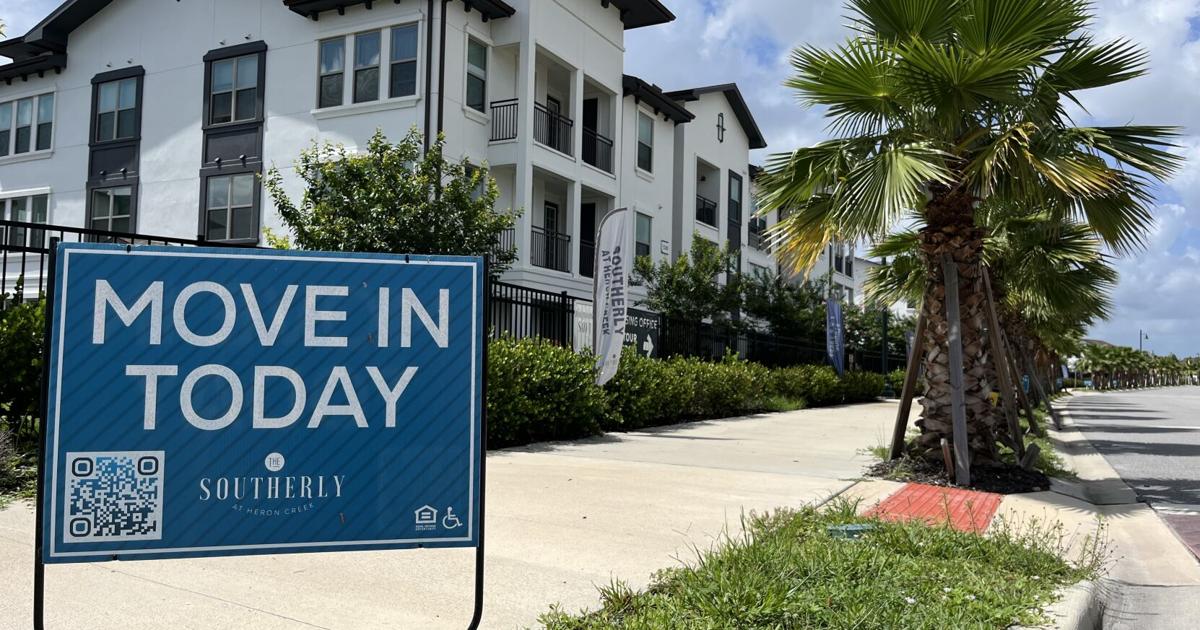
PORT CHARLOTTE — The number of evictions in Charlotte County is rising.
According to Florida Housing Data, in 2025 there were about 41 evictions in process per 1,000 households, an increase from about 37 in 2024.
In 2023, there were 31 per 1,000 households; in 2022, it was 30 per 1,000; in 2021, it was 20 per 1,000 and in 2020, it was about 23 per 1,000 as COVID began.
The end of the decade, in 2019, had 33 evictions per 1,000 homes.
Evictions are also rising in DeSoto and Sarasota counties, according to Florida Housing Data.
In DeSoto County, in 2025, it is about 37 evictions per 1,000 households, a jump from 2024, which had 8 evictions per 1,000 households.
In Sarasota County, evictions in 2025 were 32 per 1,000 households, up from 28 evictions per 1,000 households in 2024.
WHY THE INCREASE?
Florida Gulf Coast University Professor Shelton Weeks said there are a number of reasons for increased evictions.
Weeks is the Lucas professor of real estate and director of the Lucas Institute for Real Estate Development & Finance for the university.
For starters, Weeks said, local rent prices going down actually has a lot to do with the number of evictions going up.
Weeks said he recently read a paper about the people leaving their overpriced housing to move to a cheaper option.
“When rental prices go down, it can make the option to give up your home and move into a rental marginally more attractive,” Weeks said. “Think about this: if, say, your house payment is $2,000 a month and rent’s close to the same amount, you have a financial incentive to really try to stay.”
Economics plays a quick part.
“But when rent is several hundred dollars a month lower, people might think, ‘well, from a cash flow standpoint, I’d be better off just walking away from this,’” Weeks said.
Weeks said people will make those kinds of decisions to leave their home or apartment when their budgets are “strained.”
“Which is a lot of folks these days,” he said.
He pointed to “persistent inflation” during the last several years along with the cost of living in the state.
“We’ve had a lot of upward pressure on it from a variety of factors, and we’re in a market where wage growth has been notoriously slow,” Weeks said. “So, when you put those together, a lot of households are very challenged right now from a budgetary standpoint, and that’s always going to contribute to delinquency.”
Weeks also said sometimes people fall into hard times. That can result in evictions, too.
“When you’ve got this continual pressure for a long period of time, and then life happens, somebody hits a little bump in the road, somebody loses a job or gets their hours cut back, or somebody gets sick and can’t work, you’re really at risk for getting into financial difficulty,” he said.
Weeks said he has concerns over the price of rent compared to how much people in Florida get paid.
Weeks and others monitor cost-of-living trends in the ”Waller, Weeks, and Johnson Rental Index.” It identifies overvalued rent markets.
Weeks said they found rent went up drastically after 2022’s Hurricane Ian in Fort Myers and Cape Coral, with an average price of $2,300 per month. The average cost is now $600 less.
Apartments are in the “upper teens or low 20 (percentile)” in terms of vacancy, he said.
Many apartments, he said, are giving months free to get renters.
“Those sort of conditions are out there and are probably going to persist for the next couple of years,” Weeks said. “The problem is, if you go to your landlord and say ‘hey, my rent’s too high,’ they might tell you to pound sand. And then if you actually move, you’re going to incur that switching cost.”
Weeks said he could see the trend of evictions increasing continuing.
“But I don’t expect it to be dramatic,” he said.
As for the local eviction numbers, themselves, Weeks said the eviction numbers are “nothing like we saw in the great recession” from 2007-09.
Weeks — as well as data sites like Florida Housing Data — did not have great recession eviction numbers readily available, but Weeks said the number was “several times more than we’re seeing now.”
‘I COULDN’T KEEP WITH IT’ Despite evictions not being nearly as high as in the early 2000s, some residents are still feeling the strain.
Ethan Hall, a former resident, switched Charlotte County, Florida, for Charlotte, North Carolina due to his rent increasing drastically back in the spring 2022.
“With the overall cost of living and how few jobs there are, I couldn’t keep up with it,” Hall said. “My one-bed, one-bath apartment was going from $1,500 a month to $2,000.”
The rent increase to $2,000 was at the Lakes of Tuscana in Port Charlotte.
Lakes of Tuscana, according to its website, now charges about $1,700 per month for a one-bedroom unit.
“I can’t move back there it’s too damn hot,” Hall said when asked if he considered a return since the rent went down. “I was there for a bit visiting family not too long ago, that’s about as much as I can handle.”
Hall also found out he just likes living in North Carolina more.
“I don’t miss living there,” he said of the region.
Hall said his two-bedroom in North Carolina is cheaper than a one-bedroom unit at Lakes of Tuscana.
“Mine here is $1,635 for a two-bed, two-bath,” Hall said.
RENT’S IMPACT ON BUYINGLindsay Harrington, a former politician and Realtor who’s been in the trade for 47 years, said mortgages are high as well and people are having to find alternative living situations, such as having multiple roommates.
The issue of rent is also impacting people’s ability to buy homes, Harrington said.
Three houses on his street are rentals, he said. One up the street from him was asking for about $2,400 per month.
Harrington said companies who want to rent out houses will actually pay more than the home is worth so they can rent it out and make money.
According to Zillow, the average price to rent a home in Florida is about $2,350.
“There’s no way some of these people can actually put money away and even buy a starter home,” he said.
Harrington noticed a driveway recently with five cars on it. He said younger people are splitting costs, filling up homes to the brim to make ends meet.
Harrington said he thinks there’s a market for small, simple 500-square-feet housing options for young people or couples to live in. Such options may keep younger people in the area as well.
But even if they do, the mortgage world can be pricy too, according to Harrington.
Harrington said “supposedly a high percentage of mortgages in the county are underwater.”
That means the mortgage is more than the current market value of the house.
“How can a high school graduate, a husband and a wife with two kids survive?” Harrington asked.