
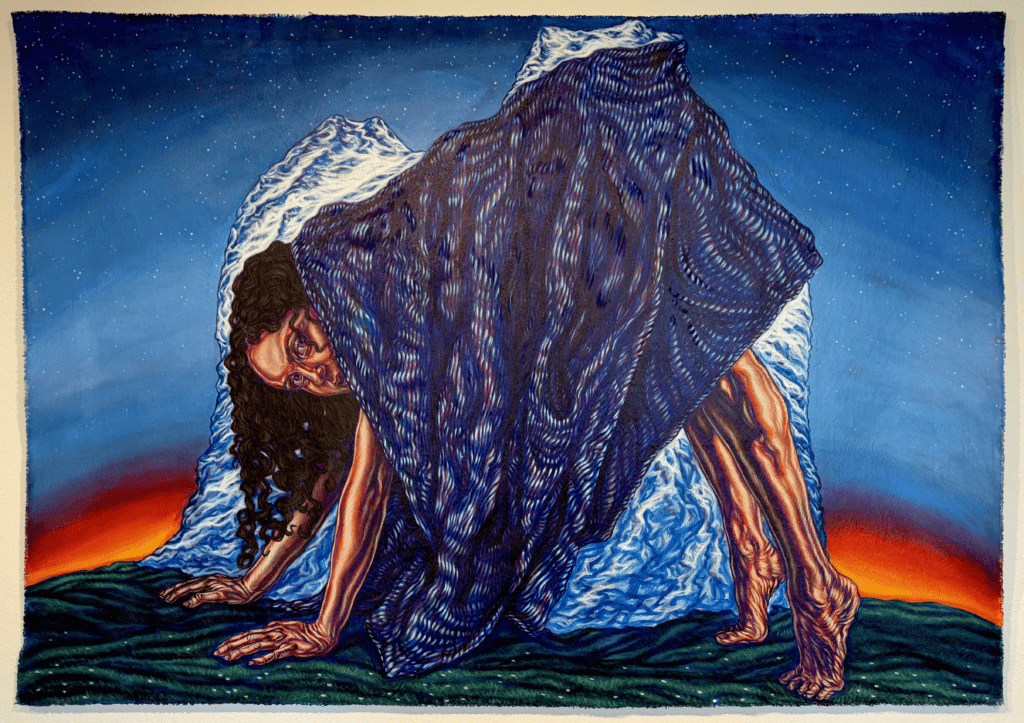
This 2026 painting by Mär Martinez, “A conversation on a bottom of a hill about the top of a mountain (in situ),” is acrylic on unstretched canvas. (JULIETTE KAHN)
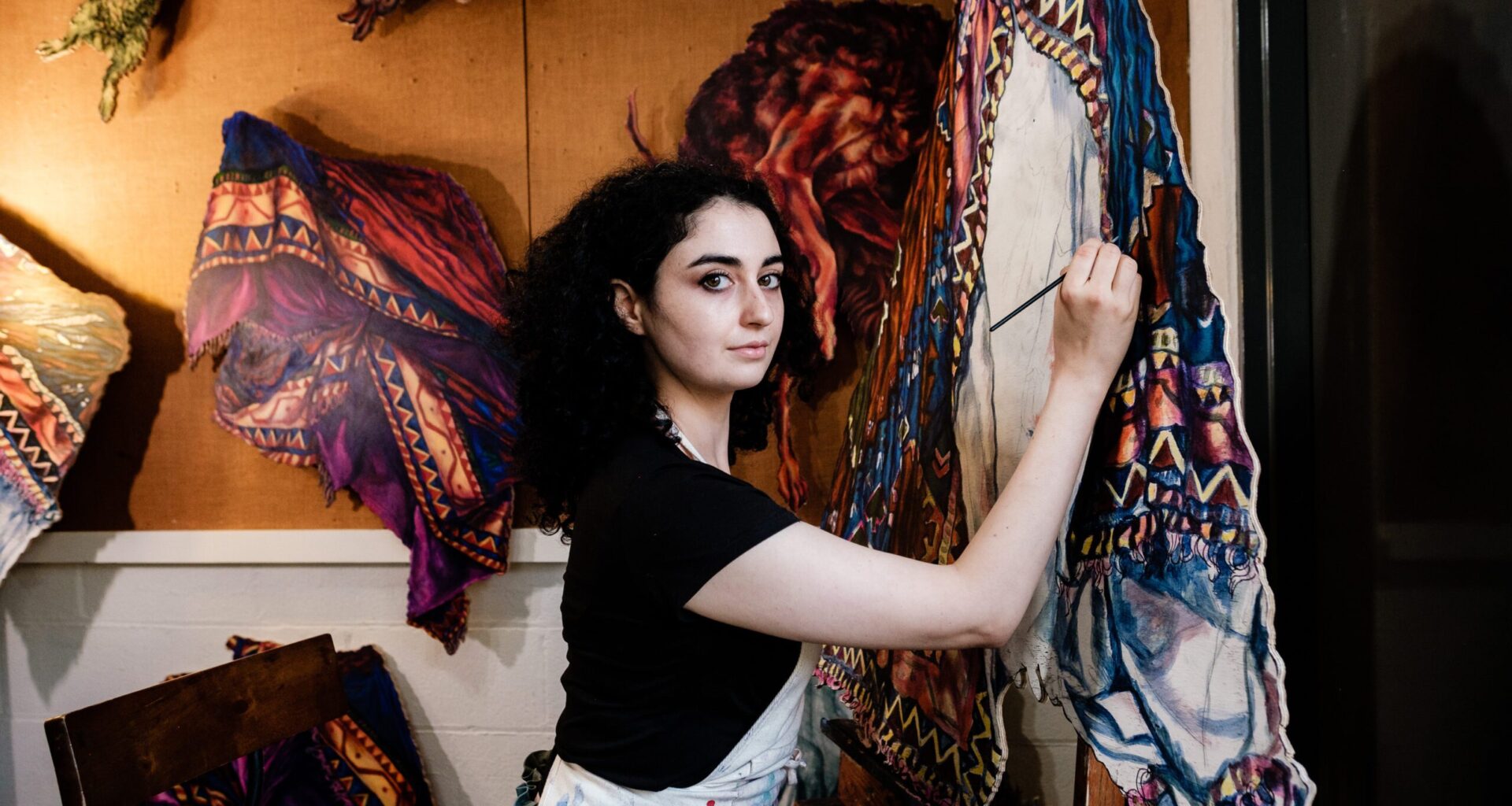
The way artist Mär Martinez puts brush to canvas is intricate and intimate. Through her use of color, her subjects almost glow. With your eyes, you can feel the individual fibers of the handwoven carpets and tangled threads she depicts in her paintings. Even her choice of using huge, unstretched canvases makes each piece reminiscent of a large rug. These tactile elements, Martinez said, are central to the themes of power and resilience she weaves into her creations.
“There’s literally nothing more resilient than a handwoven carpet,” Martinez said. “Those things will survive forever.”
Her recent exhibition, titled “a loom, a fence, a wire, a thread,” at the Art & History Museums of Maitland, was born from her 2024–2025 Fulbright research scholarship in Türkiye (formerly Turkey), where she found architectural and structural inspiration roaming the streets of Istanbul. The paintings Martinez produced during this time pull from her Cuban and Syrian background and contemplate her family’s history of displacement.
“I started thinking about how many instances that the objects that were in my home had survived regime changes, lingual shifts, moving across the country, leaving under politically dubious circumstances,” Martinez said, “and handwoven carpets are extremely sturdy, because you’re essentially wrapping thread endlessly upon itself.”
Prior to her Fulbright research, the ideas that snowballed into this series of paintings came from her 2021–2023 Artist-in-Action Residency at A&H. Her first tango with the institution came about as she was finalizing her undergraduate art history and studio art degrees at UCF. Martinez said she drove past A&H’s sign nearly every day commuting in and out of Orlando. So, she took a chance and applied.
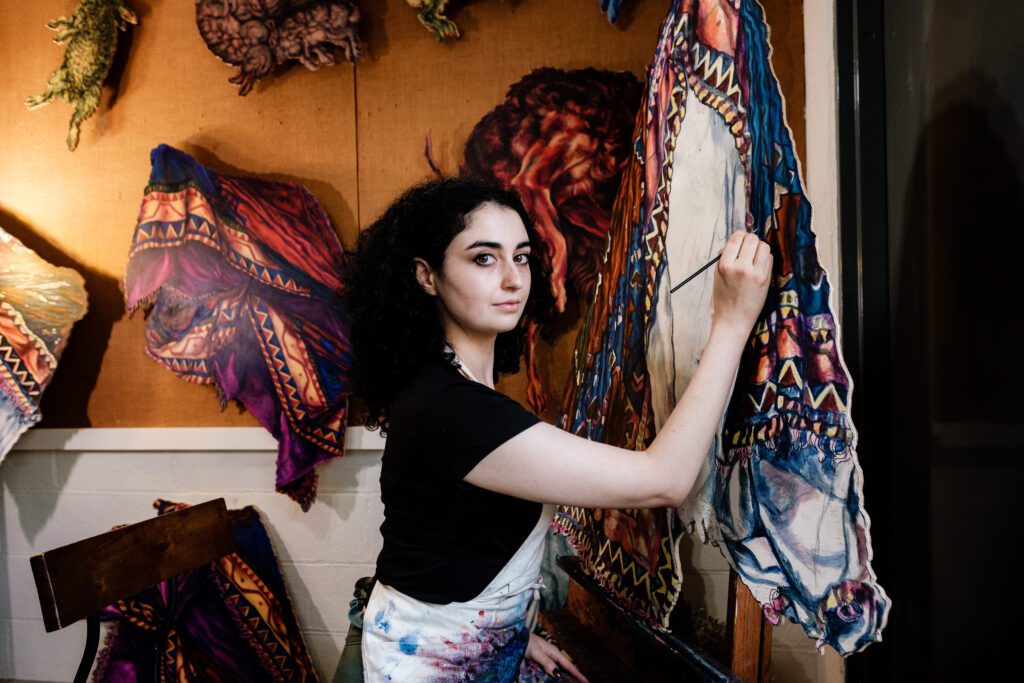
During her 2021-2023 artist residency at the Art & History Museums of Maitland, Mär Martinez experimented with painting on large wooden cutouts. (COURTESY OF MÄR MARTINEZ)
When Martinez was accepted into the cohort, what stood out to her was its local presence. No need to travel across states, or even seas. And, just as importantly, no need to be crammed in a makeshift studio out of her dining room.
Additionally, Martinez said, the residency supplied a space to more deeply develop her art while engaging with other artists. And it allowed her to work hand-in-hand with a museum that guided and supported her endeavors — one that, at the time, even renewed her residency for a second year.
“I felt like, for the first time in my whole life, that art could become a career,” Martinez said. “Oftentimes, in the arts, we’re talking about artists that have passed away, or their work is kind of mythologized — and there’s a disconnect between the actual process of how their life went, how their work was made, and then you’re seeing these kind of art objects in a museum. But this was a living museum, because the artists that were working there were very much alive. I was able to meet with them and work with them, whether they were other people in the cohort or the people that were exhibiting.”
Flash to today. Martinez has just wrapped up a solo exhibition at A&H, with another lined up in Alabama. This was not her first solo show but one of a handful she’s had the opportunity to exhibit because of the springboard this residency provided. Returning to A&H, Martinez said, was a significant homecoming.
“It was huge. It was emotional. I definitely teared up seeing everybody all at once, both old faces and new. The seeds for this project had been planted at Maitland. … To go out into the great beyond and come back with the fruits of my labor, and then exhibit it there — it was huge.”
Mär Martinez’s next show, slotted for 2027, is at the Gadsden Museum of Art in partnership with the Alabama Contemporary Art Center.