
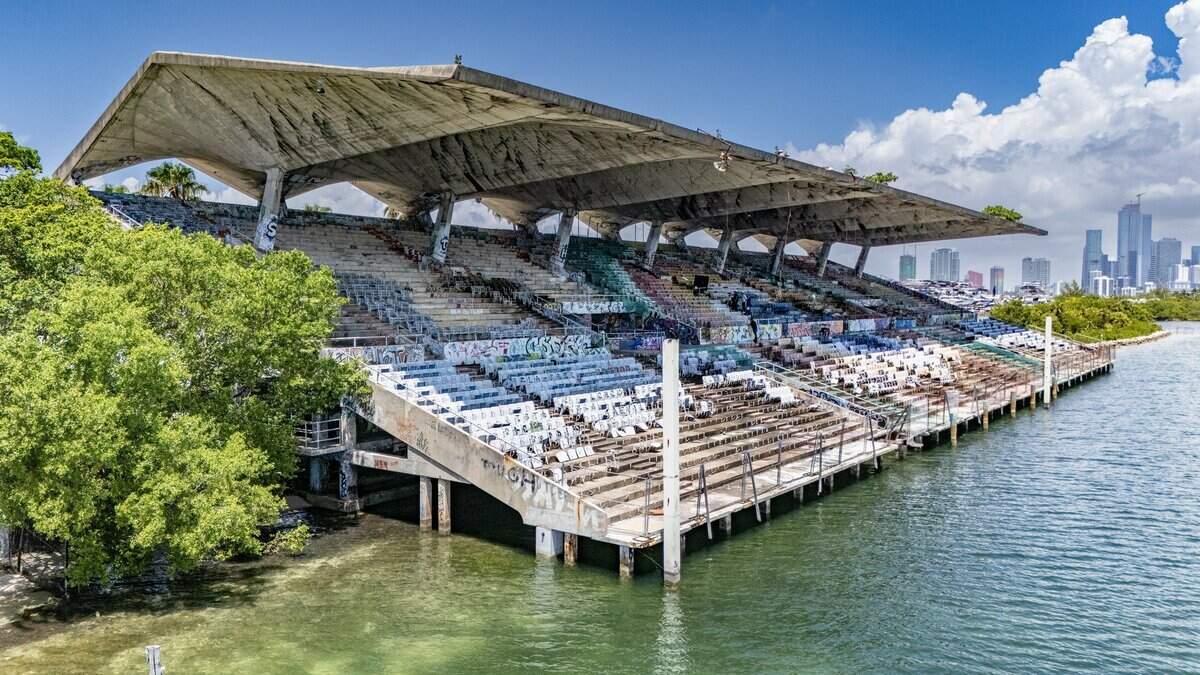
Miami residents are set to vote this August on the future of the iconic Miami Marine Stadium. Preservation leaders have spent decades advocating for the restoration of the long-shuttered venue. An aerial view of Miami Marine Stadium on Rickenbacker Causeway on July 7, 2026.
Photography by AL DIAZ
adiaz@miamiherald.com
Voters in Miami will weigh in on two ballot referendums in the Aug. 18 primary. All voters registered in the city can participate, regardless of party affiliation. Here are the Herald Editorial Board’s recommendations:
Miami Referendum 1
Recommendation: Vote “yes.”
This ballot item, if approved, will move the city’s elections from odd-numbered years to even-numbered years. The Editorial Board has advocated for this change since we published the series Miami Dysfunction in 2023. Off-cycle municipal elections often result in abysmally low voter turnout, which in Miami has guaranteed candidates don’t have to appeal to a broad swath of constituents. Moving races for mayor and commission to coincide with midterm and presidential elections would address that voter participation problem. Critics say the change would make it harder for grassroots municipal candidates to gain traction when bigger races are on the ballot.
The referendum approved by the City Commission in May isn’t ideal, though. It would move the elections starting only in 2034 and 2036 (city elections are every two years). That means two election cycles would take place before the change goes into effect: in 2027/2029 and 2031/2033, when those who are elected would serve shortened, three-year terms instead of four-year terms. The delay was meant to avoid shortening the terms of current commissioners, which is self-serving but also indicates the measure might not have cleared the commission without this concession.
Despite its flaw, this referendum is a better alternative than the attempt last summer — later struck down in court — by the City Commission and then-Mayor Francis Suarez to move the elections to even-numbered years by adding one year to their own terms without voter approval. Now that voters finally have a say, they should vote “yes” to this ballot question.
Miami Referendum 2
Recommendation: Vote “yes.”
Miami Marine Stadium has languished in disrepair since Hurricane Andrew in 1992, but it remains a striking — if graffiti-covered — feature of our waterfront: a 6,500-seat, open-air theater on Virginia Key where bands used to play on a floating stage and concert-goers could watch from boats bobbing in the basin.
This referendum, advocates say, is the best hope — and perhaps the last one — for the marine stadium to be restored and reopened.
There have been many unsuccessful attempts to revive this mid-century landmark that’s listed on the National Park Service’s National Register of Historic Places. The price tag to fix it keeps going up — an estimated $65 million or more. But this latest proposal, approved unanimously by the Miami City Commission, is designed to keep taxpayers from shouldering much of the cost.
If voters agree, the city will enter into a management agreement with Global Spectrum, a subsidiary of Oak View Group, one of the country’s largest operators of sports and entertainment venues. Oak View would turn the stadium’s vast parking lot into a water-oriented public recreational facility — a “flex park” — that could also be used for special events. Oak View would also draw up plans to renovate the stadium to be approved by the city, with financing coming from a variety of possible sources, from naming rights or the sale of historic tax credits or revenue bonds, which do not rely on tax revenues.
Oak View Group would pay the city $10 million toward restoration of the stadium. As operator of the flex park, the company would get a $400,000 a year as well as 7% of gross revenues and food and beverage sales and 15% of revenue from sponsorships and premium seating. The city would get 93% of gross sales after deducting the $400,000 management fee, plus 85% of sponsorship revenues. The agreement would have a 10-year initial term with up to three 10-year renewals, according to Miami Commissioner Damian Pardo. The stadium is in his district.
Long time advocates like Don Worth, co-founder of Restore Miami Marine Stadium, are enthusiastic about the proposal, and they say this architectural gem designed in the 1960s by Cuban architect-in-exile Hilario Candela could be the equivalent of Colorado’s Red Rocks Amphitheatre. Its location is certainly special: It sits on rare public waterfront property with a million-dollar view of the city skyline and the bay.
The agreement the city wants voters to approve isn’t perfect — there’s no specific date when the stadium would be reopened, for example, though some have estimated the work will take five years — but Pardo said the city commission retains control because it must approve the contract. And there’s a serious upside to consider: If voters approve this, it means there won’t be another high-rise built there.
BEHIND THE STORY MORE Who decides the political endorsements?
In advance of local and state elections, Miami Herald Editorial Board members interview political candidates, as well as advocates and opponents of ballot measures. The Editorial Board is composed of experienced opinion journalists and is independent of the Herald’s newsroom. Members of the Miami Herald Editorial Board are: Amy Driscoll, editorial page editor; and editorial writers Isadora Rangel and Mary Anna Mancuso. Read more by clicking the arrow in the upper right.
What does the endorsement process look like?
The Miami Herald Editorial Board interviews political candidates to better understand their views on public policy and how their policies will affect their constituents. Board members do additional reporting and research to learn as much as possible about the candidates before making an endorsement. The Editorial Board then convenes to discuss the candidates in each race. Board members seek to reach a consensus on the endorsements, but not every decision is unanimous. Candidates who decline to be interviewed will not receive an endorsement.
Is the Editorial Board partisan?
No. In making endorsements, members of the Editorial Board consider which candidates are better prepared to represent their constituents — not whether they agree with our editorial stances or belong to a particular political party. We evaluate candidates’ relevant experience, readiness for office, depth of knowledge of key issues and understanding of public policy. We’re seeking candidates who are thoughtful and who offer more than just party-line talking points.