
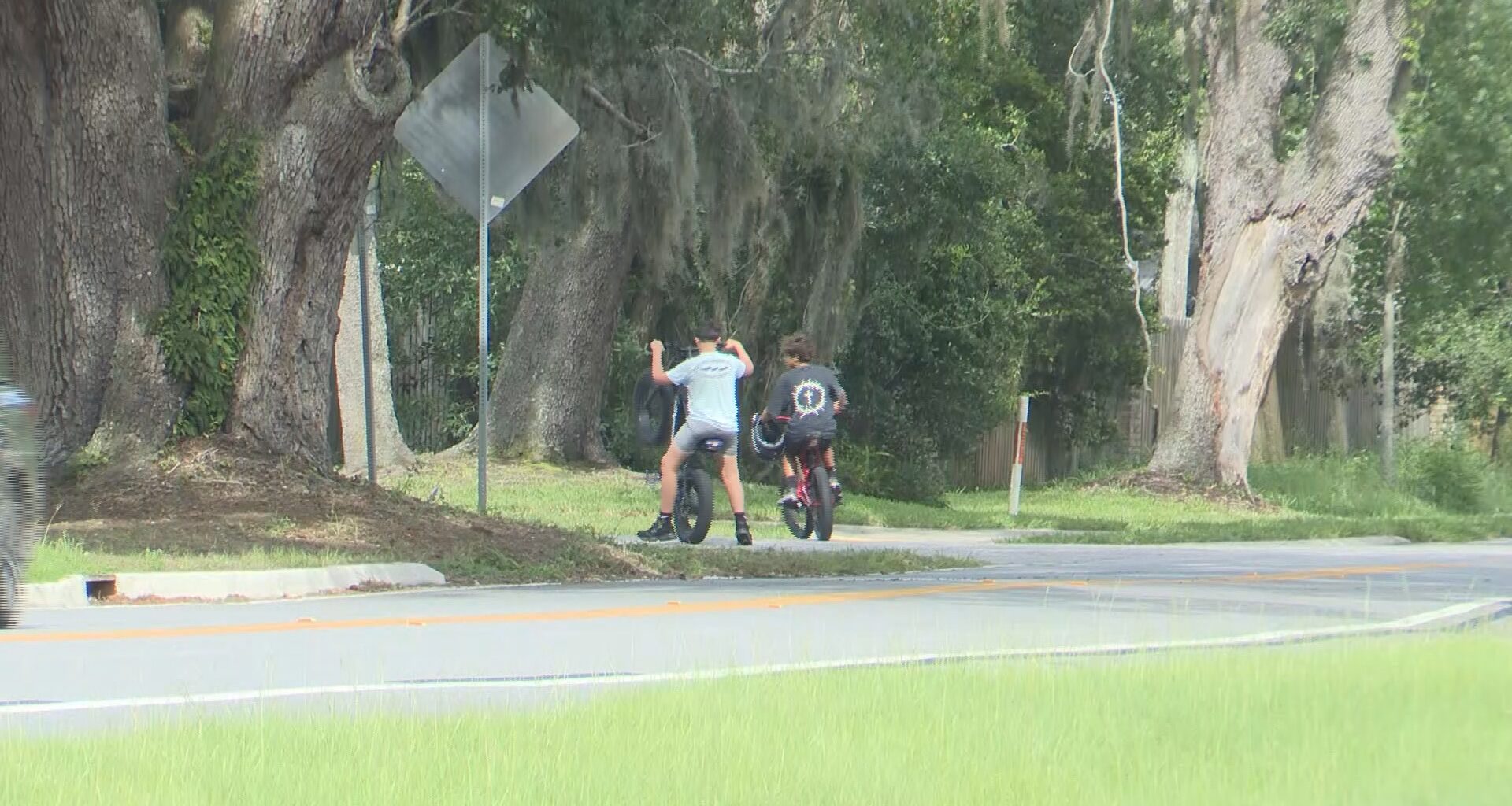
After a state-wide measure was vetoed by the governor, a Jacksonville city council member filed a similar bill to address e-bikes on the local level.
JACKSONVILLE, Fla. — Jacksonville e-bike riders could have some new rules to follow soon.
The Jacksonville city council is reviewing a proposed e-bike ordinance.
Back in June, Governor Ron DeSantis vetoed an e-bike regulation bill, citing concerns over enforcement and surveillance.
Jacksonville City Council Member Michael Boylan has been working on his own bill and was waiting to see how that one played out.

This story continues below.
Now, he figures it’s time Jacksonville has something on the books about e-bikes.
“Quite honestly, there were two or three personal incidents,” said Boylan.
Boylan says one particular crash he witnessed with a boy on an e-bike on Brady Road in Mandarin got him thinking about if the city needed a new set of rules.
“Lost control of the bike, rolled right off the road,” said Boylan. “I wouldn’t say he seriously injured himself, but certainly hurt himself, some cuts and things like that. Fortunately, he had a helmet on, but we had to help him.”
Boylan reached out to the Jacksonville Sheriff’s Office to get an idea of how many crashes were happening like the one he witnessed first-hand.
“Clearly, what we’re seeing, while the numbers aren’t significant, per se, the percentage is increasing dramatically,” said Boylan.
Some of the key components of Boylan’s e-bike regulation bill are:
A 10 mph speed limit on sidewalks
Making it illegal to drive an e-bike recklessly or carelessly
Making it illegal for kids under 11 to ride e-bikes on city roads and sidewalks and anyone under 16 would have to wear a helmet
“To recognize that e-bikes, like bicyclists have a right-of-way, but they also have a responsibility to follow vehicular rules and we need to know what those rules are,” said Boylan.
Violators would face a civil infraction, which comes with a ticket up to $100.
Boylan says the intent of the bill is to hold parents responsible for their children while they’re riding e-bikes.
“I would offer this as the first foray to see how viable it is for us to bring some attention to the safety concerns associated with e-bikes,” said Boylan.
Boylan’s bill will go before the rules committee Monday morning before a vote in a few weeks to send it before city council.
He said he hopes to plan a public meeting about it before anything is set in stone.
You can read the full text of the bill here.
Boylan also provided a list of difference between his bill and the one the governor vetoed:
Overall, our proposed ordinance is generally consistent with SB 382.
There are 3 primary substantive additions contained in SB 382:
1. Shared-Use Pathways and Recreational Trails
· SB 382 requires e-bike operators on shared-use pathways that are not adjacent to roadways, including pathways located within parks and recreational areas, to yield to pedestrians and provide an audible signal before passing.
· Our ordinance contains similar yield and audible-signal requirements when e-bikes are operated on sidewalks but does not expressly reference shared-use pathways, parks, or recreational trails.
2. Speed Restrictions Near Pedestrians
· SB 382 provides that e-bike operators may not exceed 10 mph when operating on sidewalks or pedestrian-designated areas within 50 feet of a pedestrian.
· Our ordinance is more restrictive and establishes a 10 mph speed limit on sidewalks regardless of whether a pedestrian is within 50 feet.
· SB 382 classifies violations as noncriminal traffic infractions under Chapter 318, Florida Statutes.
o Section 318.18, Florida Statutes, provides that violations of section 316.20655 (E-Bike Statute) carry a $15 statutory penalty, plus any applicable court costs and assessments.
· Our ordinance classifies violations as a Class C offense which carries a fine of not more than $100 or by imprisonment of not more than 60 days, or both.
2 other notable additions:
A. SB 382 creates the Electric Bicycle Safety Task Force at the state level. The Task Force is charged with reviewing electric bicycle and micromobility safety issues, evaluating crash and injury data, and making recommendations to the Governor and Legislature regarding potential future legislation and regulation.
B. SB 382 also requires police departments and sheriff’s offices to collect and maintain information regarding electric bicycles and other micromobility devices and submit reports to the FLHSMV for analysis. FLHSMV is then required to compile this information and provide reports to the Governor and Legislature.
· I believe the creation of the Task Force and requirement of law enforcement to keep reports and records regarding registration and crash statistics are excellent additions. I do not believe they need to be addressed in our ordinance.