
Three Chinese citizens living in the United States illegally are accused of operating a fraud ring out of Orlando that stole over $2 million by targeting elderly victims in as many as 17 states — including by telling them they had been victim of “porn fraud.”
Yongbo Li, 36, Huashan Lu, 62, and Yuxiang Zhao, 60, were recently arrested on charges of conspiracy to commit mail fraud in the scheme. Authorities are still seeking to apprehend three others in China after a months-long investigation by the Orlando Police Department and U.S. Postal Inspection Service, federal prosecutors announced Tuesday.
The scheme was based in Orlando and Winter Park, where members kept several post office boxes to which their victims would send cash, checks and money orders to through the mail, according to the DOJ. While some victims were from Florida, others lived as far away as New York and Arizona, records show.
The alleged scammers would contact victims by phone, email and Internet pop-up messages, claiming to be from groups like the FBI or U.S. Secret Service and telling them that their personal and financial information had been compromised. They said mailing funds to several shell companies they set up in Central Florida would resolve the problem and cautioned victims to tell no one what had happened, the DOJ said.
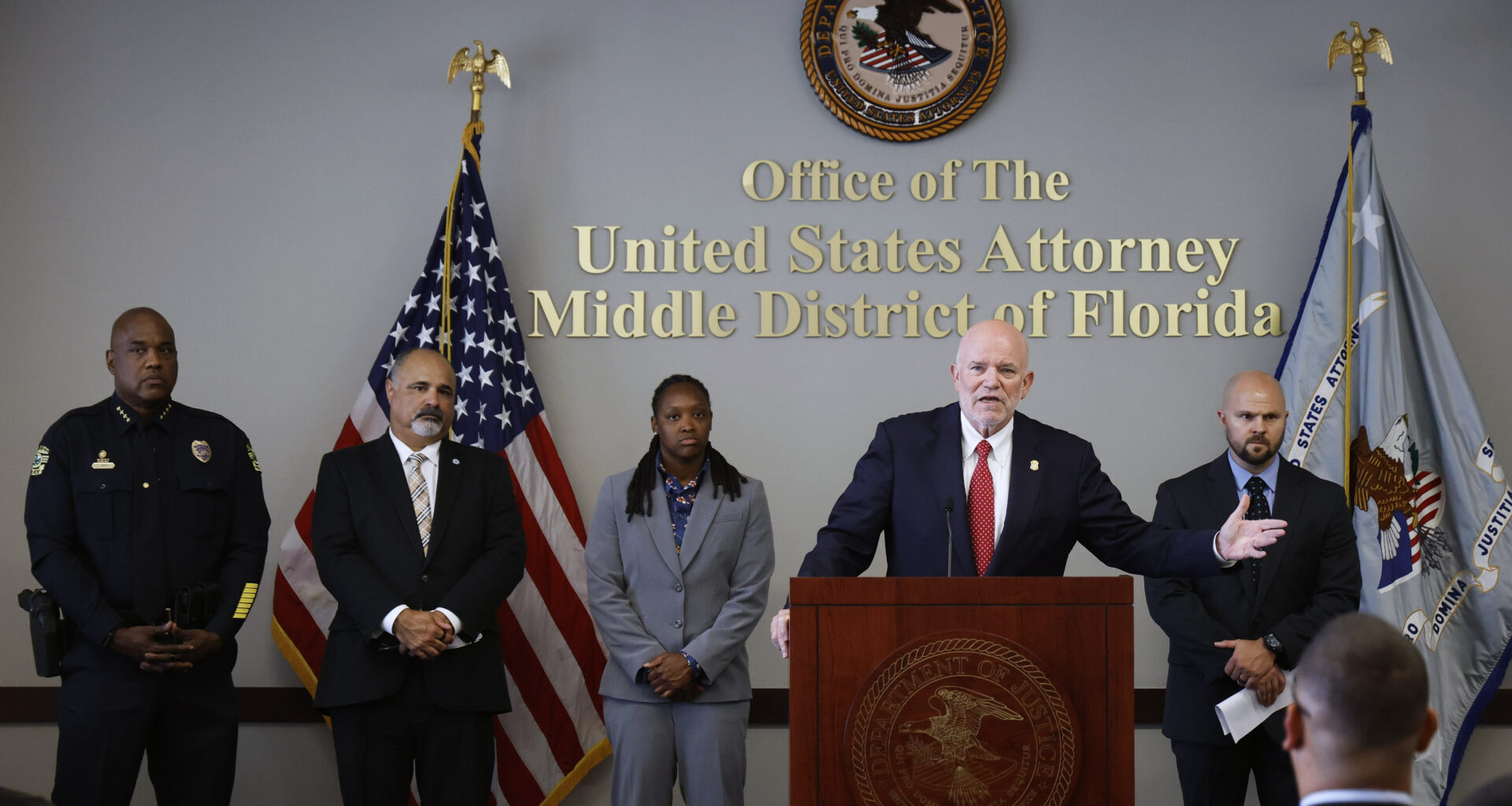
U.S. Attorney Gregory Kehoe, Central Florida’s top federal prosecutor, announced the arrests at a Tuesday news conference in downtown Orlando. He described the impact on the victims as life-changing.
“Elderly people losing several hundred thousand dollars is life-changing, life-threatening, and can you imagine the fear that these people have to live with moving forward?” Kehoe said. “You’ve spent your life putting this nest egg together and in a blink of an eye it’s gone.”
Some of the amounts sent to the group by individual victims include sums as large as $240,000, $171,000 and $150,000. Court records show the group made at least $2.2 million and likely intended to send it to financial institutions in Hong Kong and Bahrain.
Kehoe said much of that money has been sent overseas and is likely unrecoverable, but authorities are working to recover the money that remains in the U.S., having already reclaimed a few hundred thousand dollars.
He said there are currently 28 known victims, but more will likely be discovered as the investigation continues. He added the scheme worked in part because some victims were too embarrassed that they had been scammed to contact police right away.
A majority were over the age of 65 and spoke to the group over the phone. At least one victim, 80, was a U.S. Army veteran, records show.
Orlando police chief Eric Smith, also speaking at the news conference, said the massive investigation initially began out of a single call by a concerned citizen to OPD, one of thousands such calls the agency routinely receives.
“Anybody who feels like something crazy happened, something unusual happened, feels like they were taken advantage of, please call. Give us a chance to do our job and look into it,” Smith said. “You know, maybe it wasn’t anything, maybe it was something, but always give us the the chance to get involved.”
An elderly woman from Illinois had reached out to OPD in June through her bank, saying she was contacted over email by someone claiming to be from Amazon who told her she was a victim of “porn fraud,” according to court records.
She was then given a phone number, supposedly for her bank but actually a member of the group, who told her she should mail a $49,000 check made out to one of their shell companies and mail it to a P.O. Box at a UPS store in downtown Orlando.
The woman mailed the check, but it was quickly intercepted and recovered by the U.S. Postal Inspection Service, which had been contacted by OPD.
Law enforcement responded to the store, where employees said the P.O. Box was regularly accessed by three individuals, including Yongbo Li, one of the three suspects recently arrested. Surveillance footage from the store shows Li retrieving mail from the box that same day.
As for what “porn fraud” meant, Kehoe explained by referring to a different victim who was told her Apple Pay account was used to buy $150 worth of pornography in China and that she should move her remaining funds to another account where it would be safe. She sent $49,500 to the group.
After the call from the Illinois victim, Orlando police, U.S. Customs and Border Patrol and the U.S. Postal Inspection Service then began a joint investigation where the group’s members were surveilled at their shell companies’ P.O. boxes, financial institutions and other locations.
The group would sometimes discard packages, which investigators would then use to identify more victims.
Kehoe identified Li as the group’s suspected ringleader, or at least its preeminent member.
Subsequent surveillance found Li routinely accessed the commercial mailboxes used by the group’s shell companies and retrieved packages believed to contain victims’ money, acted as a spokesperson for other members during banking transactions and appeared to exercise a supervisory or coordinating role in the group, records show.
Kehoe said he plans on requesting the extradition of the remaining three suspects in China. He said one of them is an American citizen.