
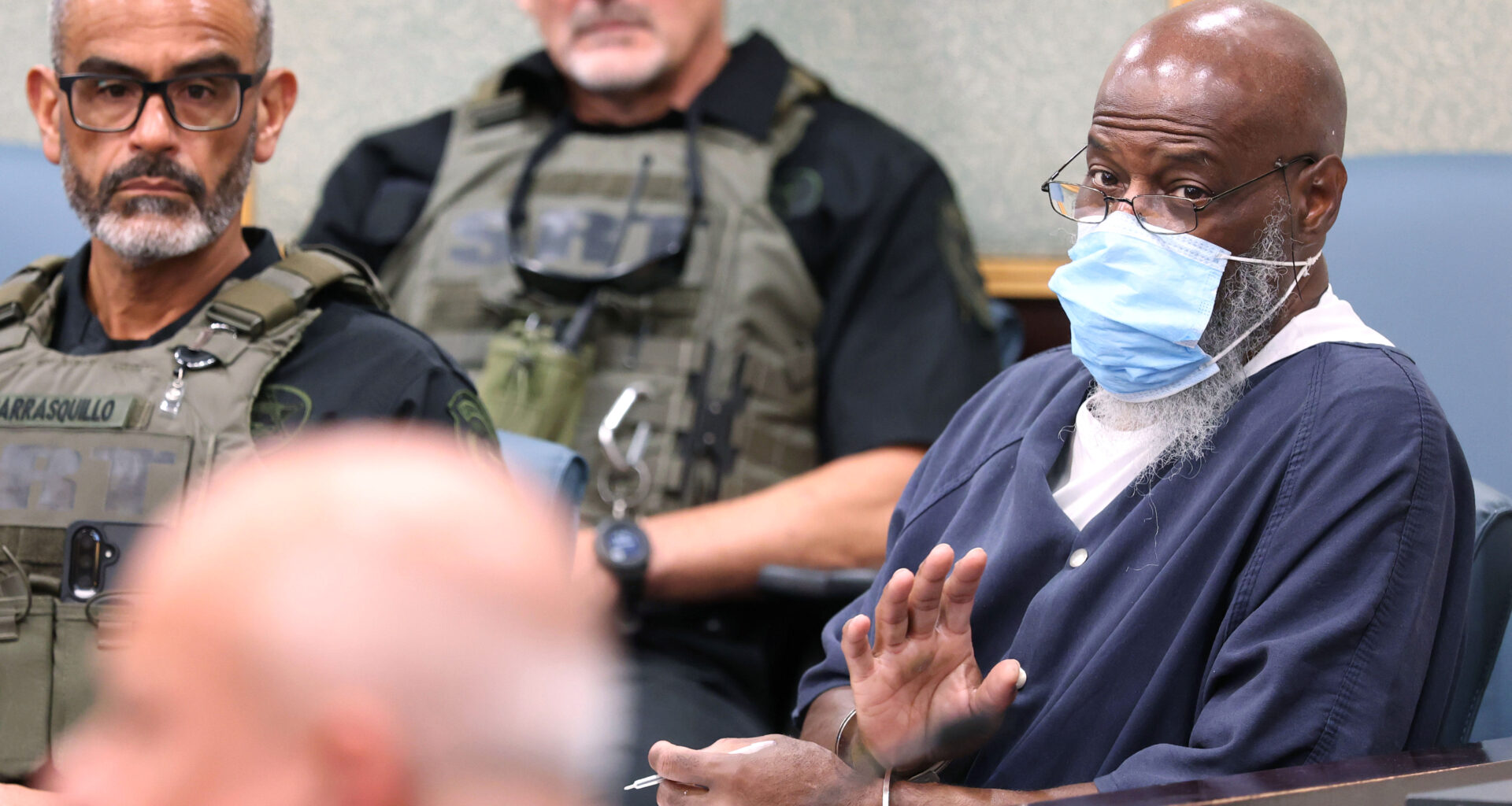
A man found guilty of killing a College Park woman in 2002 while on the lam for another murder, leading to his appearance on the TV show “America’s Most Wanted,” was sentenced to death Tuesday in an Orange County courtroom.
The jury that convicted Demorris Hunter in April had unanimously recommended a death sentence for the first-degree murder of Theresa Green, whom Hunter met after fleeing California, where he had committed the previous killing mere months earlier.
Hunter, 59, sat masked in the jury box next to armed guards and remained stoic as Chief Judge Lisa Munyon announced his fate. Green’s family, who had attended previous hearings, was not present in the courtroom.
“Demorris Andy Hunter, you have not only forfeited your right to dwell among us as a free man,” Munyon said, “but by your actions and under the law of the State of Florida, you have forfeited your right to live as well.”
“May God have mercy on your soul,” she added before Hunter was escorted out of the courtroom.
Hunter, who maintained his innocence as his attorneys pleaded for a life sentence in June, was appointed a public defender should he decide to challenge his slated execution through an appeal. His attorneys Teodoro Marrero and Eben Self declined to comment after the sentencing hearing.
Hunter, who had served prison time for an earlier manslaughter conviction, arrived in Florida with a stolen identity after killing a woman in California on March 26, 2002.
Investigators said the California victim, 41-year-old Ivora Huntley, was shot dead when she called police after witnessing Hunter attacking his then-girlfriend.
Hunter met Green shortly after coming to Florida, but Green only knew him as his alias: Michael Berry.
On the night of May 25, 2002, Hunter and Green attended a get-together at their neighbor’s apartment in College Park, where witnesses said an altercation between them ended with them tumbling down a flight of stairs before returning to her apartment.
The next morning, Hunter asked the neighbor to help him take Green’s car to a Walgreen’s parking lot in Sanford with — unknown to the neighbors, according to prosecutors — Green’s body in the trunk.
Green wasn’t reported missing until the following day, when her teenage son, Octavius Hayes, couldn’t find his mother but spotted a hole in the drywall of her apartment that was not there the night before.
Prosecutors said her body was discovered in her car wrapped in a blanket, with an autopsy finding she was likely beaten and strangled. Forensic analysts who reviewed the decades-old report, however, disagreed in their testimony with whether that determination was conclusive.
His attorneys contended there was no DNA evidence linking him to the crime, while prosecutors pointed to her injuries and insisted she did not leave her apartment alive after her fight with Hunter.
The case was prosecuted by the neighboring Fifth Circuit State Attorney’s Office, which covers several counties including Lake, after former Gov. Rick Scott removed the case from Orange-Osceola prosecutors in 2017 due to then-State Attorney Aramis Ayala’s opposition to the death penalty.
“I see no other punishment fitting for this defendant who ruthlessly took the life of Theresa Green,” State Attorney Bill Gladson said in a statement after observing Tuesday’s proceeding from the gallery. “While the Court has rendered justice under the law, the final judgment does rests with God — and may he levy an even greater punishment knowing the defendant denied every measure of mercy to his victim.”
Hunter went back on the lam after Green was killed, and the case was featured on a segment of the hit TV show “America’s Most Wanted” along with Huntly’s murder. He was later arrested in Texas and sent back to California to face charges there first.
He was convicted of murdering Huntly in 2005 and sentenced to life in prison, but it wasn’t until 10 years later that he was extradited to Florida to be tried for killing Green. Between a series of procedural delays, the change in prosecutors and the COVID-19 pandemic, the case was not brought to trial until this year.
A jury took seven hours to find him guilty and another two hours to recommend his execution.
Hunter was denied an opportunity to speak before the court Tuesday.