
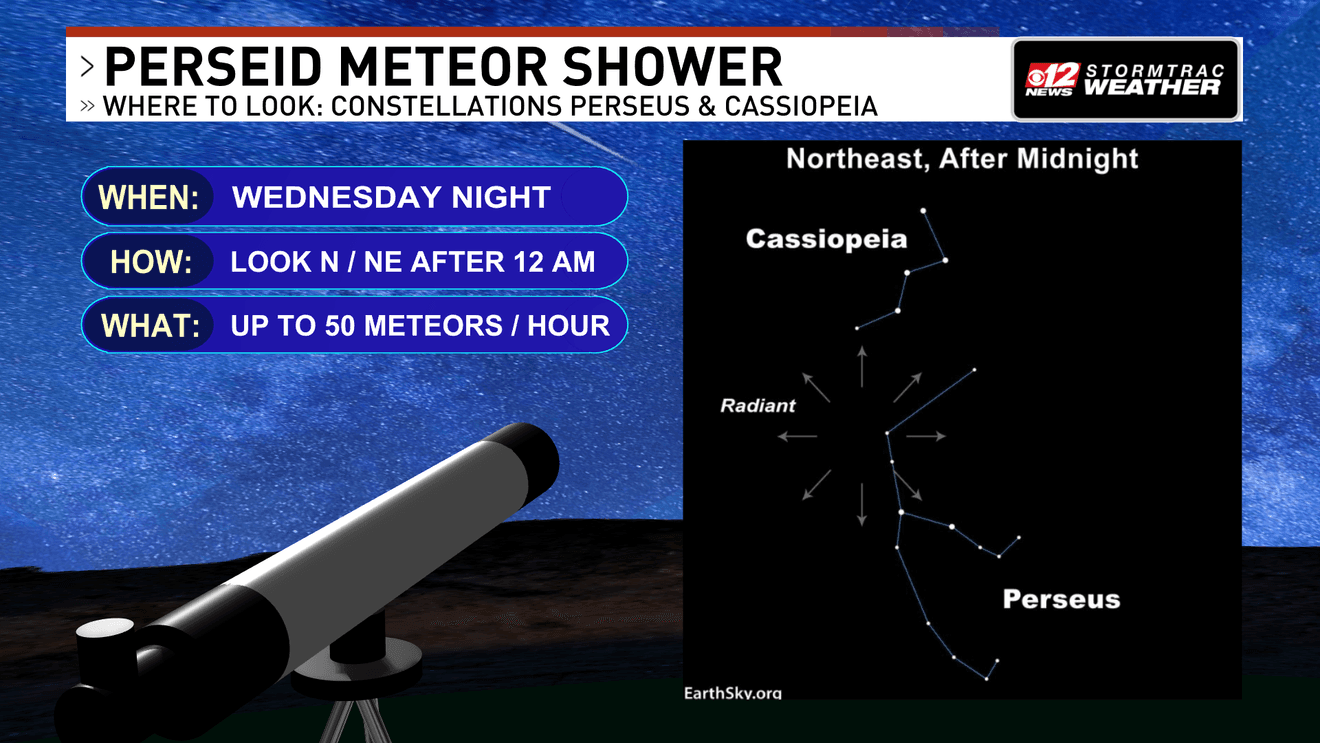
South Florida skywatchers could be in for a treat Wednesday night as one of the best meteor showers of the year reaches its peak.
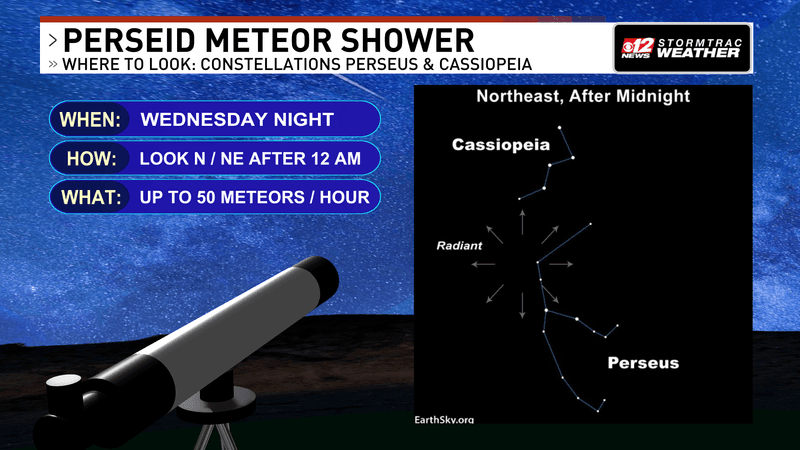
Perseid Meteor Shower.(WPEC)
The annual Perseid meteor shower will peak Wednesday night, August 12, into the early morning hours of Thursday, August 13. This year, Mother Nature is providing nearly ideal astronomical conditions because the peak coincides with a new moon, meaning there will be virtually no moonlight washing out the night sky.
For residents across Palm Beach County and the Treasure Coast, the biggest question will be whether our summertime clouds and thunderstorms cooperate.
What Are the Perseids?
The Perseid meteor shower occurs every summer when Earth passes through a stream of debris left behind by Comet 109P/Swift-Tuttle.
Tiny pieces of dust and rock enter Earth’s atmosphere at tremendous speeds and burn up, producing the bright streaks of light we commonly call “shooting stars.”
The Perseids are known for producing fast, bright meteors and occasional spectacular fireballs.
The American Meteor Society says the Perseids are active from July 17 through August 24, but activity reaches its maximum this week.
When Should You Look?
For South Florida, you can start looking for meteors once skies become dark Wednesday evening, but your chances will improve considerably after midnight and toward the predawn hours Thursday.
That’s because the constellation Perseus—the point in the sky from which the meteors appear to originate—climbs higher as the night progresses.
Under ideal, extremely dark conditions, the Perseids can produce activity approaching 100 meteors per hour at maximum. However, a more realistic rate from rural locations is often around 30 to 50 Perseid meteors per hour.
Don’t expect those numbers from downtown West Palm Beach, Boca Raton, Fort Lauderdale or other heavily populated areas. Light pollution will hide many of the fainter meteors.
New Moon Makes 2026 an Excellent Year
One thing we don’t have to worry about this year is the moon.
The Perseid peak coincides with the new moon on August 12, creating exceptionally dark skies for meteor watching.
That’s a major improvement compared with years when a bright moon is above the horizon and washes out many of the fainter meteors.
If the weather cooperates, 2026 could provide some of the best Perseid viewing conditions we’ve had in years.
Where Should You Look in South Florida?
You don’t need a telescope or binoculars. In fact, you’re better off without them.
Find the darkest and safest location you can, preferably away from streetlights, buildings and other sources of artificial light.
Once you’re outside, give your eyes about 20 to 30 minutes to adjust to the darkness. Put your phone away, because looking at a bright screen will make it harder for your eyes to see the fainter meteors.
Then simply look up.
Although the meteors appear to originate near the constellation Perseus in the northeastern sky, they can streak across any part of the sky. A wide, unobstructed view is much more important than staring in one particular direction.
A lawn chair or blanket can make the experience a lot more comfortable.
South Florida Weather Could Be the Wild Card
Of course, we live in South Florida in August.
Even with nearly perfect astronomical conditions, cloud cover will ultimately determine how much we can see.
Our typical summertime pattern can produce afternoon and evening thunderstorms, with leftover clouds sometimes lingering well into the night.
If skies clear behind the evening storms, however, there could be some good viewing opportunities—especially during the late-night and predawn hours.
Even partly cloudy conditions don’t necessarily ruin the show. If breaks develop in the clouds, brighter Perseids and occasional fireballs could still be visible.
You Don’t Have to Stay Up All Night
If staying awake until 2 or 3 a.m. isn’t an option, don’t worry.
You can still step outside Wednesday evening after skies become dark and potentially catch a few meteors. The numbers simply tend to increase as we get later into the night.
For the dedicated skywatchers, though, midnight through the predawn hours Thursday will provide the best opportunity.
And remember: meteor showers aren’t like fireworks. Meteors don’t arrive on a schedule. You may see several within a few minutes and then go through a quiet stretch.
Patience is part of the experience.