
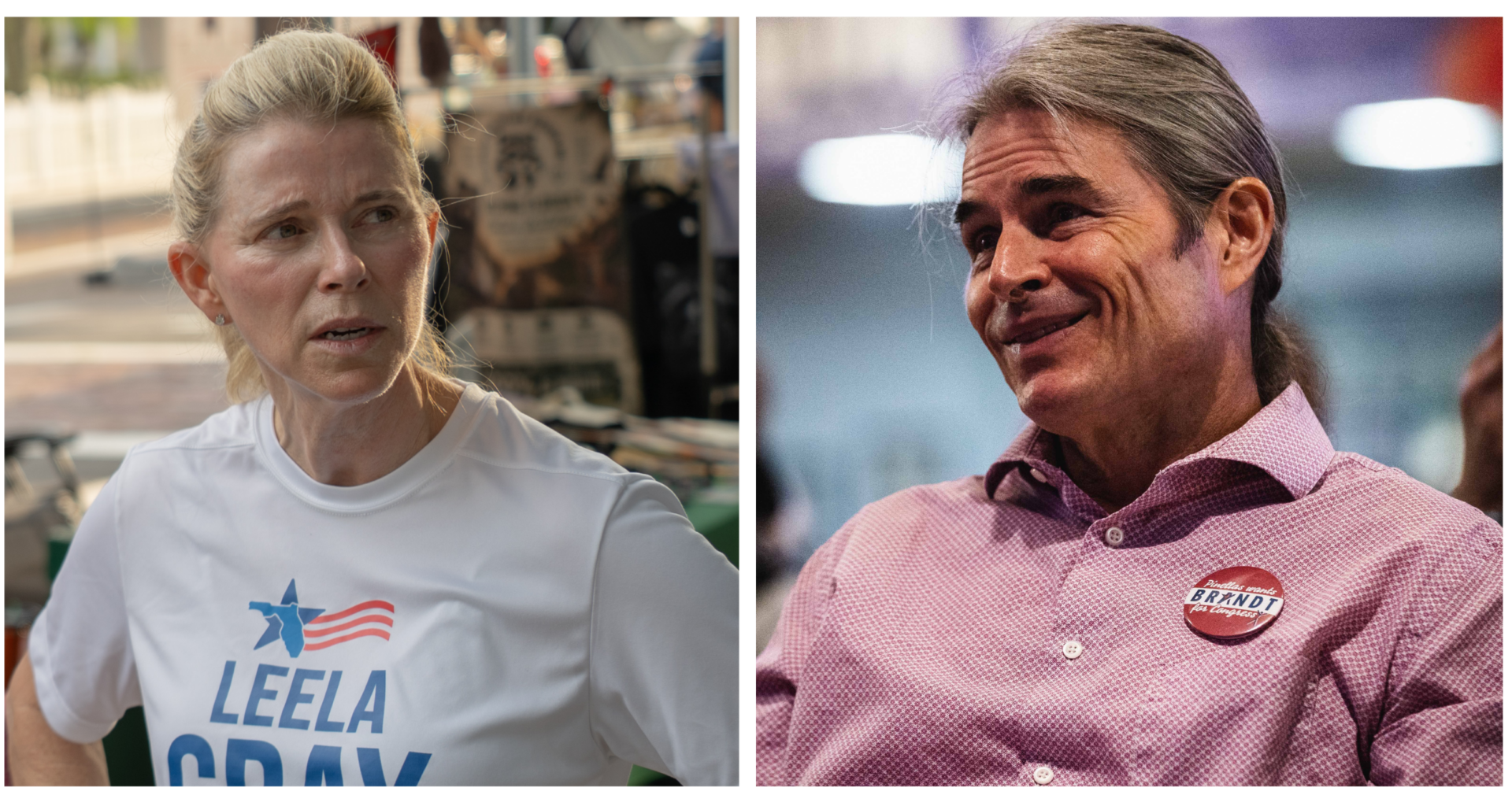
 Brig. Gen. Leela Gray (L) and Brandt Robinson Credit: Photos by Corey Richard Peterson and Dave Decker / Creative Loafing Tampa Bay
Republican incumbent Anna Paulina Luna and NPA candidate Tony D’Arrigo will soon learn which Democrat they’ll face in their race for congress.
Pinellas County Teacher Brandt Robinson, Brig. Gen. Leela Gray, and activist John Liccione are the final contenders to the Democratic primary for District 13 Congress in Pinellas County—which also covers a small portion of Pasco County.
Early voting in the primary is happening now and ends on Sunday, Aug. 16. Election Day is on Tuesday, Aug. 18.
The primary election winner will move on to November’s general election against Luna, who was first elected in 2022. D’Arrigo—a self-styled “former real Republican” and “Constitution purist”—is running as an NPA.
The redrawn district will no longer cover parts of southern Pinellas. Updated voting maps are available via the Pinellas County Supervisor of Elections.
Gray and Robinson spoke to CL about issues that need to be addressed. CL reached out to Liccione twice through email but did not hear back.
Affordability
Robinson and Gray told CL their platform’s primary focus came down to affordability for citizens in their district. According to Alice, a research institute that measures working people who earn more than the federal poverty line but still struggle to pay local living costs, Pinellas County citizens live 47% under its threshold.
Gray, 59, said the war in Iran and tariffs were a major contributor to the impact on the cost of living.
“We need to understand the drivers, and some of the drivers of this cost of living are not just on the housing front, but it’s also the Iran War,” Gray said. “It’s an illegal war that we’re in, and that has obviously a direct impact on gas and diesel and fertilizer. That is also going to impact our food supply. We need to get rid of tariffs.”
Gray also included that corruption in the healthcare industry has increasingly driven more monopolies and increased bureaucracy.
“I grew up in an era where my dad or mom took me to the dentist or to the doctor, and they paid cash right then and there for the doctor services, and I’m not suggesting we don’t need healthcare,” Gray said. “I’m suggesting that it’s overly bureaucratic, and that it’s monopolistic. And when you have monopolies, you don’t have competition. When you don’t have competition, you don’t have lower prices.”
Robinsons suggests an alternative that would relieve renters based on a person’s income.
“I would say, why can’t we have laws that will, for people who are either living below the poverty line or are struggling, the rent has to be capped at a certain percentage of a person’s income,” Robinson said. “I think that’s one of those pieces of legislation that would just be so reassuring to people because what you’re telling Americans is that we value housing and we understand how critical this is to the American dream.”
Robinson wants to reassure voters that along with affordability for renters, his platform also largely encompasses healthcare reform measures like universal healthcare and universal childcare.
National Defense Authorization Act
Typically, the NDAA is a bipartisan bill that routinely oversees the annual budget year for defense. Gray and Robinson see eye-to-eye on this issue. The bill passed on a thin margin of 216-212, citing criticisms by Democrats over partisan issues included in the bill like increasing the military budget to $1.15 trillion, strengthening ties between the U.S. and Israel and changing the name from Department of Defense to the Department of War—which is estimated to cost between $10 million and $125 million according to the Congressional Budget Office.
“Trump has been talking about expanding war, and yet here we have a piece of legislation that would simply continue to be complicit in another massive fabrication that the war in Iran actually represents,” Robinson said.
Gray was critical of how the bill was packaged alongside the cutting of federal programs like SNAP.
“We have some upside down priorities,” Gray said. “We shouldn’t be taking people off of SNAP that need it, and we’re talking about veterans, we’re talking senior citizens in some cases. I’m also very much against this ultra packaging, where instead of voting on each law by itself, they’ve just crammed all these things together. I think this entire run under Hegseth and Trump is really putting our national security at risk.”
Pitch in to help make the Tampa Bay Journalism Project a success.
Subscribe to Creative Loafing newsletters.
Follow us: Google News | NewsBreak | Reddit | Instagram | Facebook | BlueSky
This article appears in August 13 – 19, 2026.
Related