
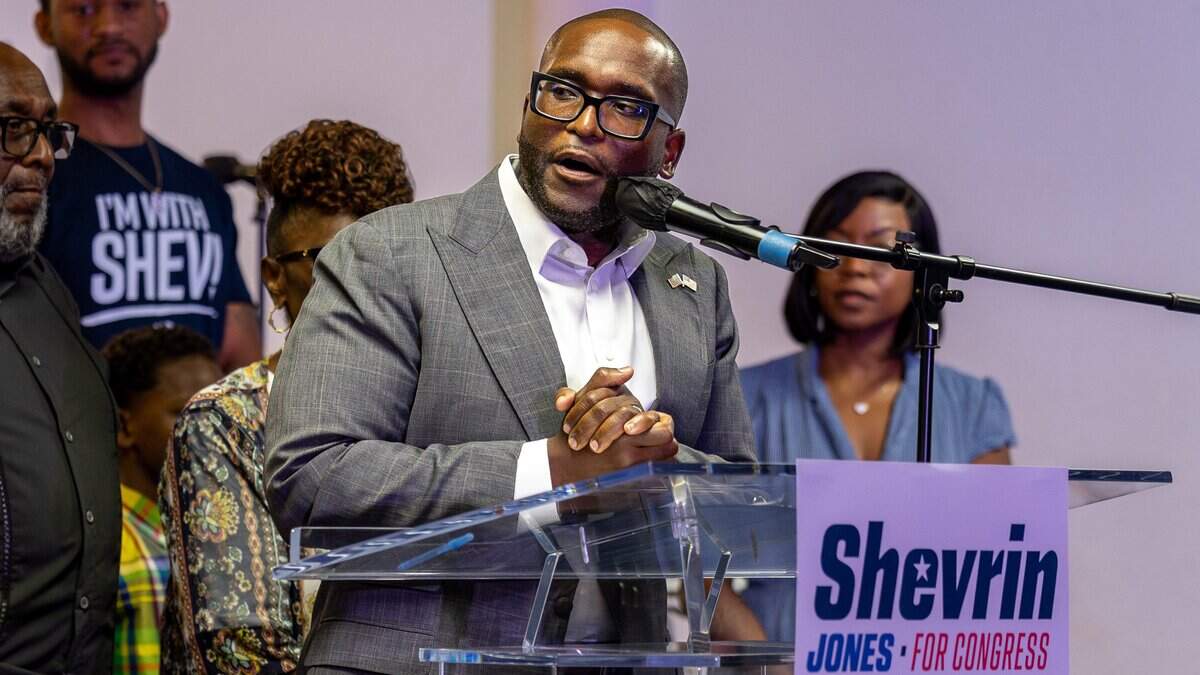
Shevrin Jones, former state senator, speaks during the announcement of his candidacy for Congress at Koinonia Worship Center in Hollywood on June 9, 2026.
Photo by Marra X. Finkelstein
mfinkelstein@miamiherald.com
If there was a hush-hush effort to undermine a well-known, openly gay Democrat in next Tuesday’s primary for a hotly contested Miami congressional seat, those efforts are now out in the open — in the most disturbing and shameful way.
Text messages sent to U.S. House District 24 voters use an old anti-gay trope: They falsely claim state Sen. Shevrin Jones has HIV, the Herald reported. Jones is one of seven Democrats running to replace U.S. Rep. Frederica Wilson, who’s retiring.
It’s unclear who sent the text messages. In a cowardly move, the messages falsely claim to come from Equality Florida, an LGBTQ+ advocacy group that endorsed Jones. They are written to appear as an appeal for sympathy for Jones on the false premise that he was turned away from donating blood to a COVID survivor because he is gay and HIV positive, the Herald reported.
Jones is gay; he does not have HIV. The texts did not come from Equality Florida. The organization said in a statement that this is an “attempt by a shady, dark money group supporting one of Shev’s opponents that trafficks in ugly tropes, misrepresents a trusted statewide organization, and weaponizes a Black man’s identity.”
In this crowded Democratic primary, mudslinging and nasty political attacks were probably bound to happen. But a fabricated story that exploits a candidate’s sexuality is a terrible low that’s been tested before. In 2022, Jones was the focus of a similar smear tactic after the Herald reported that he had been turned away from donating plasma because of a federal policy restricting donations from gay and bisexual men.
This latest attack is clearly meant to awaken anti-gay prejudice, perhaps among older, religious Democrats. And it evokes an old stigma HIV patients faced in the early days of the AIDS epidemic in the 1980s and 1990s, when misinformation about how the virus was spread made people fear those patients.
Jones came out as gay when he was a Florida House representative in 2018, after being married to, and divorcing, a woman. He told the Herald at the time, he struggled to come out while growing up in a Black conservative community where his father was a pastor — the same community he now wants to represent in District 24.
“I was a married man. My parents were conservative. My parents raised my brothers and me to be truthful and be honest. I knew I was gay back in kindergarten. I knew it,” Jones told the Herald in 2018.
Besides Jones, there is another openly gay candidate running for this seat, Kendrick Meek, Jr. It should go without saying that their sexuality has nothing to do with their ability to serve. The Herald Editorial Board endorsed Jones in the Aug. 18 primary.
Jones and Meek were the target of another text message this week that also appeared to try to mislead voters by giving the impression it came from Equality Florida, Florida Politics reported. The alleged sender was listed as “Equity Florida,” which looks like a bungling of the organization’s name. The message told voters, “Shevrin Jones and Kendrick Meek, both openly gay, are battling to replace Wilson in Congress,” according to Florida Politics.
The underhandedness of these messages — they sound pro LGBTQ+ and pretend to support the candidates — is particularly troubling. Even worse is that their real senders are unknown. Even taking into account Miami’s dirty politics standards, this is too deep in the mud.
BEHIND THE STORY MORE What’s an editorial?
Editorials are opinion pieces that reflect the views of the Miami Herald Editorial Board, a group of opinion journalists that operates separately from the Miami Herald newsroom. Miami Herald Editorial Board members are: opinion editor Amy Driscoll and editorial writers Isadora Rangel and Mary Anna Mancuso. Read more by clicking the arrow in the upper right.
What’s the difference between an op-ed and a column?
Op-Eds, short for “opposite the editorial page,” are opinion pieces written by contributors who are not affiliated with our Editorial Board.
Columns are recurring opinion pieces that represent the views of staff columnists that regularly appear on the op-ed page.
How does the Miami Herald Editorial Board decide what to write about?
The Editorial Board, made up of experienced opinion journalists, primarily addresses local and state issues that affect South Florida residents. Each board member has an area of focus, such as education, COVID or local government policy. Board members meet daily and bring up an array of topics for discussion. Once a topic is fully discussed, board members will further report the issue, interviewing stakeholders and others involved and affected, so that the board can present the most informed opinion possible. We strive to provide our community with thought leadership that advocates for policies and priorities that strengthen our communities. Our editorials promote social justice, fairness in economic, educational and social opportunities and an end to systemic racism and inequality. The Editorial Board is separate from the reporters and editors of the Miami Herald newsroom.
How can I contribute to the Miami Herald Opinion section?
The Editorial Board accepts op-ed submissions of 650-700 words from community members who want to argue a specific viewpoint or idea that is relevant to our area. You can email an op-ed submission to oped@miamiherald.com. We also accept 150-word letters to the editor from readers who want to offer their points of view on current issues. For more information on how to submit a letter, go here.