
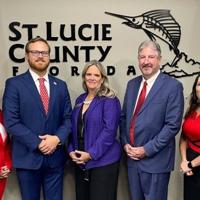
FORT PIERCE – In an effort to try and improve its chances at renewing the half-cent infrastructure surtax before it sunsets at the end of 2028, the St. Lucie County Commission majority voted to schedule it early for this November’s mid-term election despite protests from some commissioners fearing it will fail due to the inclusion of Amendment 3 on the same ballot.
County Administrator George Landry teed up the latest conversation due to comments he’d received in the interim since the Commission tabled the item July 21 and a previous workshop in which most of the Board expressed a preference to wait until 2028 to improve the amendment’s chances at passage.
“I’ve received a few emails and read some stuff online, and I think there was some confusion at the last meeting,” he said. “I think it got lost in translation out in the public about whether we were postponing it or if the Board was in support of it. I wanted to use this time to clear the air that I’ve heard nothing but support for the half-cent sales tax from all five of you up there.”
That confusion stemmed from the fact that the Commission had initially taken up the discussion during a workshop prior to the mid-July meeting, during which most commissioners expressed a preference for waiting until 2028. Because Vice-Chairman Larry Leet was subsequently absent on July 21 and Chairwoman Jamie Fowler had changed her mind since the workshop and now preferred two bites at the apple, the Board was equally divided 2-2 that day on running the amendment this year.
Commissioners James Clasby and Erin Lowry still wanted to wait two years, hence the decision to postpone the decision until the latest meeting.
District 5 Commissioner Cathy Townsend was the first to offer her viewpoint, alluding to the fact that, if the amendment fails this year, it would have to be reworded in 2028 as a new tax altogether.
“I’ll just start by saying I think two chances are better than one,” she said. “I’ve not changed my opinion. I feel that if we put it out there for 26 and it doesn’t pass, we have another opportunity. Changing the language is not that big of a deal – that’s how we got it through the first time. We put it out there, we solved some wording mistakes, came back, restructured it and it passed a second time. So, [let’s] put it out there and do as much education as we can leading up to it. Then if it doesn’t pass, we know we have time for whatever has to be changed.”
Commissioner Erin Lowry, however, still disagreed.
“I’d prefer to see it on the 2028 ballot for a number of reasons,” she said. “It’s not really going to be a second chance because it’s going to be seen, like George mentioned, as a new consumption tax. In the past, we haven’t had the real estate amendment on there with the Homestead Exemption, so I think it’s very different. So, my vote will be for 2028.”
Commissioner James Clasby echoed that sentiment.
“This discussion today is if we want to move it to the 28 ballot, which I think is exactly what we discussed in our informal meeting,” he said. “There’s certain other entities – apparently from what I’ve learned – that would like to bond out money early. That’s really not the issue here: We’re talking about which one would it more likely to be passed on. I’m not interested in running in twice if it failed once. So, that will be another discussion that we have in 28 if it does fail.”
Clasby then enumerated the reasoning for his continued opposition to running it this year.
“It’s going to confuse the voters [and] maybe even make people not like it,” he continued. “Since the previous meeting, everybody basically said yeah, I’ve going to vote against it because I want to cut taxes because they’re just foaming at the mouth with Amendment 3. I think it’s very important that we keep it in the direction that we discussed at the informal meeting of moving it to the 28 ballot where it has the most chance of success.”
Vice-Chairman Leet – like Chairwoman Fowler had on July 21 – now admitted he’d also changed his mind since the workshop discussion, making him the swing voter.
“I was on the side of the 2028 ballot because I was informed that we could only do it once,” he explained. “Then I found out we can change the wording. I do agree with Commissioner Clasby and think that it’s not going to pass on this particular ballot. That being said, we have four years to educate the public to realize what this potential loss is, if it doesn’t pass. So, I am on the side of running it twice.”
Chairwoman Fowler then reiterated her thoughts from the previous two meetings.
“When we had that informal, it wasn’t clear to me that you could essentially get two bites at the apple,” she recalled. “I don’t know how the voters are going to vote. For every person that says they’re voting for Amendment 3, I have people that say they’re not. I don’t have great luck, so if we have the opportunity to get two bites to do it, then that is the side I’m on.”
Commissioner Clasby made a final plea to his colleagues before Commissioner Townsend made a motion to place the amendment on the 2026 ballot.
“I just wanted the Board to also keep in mind that if you want the School Board tax to pass, having this on there as well doesn’t help it,” he said.
Vice-Chairman Leet then seconded Townsend’s aforementioned motion, which passed 3-2, with Commissioners Clasby and Lowry dissenting.
Since the original surtax amendment passed in 2018, St. Lucie County has completed and paid for some 53 infrastructure projects, with an additional 37 projects underway or planned.