
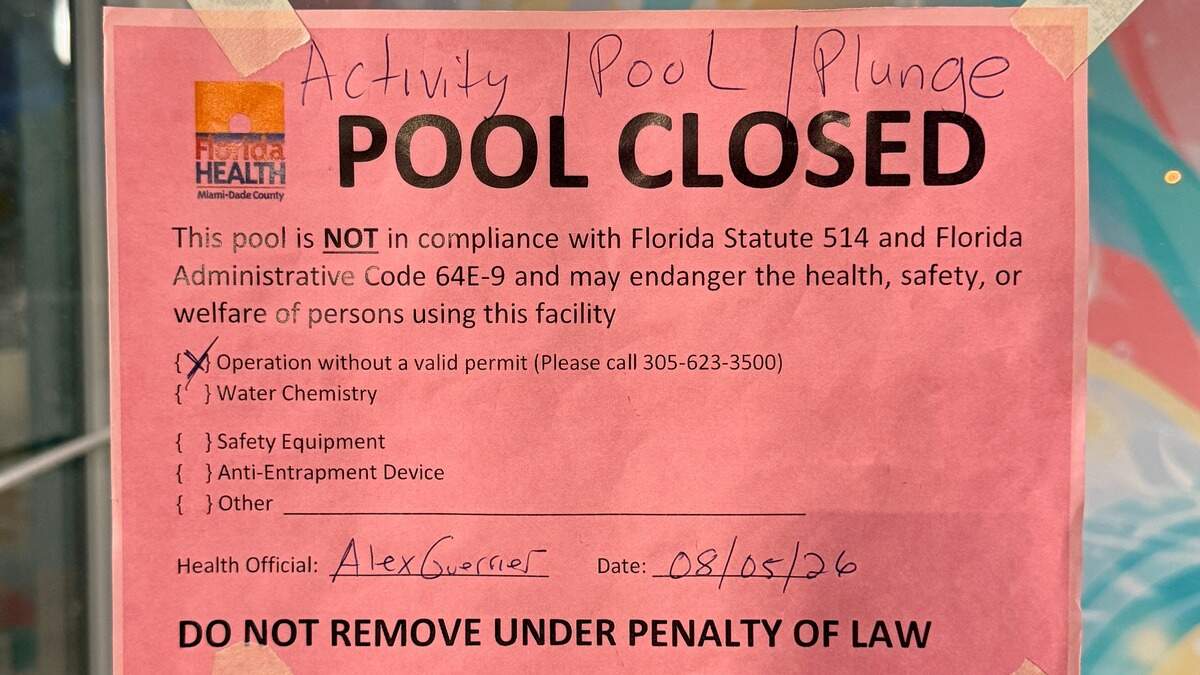
A Florida Department of Health closure notice posted at Bucky Dent Water Park after the agency ordered the Hialeah pool closed on Aug. 5.
Courtesy
Community pools can be important in Florida, especially during a hot Miami summer like this one. Residents of Hialeah waited seven long years for Bucky Dent Water Park to reopen — but it lasted only five days.
After less than a week of operation, the Florida Department of Health shut the pool down after inspectors found 34 violations, and they weren’t minor. Inspectors found broken safety equipment, a drain cover missing screws — posing an entrapment risk — and problems with pumps and filtration systems, the Miami Herald reported. Critically, the facility had opened without the required state permit, too.
After Bucky Dent was closed, the city shut down three other public pools as well to evaluate whether any corrective measures are needed there. Now, every public pool in Hialeah is closed.
When the state health inspector raised safety questions about Bucky Dent, Hialeah Mayor Bryan Calvo decided all the pools needed to be checked. “We need to exercise due caution,” he told the Miami Herald Editorial Board.
Closing all of the city’s pools during the hottest part of the year must be seriously frustrating to residents, but Calvo had no choice. The city has a serious responsibility to ensure those who use the pool, including seniors and children, can swim without risk.
“I have to be prudent, and I have to take drastic actions and close everything down until we can really see what’s going on,” Calvo said. “Because I don’t want to put anybody’s life in danger.”
All of this started on Tuesday when an 80-year-old swimmer became unresponsive and had to be rescued from one of Bucky Dent’s pools. The rescue resulted in two complaints filed to the state Department of Health, followed by an inspection and the closure.
Calvo, who has been mayor for seven months, said he wants an independent pool expert to inspect each facility before they reopen.
He wants somebody “from the outside [to] give us a thorough analysis of everything that’s going on and figure out what the conditions are,” he said. “If there’s anything that we need to fix, absolutely we should fix it. We should do it as soon as possible.”
The shutdown was right, but it raises a harder question: How did this happen? Hialeah residents deserve to know why Bucky Dent reopened without a valid operating permit and despite the problems later found by inspectors. Residents also deserve clear answers about the condition of the city’s other pools.
This isn’t just about pools, either. It’s also about trust in city government.
Calvo told the Board that the city’s pools have had years of deferred maintenance. Maybe so, but that doesn’t explain how the city could go from ribbon-cutting to state closure in a matter of days. And what happened to the money that was supposed to be used for maintenance? At least $2 million has been budgeted for aquatic projects and pool-related work since 2022, the Herald reported. Calvo says that money was appropriated but wasn’t spent.
He now estimates repairs will start at $5 million and go up from there.
“The city needs much more than $5 million,” Calvo said, noting three pools — Bright Pool, Walker Pool and Reed Pool — have been closed for more than seven years and could cost at least $2 million each to reopen. Bucky Dent’s independent evaluation will most likely cost more.
For Hialeah, Miami-Dade’s second-largest city, that will add up to a hefty price tag. If additional money is needed to make pools safe, taxpayers should be willing to listen. But they also deserve to know how the city’s pools got into such a dangerous mess to begin with.
Calvo says the city’s parks department is working to reopen the pools; he hopes that will happen in a few weeks. So do we. Residents shouldn’t lose access to their community pool longer than necessary.
But there can be no shortcuts when it comes to safety in Hialeah’s community pools. The city should fix the pools, inspect them independently and explain in clear terms what went wrong. Then reopen them — when Hialeah residents know the pools are safe.
BEHIND THE STORY MORE What’s an editorial?
Editorials are opinion pieces that reflect the views of the Miami Herald Editorial Board, a group of opinion journalists that operates separately from the Miami Herald newsroom. Miami Herald Editorial Board members are: opinion editor Amy Driscoll and editorial writers Isadora Rangel and Mary Anna Mancuso. Read more by clicking the arrow in the upper right.
What’s the difference between an op-ed and a column?
Op-Eds, short for “opposite the editorial page,” are opinion pieces written by contributors who are not affiliated with our Editorial Board.
Columns are recurring opinion pieces that represent the views of staff columnists that regularly appear on the op-ed page.
How does the Miami Herald Editorial Board decide what to write about?
The Editorial Board, made up of experienced opinion journalists, primarily addresses local and state issues that affect South Florida residents. Each board member has an area of focus, such as education, COVID or local government policy. Board members meet daily and bring up an array of topics for discussion. Once a topic is fully discussed, board members will further report the issue, interviewing stakeholders and others involved and affected, so that the board can present the most informed opinion possible. We strive to provide our community with thought leadership that advocates for policies and priorities that strengthen our communities. Our editorials promote social justice, fairness in economic, educational and social opportunities and an end to systemic racism and inequality. The Editorial Board is separate from the reporters and editors of the Miami Herald newsroom.
How can I contribute to the Miami Herald Opinion section?
The Editorial Board accepts op-ed submissions of 650-700 words from community members who want to argue a specific viewpoint or idea that is relevant to our area. You can email an op-ed submission to oped@miamiherald.com. We also accept 150-word letters to the editor from readers who want to offer their points of view on current issues. For more information on how to submit a letter, go here.