
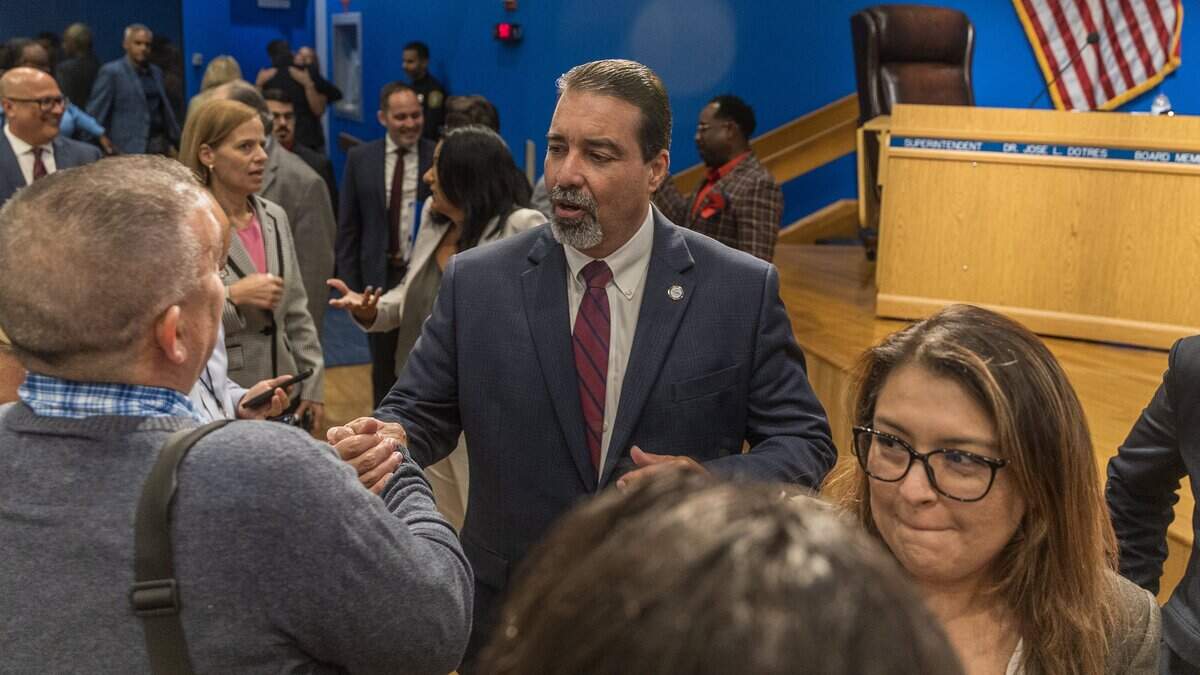
Attendees greeted Rafael Villalobos after he was selected as the new Miami-Dade County Public School superintendent during a special meeting to replace Superintendent Jose Dotres in Miami, on July 29, 2026.
Pedro Portal
pportal@miamiherald.com
When Miami-Dade County’s new school superintendent, Rafael Villalobos, officially begins his job running the third-largest school district in the nation later this school year, he’ll face a huge challenge right away: school closures.
They’ll be far from his only priority, of course. A host of other important issues will be vying for his attention, such as increasing teacher pay and retention, the use and teaching of AI in schools, testing, book challenges, changes to the free breakfast and lunch programs and the “parental choice” movement.
But consolidation and closure of schools is front and center because it’s happening right now. So far, nine schools were closed or consolidated over the summer under retiring Superintendent Jose Dotres as the district tries to manage steep enrollment declines and resulting financial pressures. Students in Miami-Dade returned to classrooms Aug. 13, some to different schools. More closures are almost certainly coming because many schools are still operating way under capacity.
Closing schools is no easy matter. It’s hard on students, difficult for parents and tough on teachers and staff. Closures are also a marked change for a district accustomed to growing and building new schools. “We couldn’t do it fast enough,” Villalobos said in a recent interview with the Herald, noting that “now we’re in a different environment” in Miami-Dade County.
Seven of the nine closed or consolidated institutions had majority-Black populations — even though Black students make up only about 20% of enrollment in district-run schools. That raises a concern about fairness. Adding to that concern: 22 of the 30 schools with the lowest rates of use are located in Black communities, meaning they could be at the top of the list to be closed.
And then there’s the big question. How many more schools will need to close in Miami-Dade? This is not just a Miami-Dade problem, either. In Broward County, the school board closed six schools so far with another 10 under consideration.
Complicating matters, under Florida’s expanded “Schools of Hope” law, districts have to make underused and ”persistently low-performing” schools available for potential use by approved charter operators, often at a low cost. That may be a practical idea, but it also raises questions about whether public schools are being hollowed out in favor of charter schools.
Closing schools, if that is truly what’s needed, must be done in an even-handed way — and that means making sure the schools with the least resources aren’t the ones most likely to be targeted. As Lissette Fernandez, co-founder of Moms for Libros, said in a recent USA Today story about the closures over the summer, “These schools serve some of the highest-poverty communities in Miami-Dade. The state has underfunded public schools to the point where this district is closing the schools that serve children who have the least.”
Enrollment in traditional public schools has been sliding in South Florida, including during the 2025-2026 school year when the district experienced a drop in enrollment of about 13,000 students. A combination of factors are being blamed, including more children attending charter schools, a lower birth rate, people leaving town for cheaper locales and fewer immigrants.
Whatever the reason or reasons, the bottom line is that fewer students means less taxpayer money for schools and an increase in pressure to close schools that aren’t well-used.
Villalobos will start his job as the district grapples with what’s to come. He’s a veteran of Miami-Dade schools, the current South Region superintendent and was chosen unanimously after a search that lasted about three months. Critics see him as the safe choice, someone likely to maintain the status quo.
But he was also principal of the year in 2020 when he ran John A. Ferguson High School with a 99% graduation rate, and he was the first principal to lead two high schools at the same time — Booker T. Washington Senior High and Law Enforcement Officers’ Memorial High in 2009 and 2010.
That shows resourcefulness and discipline, qualities that Miami-Dade schools will be sorely in need of as we face a new educational system and try to decide what will serve us best.
BEHIND THE STORY MORE What’s an editorial?
Editorials are opinion pieces that reflect the views of the Miami Herald Editorial Board, a group of opinion journalists that operates separately from the Miami Herald newsroom. Miami Herald Editorial Board members are: opinion editor Amy Driscoll and editorial writers Isadora Rangel and Mary Anna Mancuso. Read more by clicking the arrow in the upper right.
What’s the difference between an op-ed and a column?
Op-Eds, short for “opposite the editorial page,” are opinion pieces written by contributors who are not affiliated with our Editorial Board.
Columns are recurring opinion pieces that represent the views of staff columnists that regularly appear on the op-ed page.
How does the Miami Herald Editorial Board decide what to write about?
The Editorial Board, made up of experienced opinion journalists, primarily addresses local and state issues that affect South Florida residents. Each board member has an area of focus, such as education, COVID or local government policy. Board members meet daily and bring up an array of topics for discussion. Once a topic is fully discussed, board members will further report the issue, interviewing stakeholders and others involved and affected, so that the board can present the most informed opinion possible. We strive to provide our community with thought leadership that advocates for policies and priorities that strengthen our communities. Our editorials promote social justice, fairness in economic, educational and social opportunities and an end to systemic racism and inequality. The Editorial Board is separate from the reporters and editors of the Miami Herald newsroom.
How can I contribute to the Miami Herald Opinion section?
The Editorial Board accepts op-ed submissions of 650-700 words from community members who want to argue a specific viewpoint or idea that is relevant to our area. You can email an op-ed submission to oped@miamiherald.com. We also accept 150-word letters to the editor from readers who want to offer their points of view on current issues. For more information on how to submit a letter, go here.