
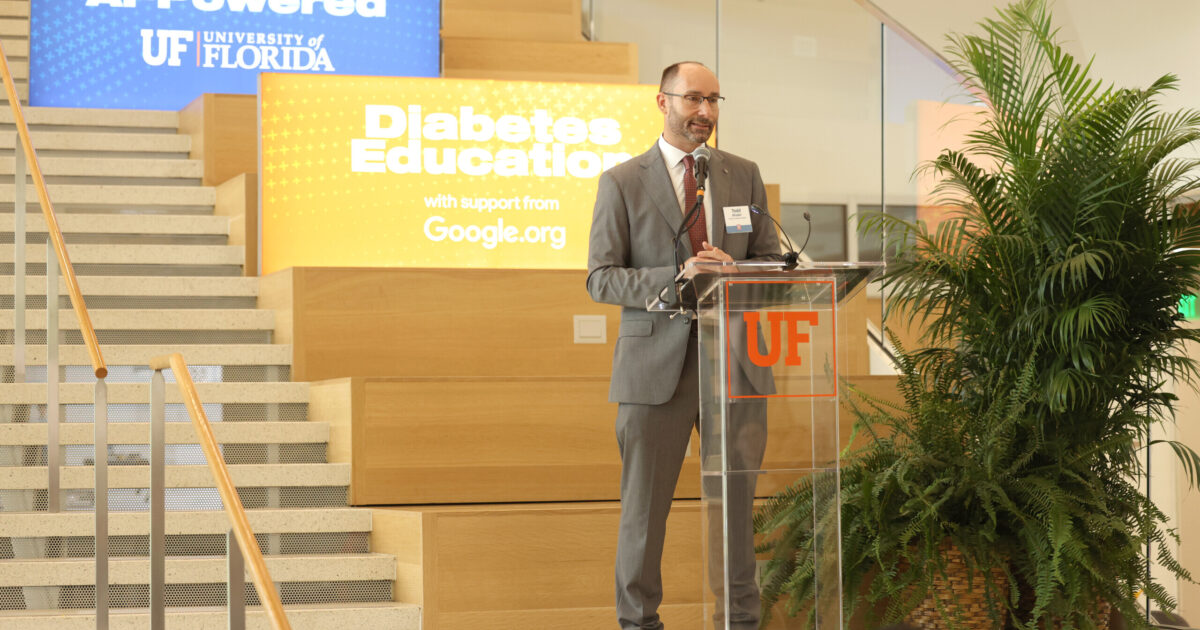
UF Diabetes Institute Director Todd Brusko, Ph.D., speaks at Thursday’s event announcing funding from Google.org to boost diabetes care in Florida. (University of Florida photo/Tim Casey)
GAINESVILLE, Fla.
— With funding from Google.org, Google’s philanthropic arm, the University of Florida Diabetes Institute is using artificial intelligence to improve diabetes detection, expand primary care provider training and strengthen care for the millions of Floridians living with diabetes or those at risk of developing the disease.
More than 11% of Americans have diabetes and another 28% have prediabetes, according to the American Institutes for Research. Diabetes, a chronic disease that affects how the body processes glucose, or blood sugar. It can wreak havoc on the heart, kidneys, eyes, nerves and other organs if not properly managed.
Given its rapid growth in the U.S. and a national scarcity of adult endocrinologists, more than 90% of diabetes care is delivered in primary care settings. But limited access to diabetes specialists and insufficient training for general practitioners often results in patients being misdiagnosed or underdiagnosed, a problem the UF Diabetes Institute has worked to address by training physicians from more than 120 clinical sites across the state.
The funding will allow the institute’s Project Extension for Community Healthcare Outcomes Diabetes, or ECHO, initiative, to expand. It works to address gaps in diabetes care through physician training and patient screening in rural and underserved areas.
“At Google, we believe that information is a determinant of health, and access to the right clinical guidance at the right time can transform lives,” said Garth Graham, M.D., M.P.H., global head of healthcare and public health at Google and YouTube, and former assistant dean for health policy at the UF College of Medicine’s Department of Medicine. “We are deeply proud to support the University of Florida as they pioneer new ways to scale clinical expert guidance using technology.
“This work is so important as healthcare is deeply personal, and by helping local doctors deliver more practical care on the ground, we can ensure that families all across Florida, no matter their ZIP code, have a fair shot at a health future.”
Ashby Walker, Ph.D., an associate professor in the UF College of Public Health and Health Professions and Diabetes Institute associate director of community and population health, and Michael Haller, M.D., a pediatric endocrinologist and Diabetes Institute associate director of medicine, will lead the project.
This support will allow researchers to create an AI-powered virtual assistant that provides primary care clinicians with guidance for diagnosing and managing diabetes. Additionally, the institute will expand the program to clinical sites throughout Florida.
“The Google.org funding and transformative program have the capacity to educate healthcare professionals and improve the lives of those living with diabetes today,” said Todd Brusko, Ph.D., UF Diabetes Institute director. “Amplifying the results of our original program success can have far-reaching benefits to other serious conditions such as heart disease, stroke risk and neuropathy, with the potential to improve outcomes for millions of patients across the state, the nation and the world.”
AI-assisted module topics will range from continuous glucose monitoring to nutritional guidance. ECHO’s diabetes support coaches will provide mentoring to patients through enhanced access to “food as medicine” resources designed to reduce diet-related stress and food insecurity. The program can be scaled and adopted by other institutions.
“The University of Florida’s Project ECHO Diabetes is not only leading the discussion on how to leverage AI within rural Florida communities but also empowers healthcare providers to deliver routine specialty care to those in need. Thank you to Google.org for their generous support of Project ECHO Diabetes. This grant will help integrate AI technology to address disparities in healthcare access, food security, identify geographic hotspots in Florida, and allow for much-needed training of additional primary care physicians for real-time support of patients,” said Florida House Speaker-designate Sam Garrison (R-Fleming Island). “This is an exciting development and innovative approach to expanding access to care for adults and children living with Type 1 and Type 2 diabetes here in Florida.”
Google.org’s funding also will support the development of AI-assisted tools to identify patients at risk for diabetes or those who have been incorrectly diagnosed.