
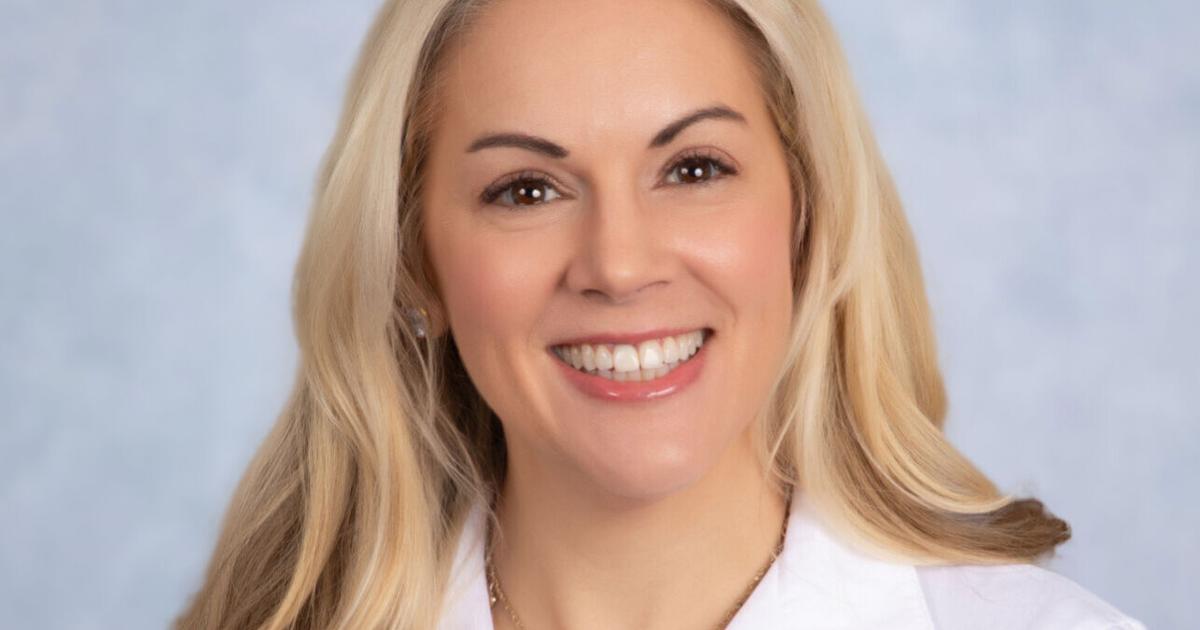
As a little girl growing up in Madison Heights, Virginia, Mary Carolyn Vinson didn’t dream of becoming a princess, an astronaut or a teacher.
She wanted to be a doctor.
“I can vaguely remember walking into the kitchen one day and telling my parents, ‘I know what I want to be. I want to be a doctor,’” Vinson recalled. “I never really mentioned it again because that was just the path I was going to take.”
Life, however, took her on a few unexpected detours before she ultimately fulfilled that childhood dream.
Today, Dr. Mary Carolyn Vinson is leading one of the most innovative specialties in medicine as a thoracic surgeon with Tampa General Hospital Crystal River. Her work establishing a robotic thoracic surgery program in Citrus County earned her the Citrus County Chronicle’s Healthcare Heroes Innovation in Healthcare Award.
For Dr. Vinson, the recognition came completely out of the blue.
“I had no idea,” she said. “I actually thought the award was for our nurse practitioner. It was completely unexpected.”
The honor carries special meaning because it recognizes years of work building a program from the ground up.
“I’ve put my heart and soul into building this program and bringing new things to this community,” she said. “It’s really nice to be recognized. You see the fruits of your labor, and patients are appreciative.”
Dr. Vinson’s journey began in the Blue Ridge Mountains of Virginia, where she attended high school before enrolling at Bluefield College, a small private Baptist institution.
She initially pursued a career in research, earning a master’s degree in microbiology at Louisiana State University while beginning work toward a doctorate.
The science fascinated her.
“I was doing very well,” Dr. Vinson said. “One of my professors was encouraging me toward a Ph.D., but I realized, ‘This isn’t what I wanted to do.’ Finding a cure for cancer is wonderful.”
It was her future husband, Mark, who encouraged her to revisit the dream she had quietly carried since childhood.
“He asked me, ‘Whatever happened to those medical school dreams?’” she said.
At the time, medical school admissions were fiercely competitive, and despite solid grades, she had fallen short on her first attempt. Encouraged by her husband and friends who had enrolled in osteopathic medical schools, she decided to take the Medical College Admission Test again and apply.
She submitted applications to four schools and was accepted by three.
One stood out immediately.
The Edward Via College of Osteopathic Medicine, affiliated with Virginia Tech, was opening its doors for the very first time.
Dr. Vinson became a member of the school’s inaugural class.
“It was really fun,” she said. “It was kind of cool to be part of a brand-new medical school. The curriculum was changing constantly as they figured out what worked best. We started every student organization because none of them existed.”
Graduating in 2007 with the school’s first class remains one of the defining experiences of her career.
“I knew Virginia Tech wasn’t going to attach its name to something unless it was going to be excellent,” she said. “I got a great education.”
After medical school, Dr. Vinson’s path once again required sacrifice.
Her husband, Mark, had accepted a position with the Tampa Bay Rays, who he still works with today, serving as a medical coordinator.
While he remained in Florida, Dr. Vinson entered a general surgery residency in West Virginia.
“We had a long-distance marriage for five years,” she said. “It wasn’t fun, but we made it through.”
Following residency, she completed a thoracic surgery fellowship under renowned surgeon Dr. Eric Sommers, where she discovered a technology that would redefine her career.
“When I finished my fellowship, robotics really wasn’t something many thoracic surgeons had been trained in,” Dr. Vinson said. “I thought, ‘This is what I want to do.’”
She became part of a new generation of surgeons embracing minimally invasive robotic procedures that dramatically reduce pain, shorten hospital stays and speed recovery for patients undergoing lung and chest surgery.
“Robotics has changed thoracic surgery so much,” she said. “Years ago, most operations were done through large incisions. Now we’re able to do things that simply weren’t possible.”
The field has evolved so rapidly that thoracic surgery has transformed from a specialty many young physicians avoided into one of medicine’s most competitive fellowships.
“Everything has changed,” Dr. Vinson said.
The timing proved significant.
Advances in robotic surgery have coincided with revolutionary improvements in lung cancer screening, diagnosis and treatment.
“Lung cancer is still the No. 1 cancer killer,” she said. “But we’re finally moving the needle.”
For decades, lung cancer was often discovered only after symptoms appeared, when treatment options were limited.
“People thought it was a death sentence,” Dr. Vinson said.
Today, low-dose CT screening identifies cancers much earlier, while robotic bronchoscopy allows physicians to biopsy tiny lung nodules with remarkable precision.
“None of that existed years ago,” she said. “We didn’t have these tools.”
And the next wave of innovation is already on the horizon.
“Eventually, instead of removing part of a lung, we may be injecting chemotherapy directly into a small tumor or freezing it,” Dr. Vinson said. “Those are the next innovations for treating early lung cancer.”
Following years practicing in the Tampa Bay area, the COVID-19 pandemic prompted Dr. Vinson and her family to reevaluate their future.
Like countless healthcare workers, she experienced the emotional exhaustion of treating critically ill patients during the pandemic.
Her husband also spent time working inside Major League Baseball’s COVID “bubble.”
“We were getting burned out,” she said.
The family considered returning to Virginia to be closer to relatives.
Instead, an unexpected opportunity emerged.
When a local thoracic surgery program closed, one of Vinson’s mentors suggested launching a new program through Tampa General Hospital Crystal River.
“It was a great idea,” she said.
She joined the hospital in September 2024, bringing advanced robotic thoracic surgery to a community that previously had limited access to the specialty.
The move also felt personally right.
“This area reminds me so much of where I grew up,” she said. “Horse country, smaller towns – it feels like home.”
Away from the operating room, Dr. Vinson enjoys a quieter pace of life with her husband and their 3 1/2-year-old son.
The family is deeply involved at Seven Rivers Presbyterian Church, participating in a church life group while spending weekends swimming, visiting ZooTampa, attending the occasional Rays game and making frequent trips to Walt Disney World.
Her son has little interest in roller coasters.
“He’s all about the animals,” Dr. Vinson said with a laugh. “Animal Kingdom is his favorite. He loves Epcot because he’s very science-oriented.”
Watching her son discover the world reminds Dr. Vinson of the curiosity that first led her toward medicine.
Nearly four decades after declaring her career plans in her parents’ kitchen, she remains driven by the same desire to help others.
Receiving the Chronicle’s Innovation in Healthcare Award is gratifying, she said, but the greatest reward comes from seeing patients benefit from technologies that did not exist when she began medical school.
“It’s exciting to be part of bringing those advances here,” Dr. Vinson said. “Patients in this community deserve access to the same innovative care they would receive anywhere else.”
For Dr. Vinson, innovation has never been about technology alone.
It is about giving patients hope through earlier diagnoses, less invasive procedures and better outcomes.
And that, she believes, is the future of healthcare.