
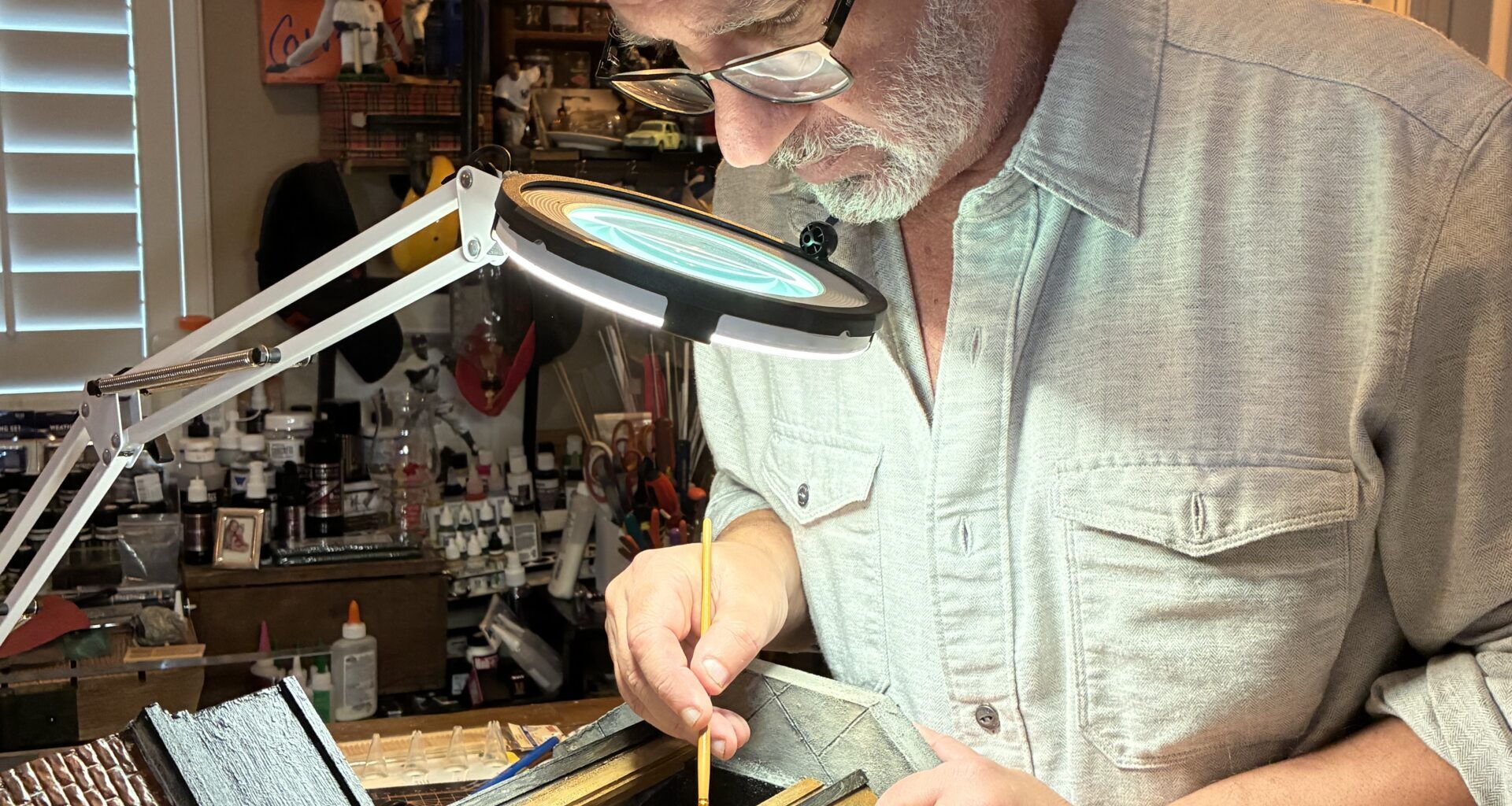
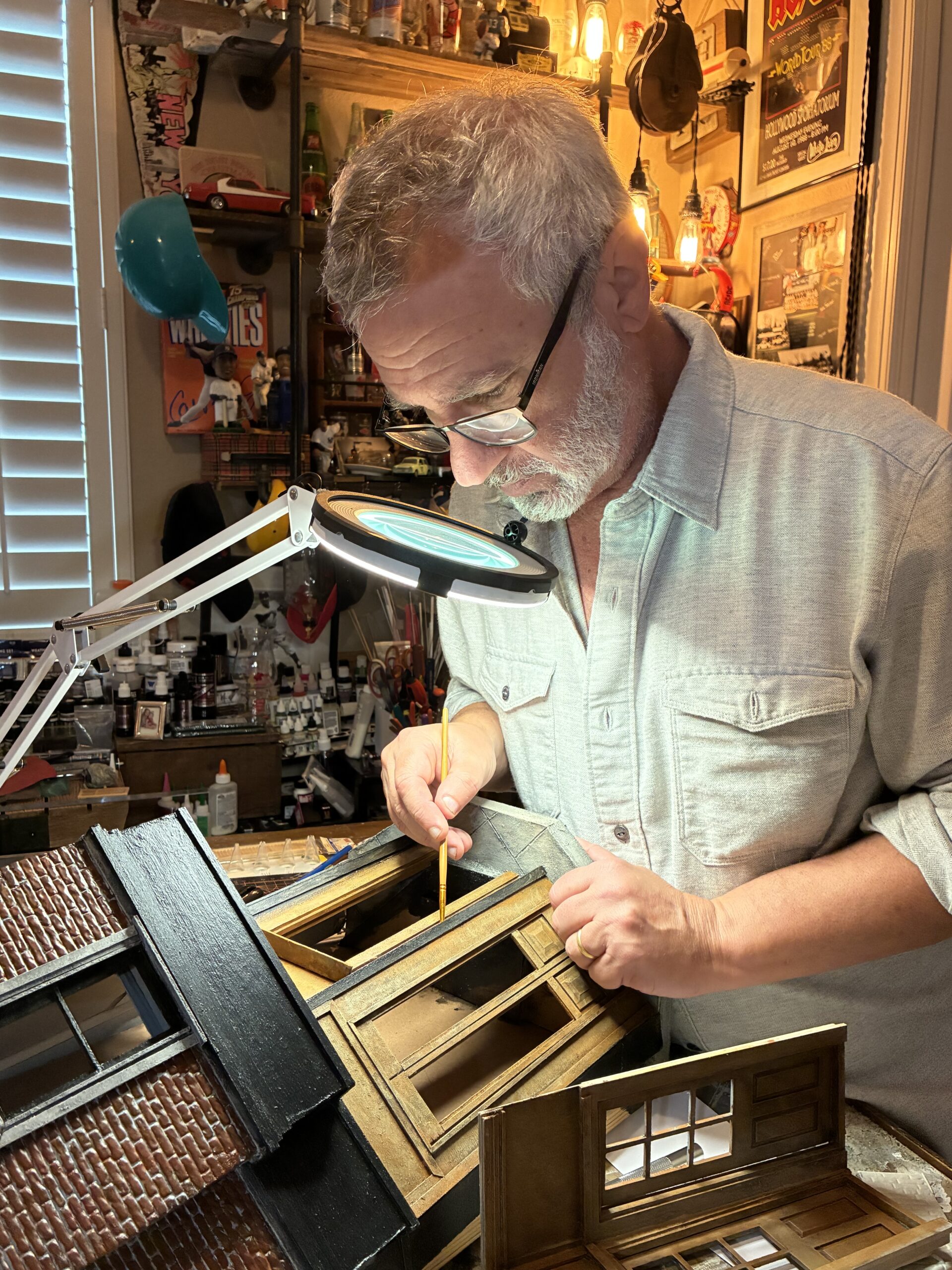
Miniaturist Alberto Chailosky at his home studio in Fort Myers creating mini worlds of famous locales in major cities. -COURTESY PHOTO
As architects of miniature worlds, dedicated hobbyists pack their creations with details that are nearly invisible to the untrained eye. It is an art form driven by creativity, engineering and precision: the world of miniature model-making.
Driven by a passion for precision and a non-negotiable need for accuracy, artisans in Southwest Florida are consumed by this oft-overlooked hobby, whether they recreate mini-sized cityscapes or model-train layouts.
Big cities, small creations
Claiming to be one of the original craftsmen in the style of miniature urban scenes, Alberto Chailosky’s miniature art establishes him as the preeminent archivist of a period long past.
At five years old, with crayon and paper as his toys, he started his obsession. He drew scenes that captured his imagination, transported by the sights of the make-believe world of television’s Mister Rogers’ Neighborhood and Sesame Street. Cuban-born, it’s how he learned English.
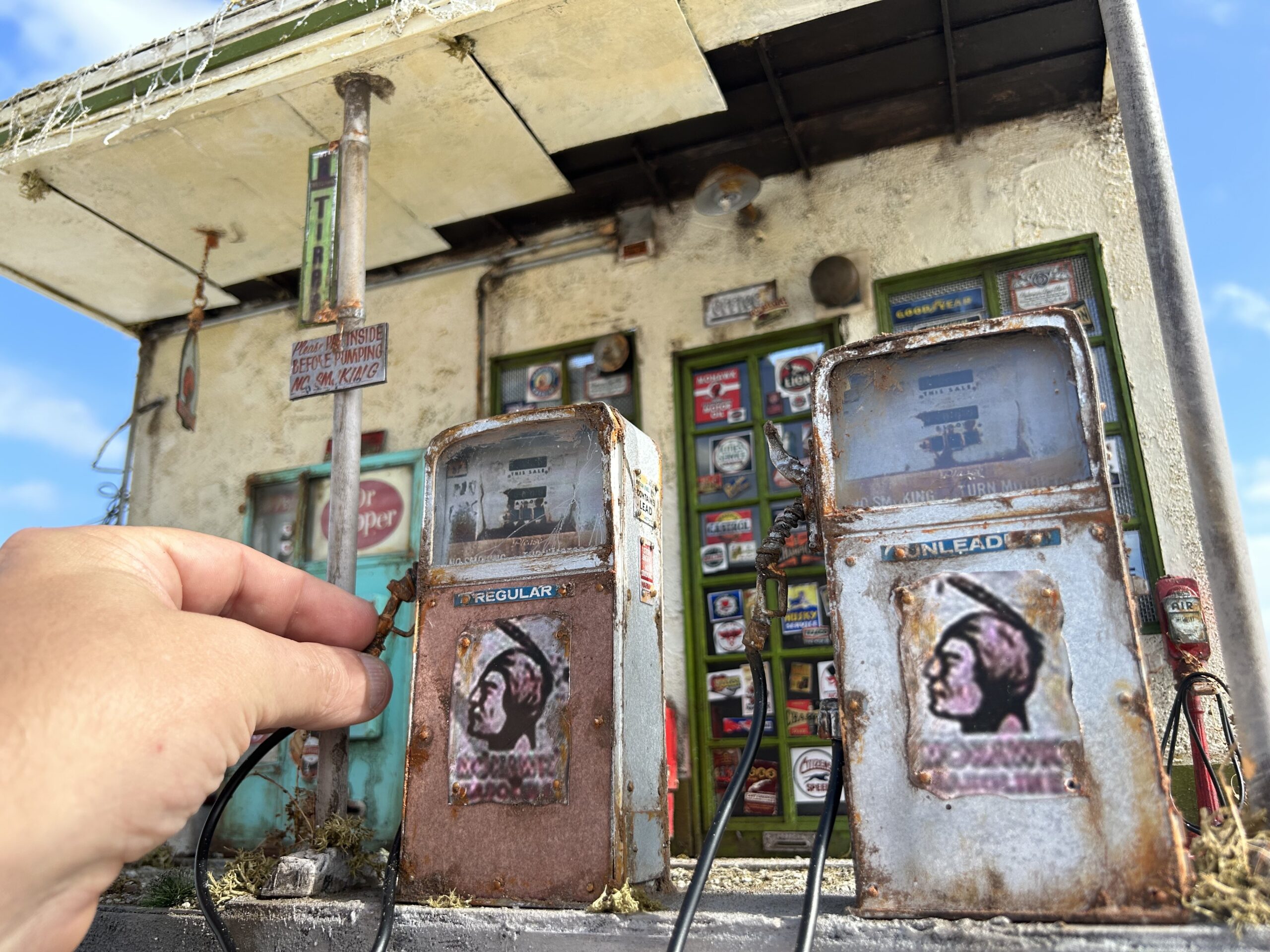
A mini gas station being crafted by hand by Alberto Chailosky. -COURTESY PHOTO
In 1990, he started college in New York City and was so talented that he was tapped for a full scholarship. He mastered set design and worked as a set designer in Broadway theatre and on television’s “Saturday Night Live” for over a decade.
At the same time, he did art shows in Soho, New York, that began to shape his artistic vision. Eventually, his interest evolved into depicting scenes of small businesses in the city in the ’80s and ’90s — specifically those being torn down and replaced by office buildings and larger businesses.
“I work on models of places I’ve experienced and loved that are also socially important,
archiving that time,” Chailosky said.
“Everything is disappearing, block by block. Buildings and social icons like CBGB’s, a legendary music club, which is now a John Varvatos store (designer men’s brand), must be remembered. I’m reliving a time that is being erased and telling my personal stories about iconic places, how they looked and how people behaved.”
His world of miniatures
Armed with some 8 to 10,000 photographs of New York City spots — he says they are worthy of their own museum collection — they have become the inspiration for his mini worlds.
He describes his art as architectural models that either hang like a 3-D wall piece or can be placed on pedestals. They depict scenes of locales mostly in New York, but now also in Key West or Miami, where he has lived and visited.
“I want the viewer to experience my art as a walk back through time,” Chailosky said. “I am different from 99% of miniaturists who use 3-D printers to create replicas in that I make stories by hand in minute detail.”
Working from his home studio, he said, it looks like an exploded miniature model with collectibles everywhere; his materials are anything he can find.
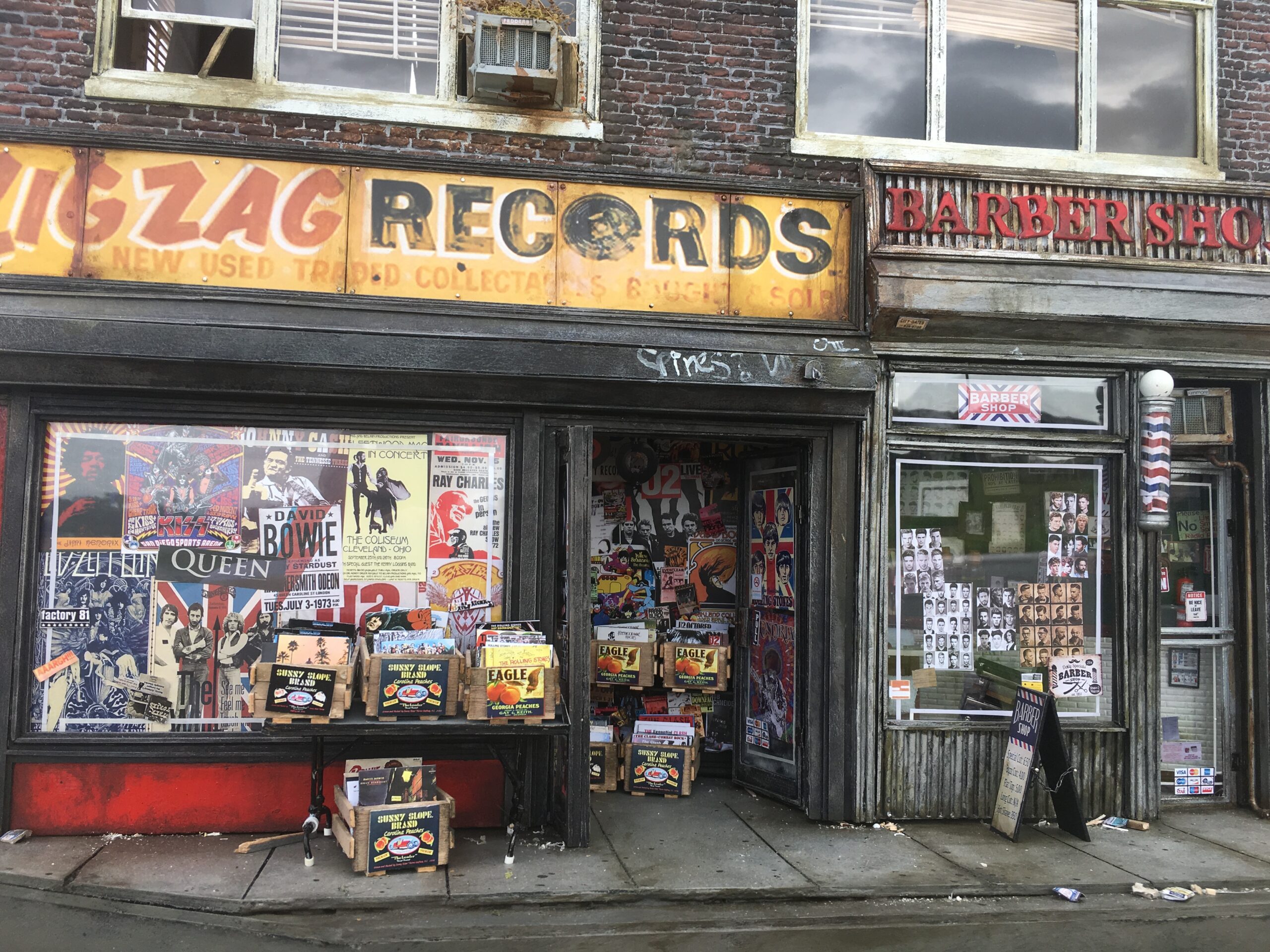
Zig Zag Records a heavy metal and rock music store in Brooklyn and an icon of the 80s lives on in mini form recreated by artist Alberto Chailosky. -COURTESY PHOTO
Starting with basswood and chipboard, he approaches his models like a set with a wood frame and builds out from there, adding details like a neon sign that flickers. He admits that the best part of his work is figuring out, by trial and error, how to do things he has never tried before.
For one work, he created a mini scene of a famous candy store and set it inside a vintage, rusted gumball machine found on eBay. For another, he bought 25 cans of late-80s Krylon spray paint, cut open the lids and created graffiti scenes.
The largest scale he works in is 1:12 (one inch equals one foot), and down to 1/2-inch to 1/4-inch and even 1/8-inch to a foot. Some models can be as large as 15 to 20 feet in length using a 1/2-inch scale and include recreation of all the graffiti and grunge of the time.
“Some pieces take four to six weeks and others just a few days,” he said. “Most challenging is figuring out the theme and the stories about something that I’ve experienced that have a history like iconic bars and music venues.”
Today, by day, the artist works as a creative director in the fashion industry, overseeing a six-man team that supplies art for companies like Wrangler, Lee, J. Crew and Chico’s, and by night, he works on his hobby for pure joy.
Last year, he captured first-place honors at Naples National Art Fair and last season displayed pieces at a miniature art show at Tribby Arts Center at Shell Point, as well as prestigious shows in Tampa and Winter Park.
His models sell for up to $15,000. One replica features “Blood Alley,” a famous New York City Chinatown restaurant alleyway where rival gangs once rumbled, measuring 28 inches tall by 5 feet wide.
“From the start of a model with a sketch to its display at shows, what sets me apart from other artists is that I include a small plaque that tells my story of the place, its significance and what became of it,” he added.
“So, viewing my pieces is like going through a library’s archive of a period,” he said. “I put a time stamp on the past and say, ‘Don’t forget about this.’”
Keeping the miniature trains running
At the Naples Lionel Train Museum (open October through April), find an extensive, interactive, small-scale, Lionel “O” gauge layout featuring over 100 interactive buttons and about 10 running trains, complete with intricate background and scenery.
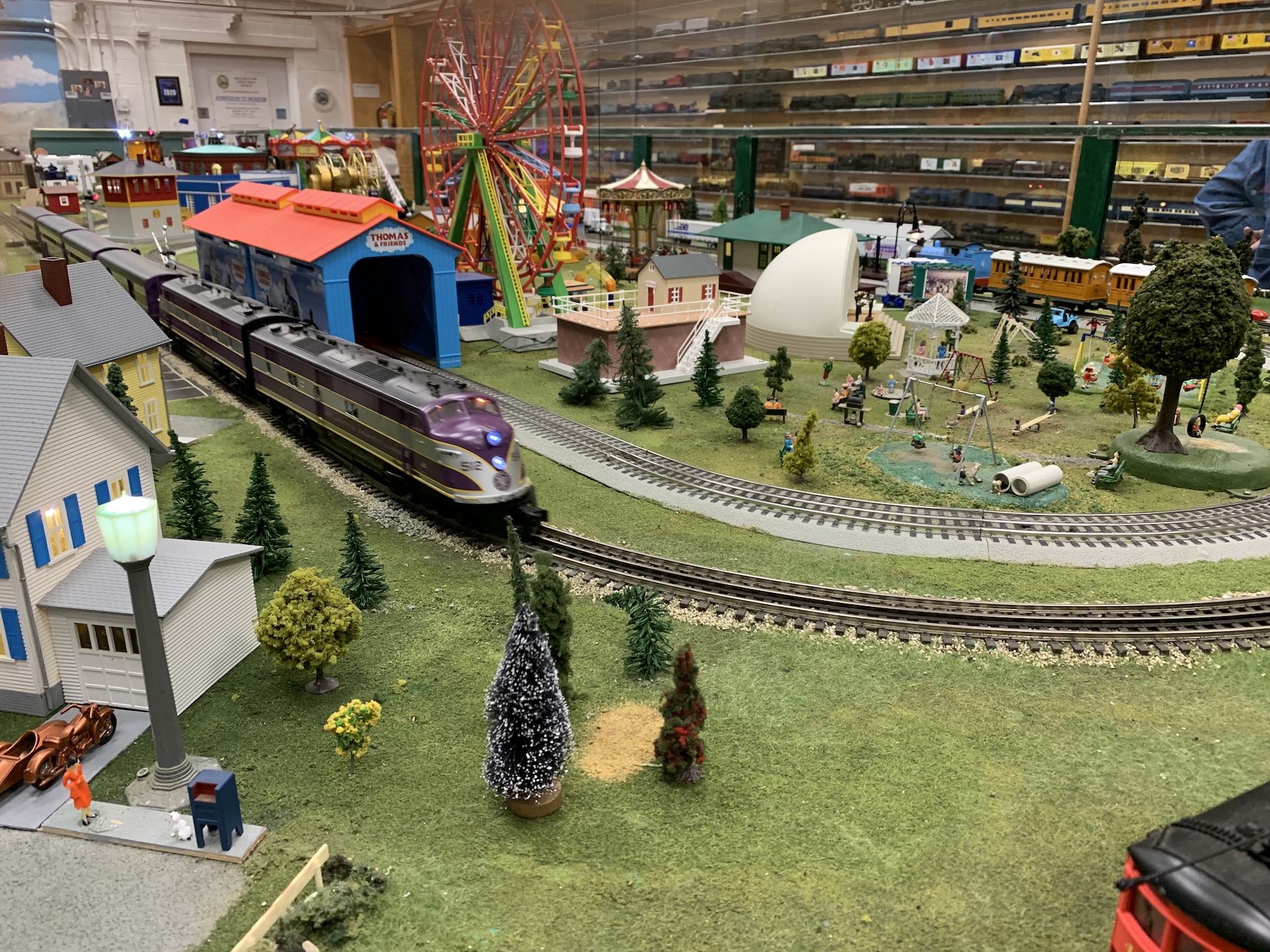
A Wall of Trains pictured in the background features a display of rare Lionel locomotives in miniature form at The Naples Lionel Train Museum, open to the public. -COURTESY PHOTO
The museum’s layout reportedly was built beginning in the 1980s and is maintained and continuously refined by a dedicated group of more than 25 volunteers who repair, expand and operate the indoor miniature toy train layout. Some trains are made of brass to scale and others used as toys that children and visitors can handle.
The volunteers also maintain and run the outdoor miniature 7.5″ gauge riding train named “Miss Naples,” outfitted with a steam-powered engine, that runs seasonally and offers unlimited rides on Fridays.
Bob Davis is one of the museum’s long-time volunteers, the in-house historian, and an accomplished model railroad enthusiast. Of the three types of toy train hobbyists — toy train folks, scale modelers and hi-railers (a cross between the two) — Davis is a hi-railer.
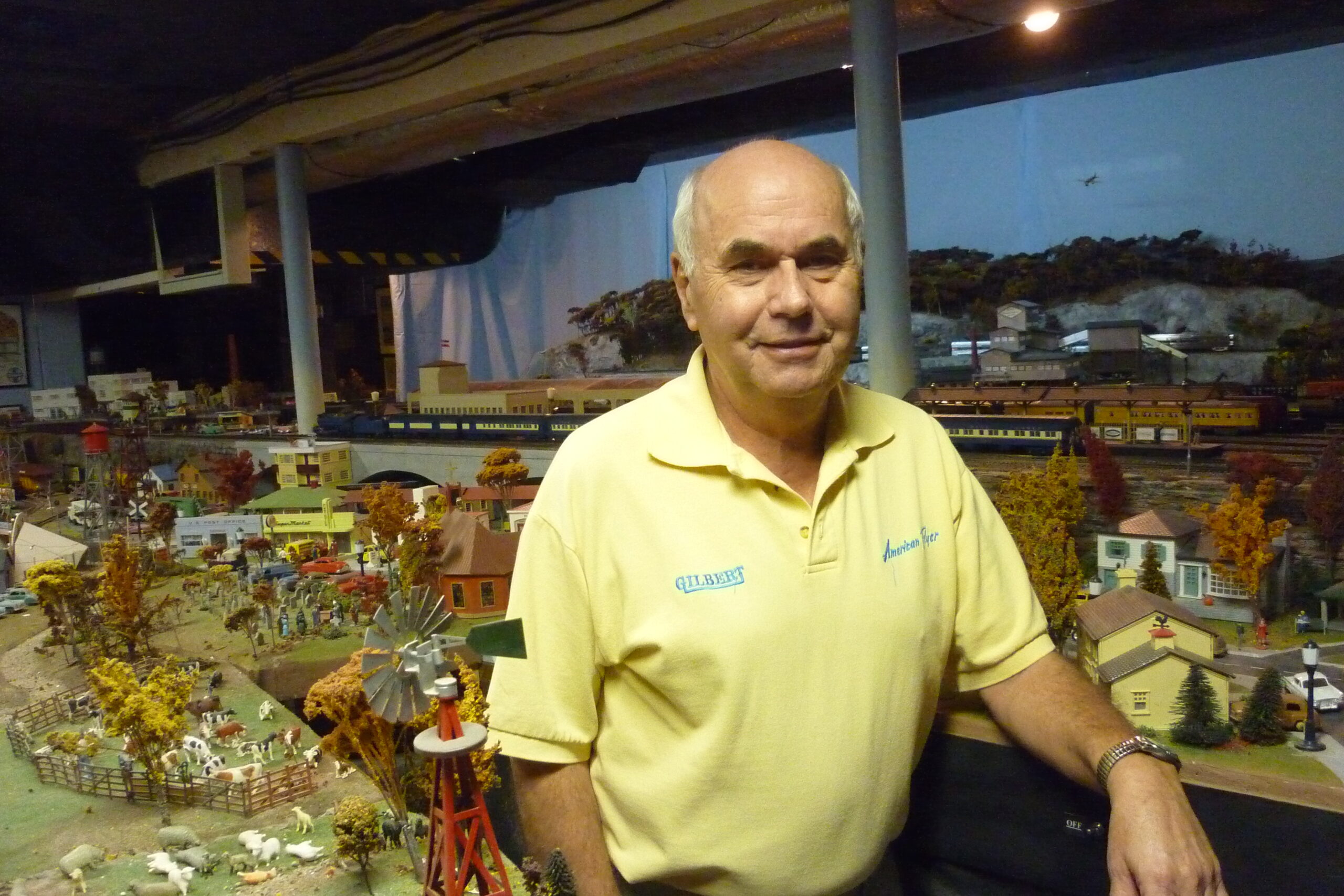
Hobbyist Bob Davis has spent over 25 years at the craft of mini train layout and design. -COURTESY PHOTO
Davis has been fascinated with the craft of mini model making, where he can create a miniature world to display toy trains that he enjoyed as a child and has since collected.
“I am passionate about creating realistic environments and modeling the scenes and atmosphere in which the rains run; it’s a world of miniatures,” he said.
A testament to his more than 40-year hobby is the 30’ by 24’ layout space in his basement that, after banishing a pool table, now holds worlds of miniature people, animals, toy trains, houses, barns, foliage, fruits and vegetables, trestles, bridges and much more.
Planning, gauge, scale and layout
For those planning to enter the hobby, he cautions that first, you must consider the area you have to work with and then pick a gauge that fits the space.
In the toy train world, sizes are determined by gauge (the distance between the tracks) and scale (the size ratio compared to a real train), according to Davis. He said that those interested in the train world understand the gauge letter and what relative-size train it refers to.
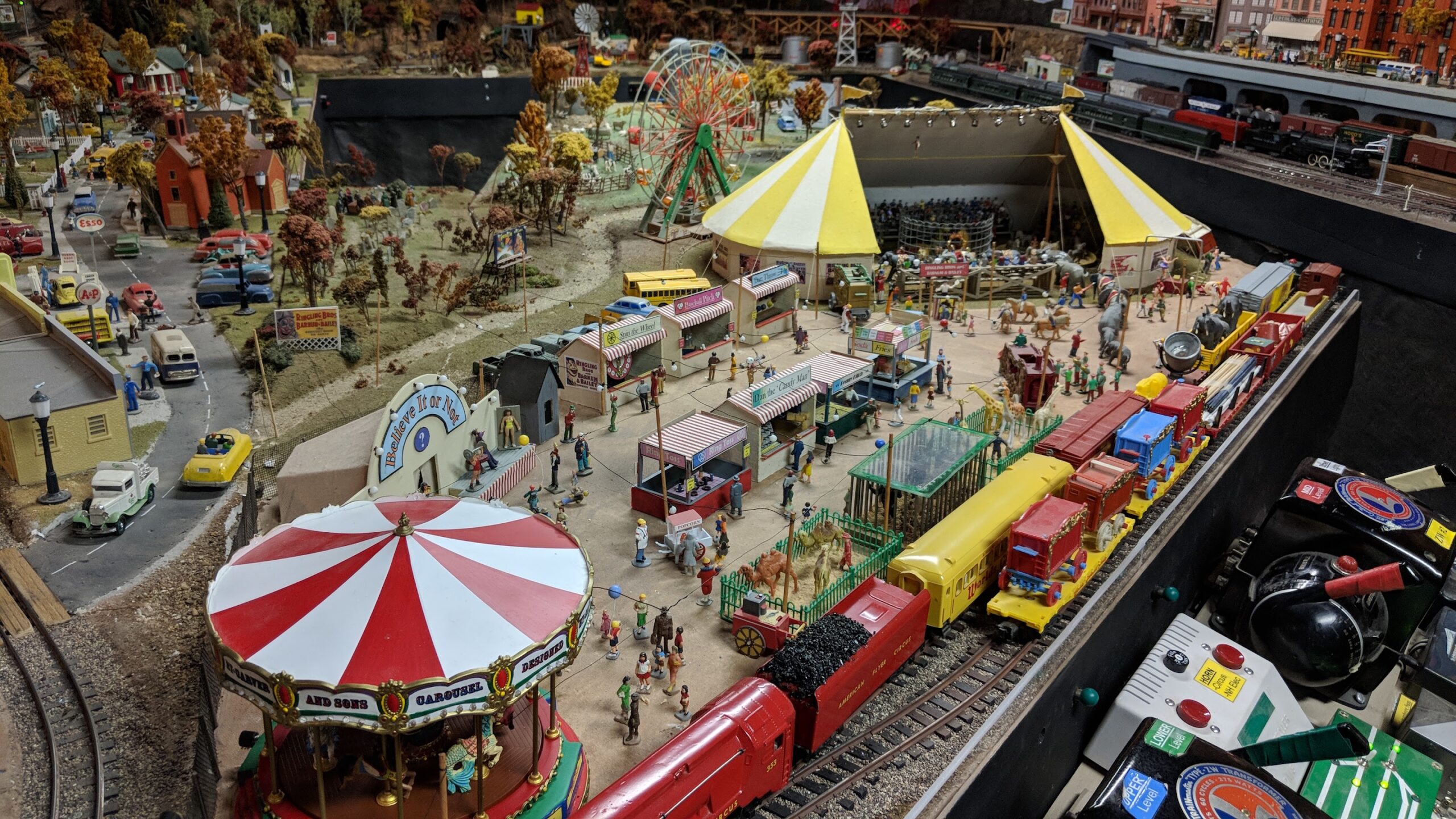
A miniature merry-go-round and open-topped circus tent are part of the American Flyer model train layout made by Bob Davis over 35 years. -COURTESY PHOTO
G-gauge is the largest (garden railroads) and Z-gauge the smallest, with O, S, HO, and N sizes falling in between. The most popular toy sizes were O and S, associated with Lionel and American Flyer trains of the 1940s and 1950s.
“For example, O gauge is 1:48 scale or 1/4″ to the foot and runs on three rails (generally Lionel and many other makers),” Davis explained. “My trains are S gauge, which is 1:64 scale or 3/16″ to the foot and synonymous with American Flyer trains that I use.”
“Smaller scales HO, N and Z evolved later and are preferred by the purist and scale modelers as kits since the engines are to exact scale.”
Next, the hobbyist must decide if he wants to place his layout on a rectangular table enabling one to walk around all sides, against a wall to walk around three sides or in a corner to walk around two sides or make a shaped layout such as an e-shape.
The e-shaped layouts are some of the best, he said, because you can walk inside of the model, as opposed to looking at it from the outside.
“It’s a skill and an artistic endeavor,” he said. “Taking an idea for scenery from inception to completion can be accomplished with the use of a computer-aided drafting tool to lay it out.”
“A factor is determining if a 6”x 6” accessory fits between two merging tracks or only a 42-inch curved track. You also must ensure that the layout, the track work, electronics and electrical hookups are in working order before you put one tree or one piece of plaster on it.”
Materials, sourcing and fooling the eye
Davis started his hobby by building a mini mountain replete with intricate, high trestles; he has expanded the layout ever since.
The underpinnings of my creations are materials that include 2-by-4 or 2-by-6 pieces of plywood with screening over the plywood cutouts that I spray with foam or plaster or cover with papier-mâché,” said Davis.
Rocks are cast from rubber balls filled with plaster and strategically placed to create realistic-looking mountains or hillsides. Creating weathering and texture, like rust or mud, is yet another process. For shiny penny metal trains, a rust-colored paint gives a look of wear and tear.
Coming up with and improvising usable materials is a challenge. He uses hardware store items to solve construction problems and create scenes when miniatures are not available to purchase.
For example, Davis uses plastic to craft “glass” windows in buildings and leaves it out of others to view scenes that he has created within. His guiding principle is “why buy it when you can build it and have fun making it?”
Trains are sourced from trade shows, eBay, flea markets, garage sales, ads in local papers or church sales.
Aside from never having enough room or space to create, the most challenging aspect is stated — to fool the eye.
“You must fool the eye, so it focuses on that scene and brings the viewer into that area while using wood, plaster, foam, paint and plant materials,” he explained.
“Once, I had no background behind a particular building; it was just painted red and looked like it was from a Spaghetti Western scene. So, I took each building, made a copy of it, reduced it in size, changed the color and put it in the background for depth. When I try something, if it doesn’t work, and I do make mistakes, I just start over again; you do different things, so it’s always new and fun.”
A love for trains big and small
A volunteer trainman for 16 years with Naples Lionel Train Museum, at age 5 with one steam engine, a few boxcars, a Grand Old Flag car and a caboose, George Turczyn’s love affair with all things trains began.
Still chugging along, today he is Naples only outdoor scale steam engine train operator at the Museum, piloting and maintaining the train.
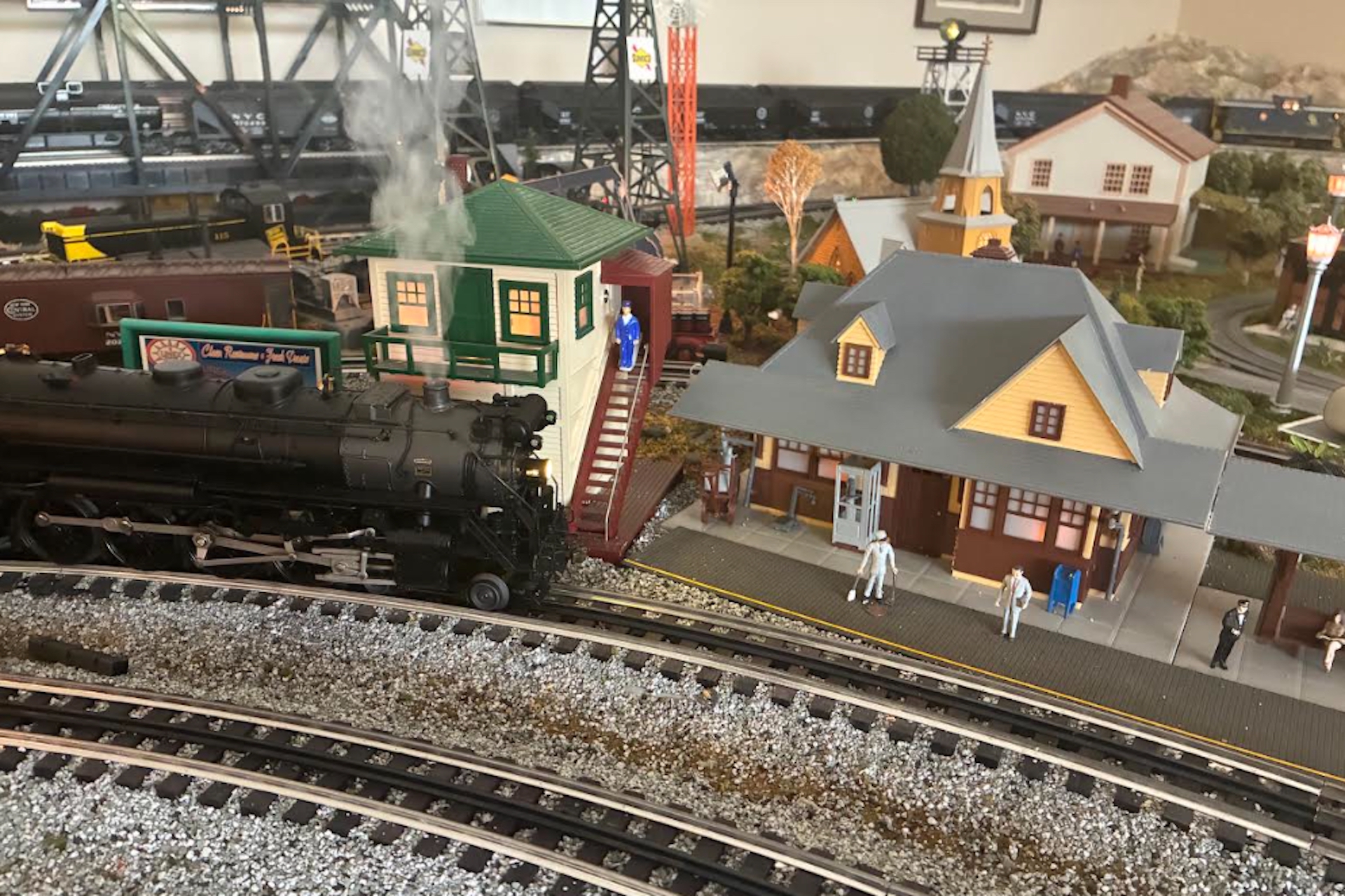
Ballast in and around the train tracks shows the level of detail in George Turczyn’s home model train layout. -COURTESY PHOTO
Around 2002, his interest in trains grew, and he started collecting them. Eventually, he hand-built a table occupying a 20-by-16-foot space for his layout, for which he crafts the scenery, environment and background to add depth for the small model trains.
Trains and materials for intricate scenes are sourced from local hobby shops and others located in the northeast.
The layout starts with a computer-aided design software program, RR Track, that turns the computer into an electronic layout board. He uses an O scale and builds according to the space he has, then uses the track traffic plan to figure out what he wants to create.
“Do I want to have two main lines or a city line or two railroad yards? I lay it all out on the computer program and then get the track and put it in place,” he said.
Turczyn’s layout is an L-shape, and his greatest challenge is getting as much track on every part of the table as possible to run as many trains as possible on different tracks.
Crafting miniatures
To make his miniatures, he first builds the structure with pieces of wood and screen. Then, he takes strips of clothlike material overlayed with a powder, soaks it in water and shapes it to any position. He then takes a pliable foam board and covers it with plaster.
To create a realistic look of a mountainside, he uses watered-down India ink, drips it onto certain areas, and lets it flow down.
“Using only one color creates a static look that I want to avoid,” Turczyn said. “So, I mix materials and use several colors.”
He then described his process of mixing equal parts of water and Elmer’s glue that he brushes and drips onto the ballast, which is the crushed stone under and around the tracks.
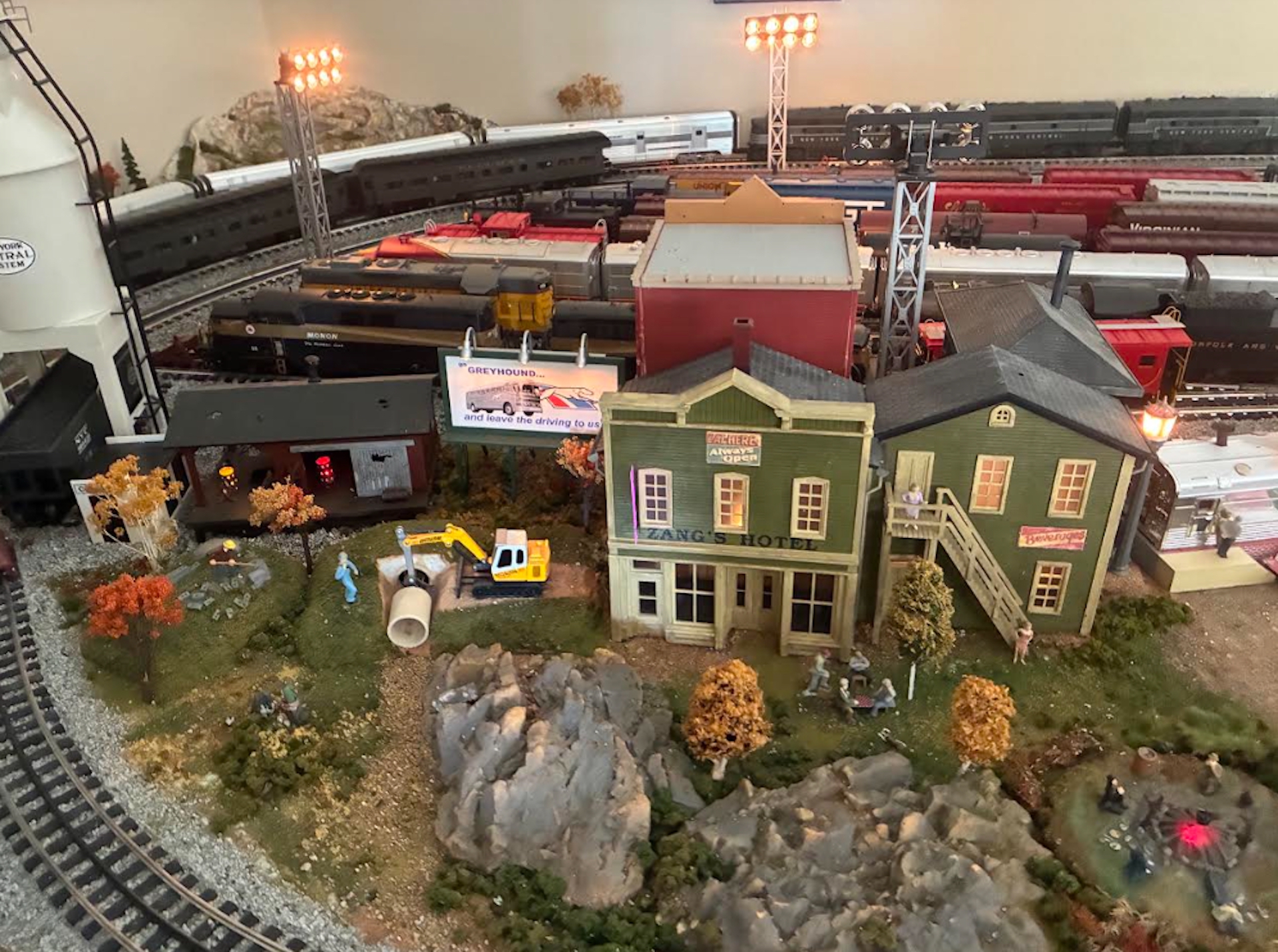
A portion of model maker George Turczyn’s intricate model train layout shows scenery and buildings in miniature scale. -COURTESY PHOTO
Most rewarding, he said, is that his modeling hobby is like a meditative escape.
“You use diverse skills to build your table,” he added. “Some steps require carpentry skills, while laying track demands electrical wiring. Next comes sculpting the scenery, building mountains and creating realistic terrain.”
“Afterward, you must add and position lighting to make the layout look natural. Finally, you get to the most enjoyable part: operating the trains.”
In the KNOW:
What: Naples Lionel Train Museum with model train exhibits and train ride
Where: 401 10th St. S., Naples
Hours: 10 a.m.- 2 p.m. Fridays and Saturdays (seasonal from Oct. 16 to end of April)
Admission: Free under age 3; $4 ages 3-13; $8 for ages 14 and adults; $4 for first responders, medical and military veterans with ID. $8 per adult, $4 per child (ages 3 and up); $4 for first responders and military personnel. Admission includes access to the interactive indoor Lionel “O” gauge train layout (featuring over 100 interactive buttons and usually 10 running trains) and unlimited rides on the outdoor miniature 7.5″ gauge riding train. On Fridays, the steam engine, “Miss Naples,” runs outdoors
Contact: 239-262-1776 or naplestrainmuseum.org