
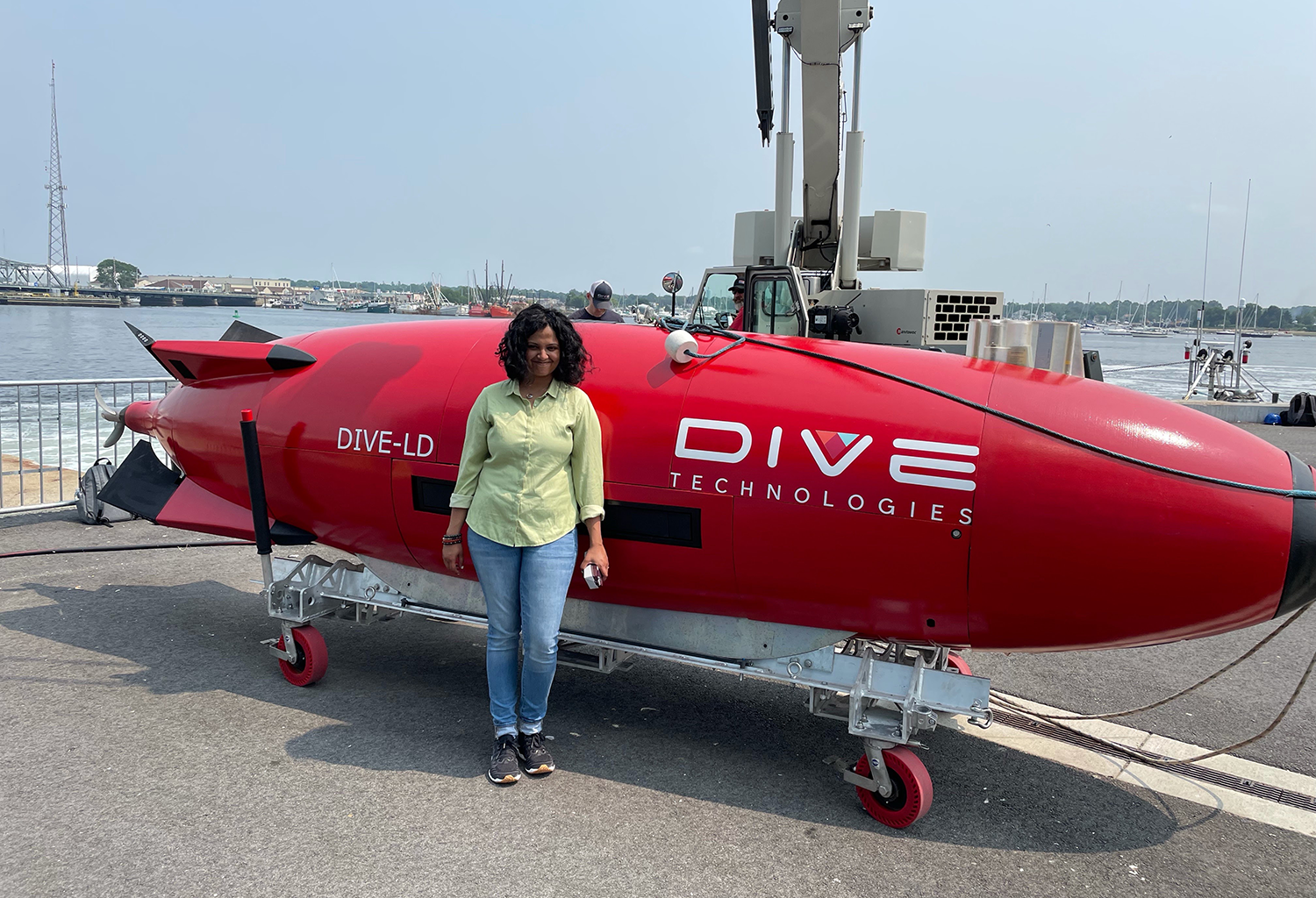
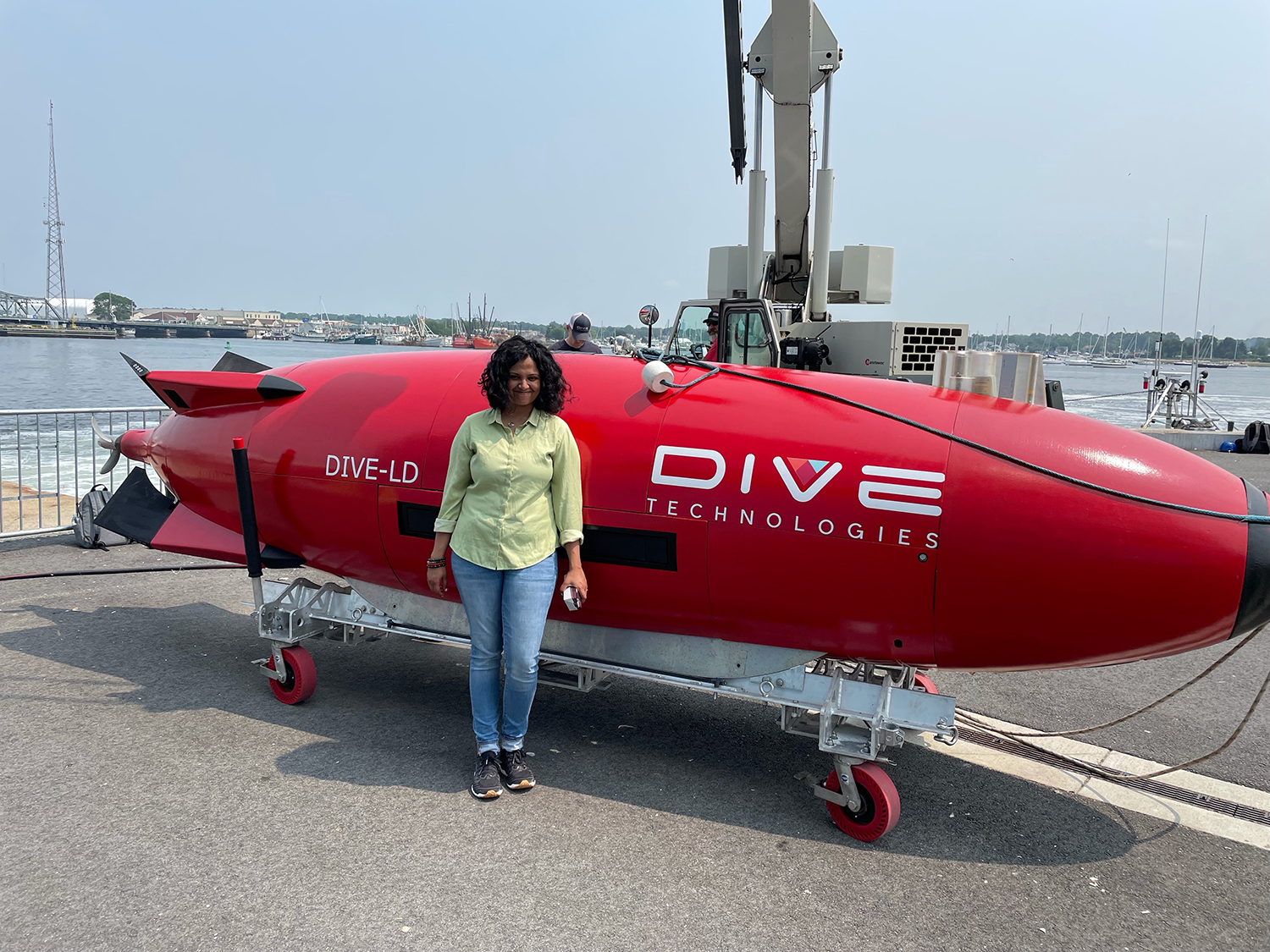
Lakshmi Miller, assistant professor of hydrography, is an ocean engineer with expertise
in developing autonomous and unmanned underwater vehicles. Courtesy of Lakshmi Miller
Dyllan Furness, College of Marine Science
The USF College of Marine Science welcomes its newest faculty member, Lakshmi Miller,
assistant professor of hydrography. With a background in ocean engineering, she joins
the college to help expand its underwater capabilities through the development of
autonomous and unmanned vehicles that help researchers map, monitor, and explore the
ocean and seafloor.
Here, Miller describes her career path, passion for marine science and engineering,
and goals as a researcher at USF.
Q: What first attracted you to the USF College of Marine Science, and what are you most
excited about in your new role?
A: The reputation of being a global top 10 leader in marine science excited me about
USF. There are a very few institutions that would position me to perform research
on underwater craft in extreme weather conditions. Upon interviewing, the stunning
collegiality and support among college faculty and staff is what made me like it even
more. This college has colleagues that genuinely like each other. The approachability
of leadership truly surprised me. And, to work in the same college as Professor Pam Hallock-Muller — hands down, no brainer.
Q: Tell us about your research interest — what’s your focus, how did you get started,
and what makes your work meaningful to you?
A: I always wanted to be a career scientist. I do not come from a family of scientists
or engineers and was purely impressed through science classes at my local elementary
school. Upon finishing my master’s in mechanical engineering at the relatively young
age of 23, I knew that I wanted a PhD in ocean related topics. I had a specific and
obsessive interest in ocean craft and naval warfare. There were years I spent hours
just watching navy videos of frigates and submarines. Though I was gainfully employed
at a Fortune 500 firm at the time, I quit my job once the right school came along
and took up a PhD program at Virginia Tech.
Thanks to the Center for Marine Robotics at Virginia Tech, I was part of multiple projects working on underwater vehicles, which led me to
write a dissertation on the maneuvering of underwater vehicles, making advances to
the literature that existed at the time. Right out of my PhD, Dr. Eric Paterson of
the National Security Institute at Virginia Tech hired me into a research faculty position. I then found that it was especially meaningful
to me when my students go on to work for defense and government entities of the country
such as the Naval Warfare Centers. I consider it my duty to use my education to defend
and strengthen our country in this unique way irrespective of political climate. Of
course, all of this has been and continues to be possible due to my supportive family.
Q: What is a lesser-known fact about your area of expertise that others might find compelling?
Autonomous underwater vehicles and unmanned underwater vehicles are self-propelled
using a battery. Unlike gliders and buoys, their mission and way points are highly
specific and controllable, making scientific discovery planned rather than opportunistic.
They are becoming increasingly cheap to manufacture, and their hulls can be 3D printed.
A: Describe the short-term and long-term impacts you hope to have through your research.
In short term, I hope to achieve excellence professorially, through research, teaching,
and publications. Long term, I hope to make these vehicles as well-understood as cars
on the road. I would look to work more towards recreational subsea safety. I would
consider it my mission — along with other professors and scientists — to ensure that
the U.S. remains a leader in subsea technology.
Q: What advice do you have for prospective marine science graduate students in your field
of study?
A: You are learning a unique area in science that is not taught often. Make sure to
have a rough idea of what you want to do with it before starting your studies. Careers
include entrepreneurship, academia, science, and the environment. Each of these careers
requires a different flavor of the same learning and can be geared to suit you better
if you have an idea of what you want to be. Before starting graduate school, ensure
that your personal life and goals permit the time commitment it requires.