
For Shirley, looking for work has become a job of its own.
The South Florida woman, who declined to give her last name as she continues the job hunt, has been looking for employment since losing her government position three years ago. Shirley estimates she has applied for “at least 1,000” positions since then, describing the search itself as “a full-time job.”
Shirley spent more than seven years working with children and families, including juveniles and children in distress, and about 15 years overall in the public sector. Since losing her job, she has relied on savings, investments and her 401(k) while searching for the stability, benefits and retirement security she once found in government work.
Last Thursday, Shirley, who’s in her 50s, joined hundreds of job seekers at a federal job fair at Miami Dade College’s North Campus, hoping to find an opportunity that will finally end her years of searching.


Job seekers gather inside the federal job fair at Miami Dade College’s North Campus, where government agencies offer information about employment opportunities.
(Ivette Franco for The Miami Times)
“It’s emotionally draining,” she said of the cycle of applying, waiting and receiving rejection notices. “It’s debilitating.”
Her experience predates the latest federal workforce reductions. But her struggle to re-enter the workforce comes as Black women nationally have experienced employment losses, particularly in government jobs.
Black women ended 2025 with a net 113,000 fewer jobs than at the beginning of the year, according to an analysis by the Institute for Women’s Policy Research (IWPR).
Finding another job has also taken longer. In December 2025, Black women spent a median of 19 weeks without work, compared with nine weeks for white women, an IWPR analysis of federal labor data found.
Public-sector losses were particularly significant. An Economic Policy Institute (EPI) analysis found that Black women lost about 156,000 public-sector jobs between 2024 and 2025, including roughly 95,000 federal jobs, even as they gained about 76,000 jobs in the private sector.
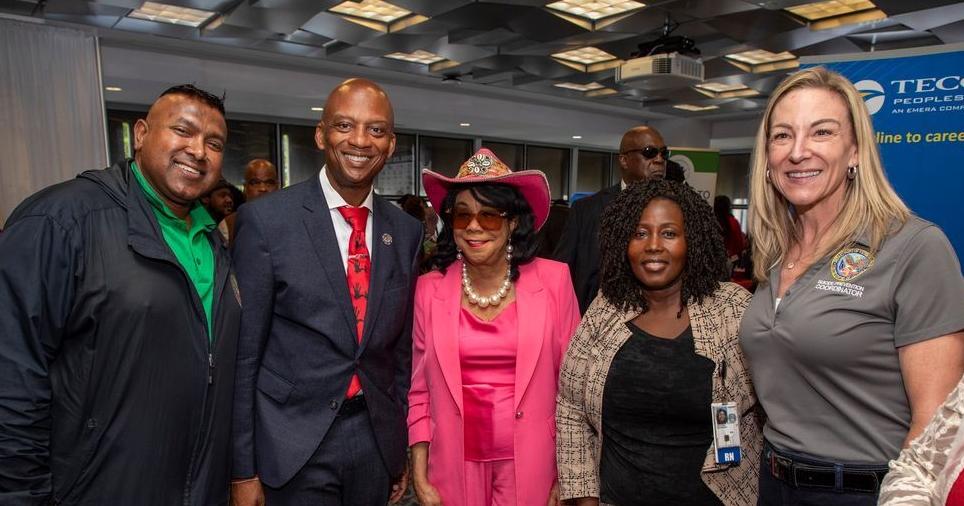
U.S. Rep. Frederica S. Wilson, who hosted the Aug. 13 federal job fair alongside former Miami-Dade County Commissioner Oliver Gilbert III, said she is concerned about the effects of the workforce reductions on Black communities.
Wilson said she believes Black women have been particularly affected by the reductions. She attributed the disparity to “racism and prejudice,” but emphasized the need to respond by creating opportunities for affected workers.

Congresswoman Frederica Wilson interacts with community members during the federal job fair at Miami Dade College’s North Campus.
(Julie Robinson)
“We have to say, ‘What are we going to do to counteract what they have done to our community?’” she said.
Wilson also linked the employment challenges facing Black women to the Trump administration’s rollback of federal diversity, equity and inclusion initiatives and its efforts to shrink the federal workforce.
“You just have to give people the opportunity,” Wilson said.
Beyond federal cuts
The government has historically been a source of stable employment for Black women. But broader economic factors can also affect their job prospects.
Hakan Yilmazkuday, a professor of economics at the FIU Steven J. Green School of International and Public Affairs, said Black women’s concentration in certain occupations can leave them more exposed when those sectors contract.
“Cyclical downturns and occupational segregation leave these workers highly susceptible to macroeconomic shocks,” Yilmazkuday told The Miami Times.
Yilmazkuday also pointed to the rollback of DEI initiatives as another potential pressure. He said removing programs intended to address bias in hiring and retention could create additional barriers for Black women seeking work.
The job challenges extend beyond the federal government.
In South Florida, CareerSource South Florida has seen an increase in teachers seeking employment following local school closures and staffing reductions, said Jarvis Washington, the agency’s One-Stop Operator.
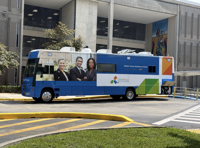
CareerSource, South Florida’s Mobile Career Assistance Center sits outside Miami Dade College’s North Campus during the federal job fair.
(Ivette Franco for The Miami Times)
The federal job fair drew an estimated 600 to 700 job seekers and about 50 vendors. Washington described “long lines” to enter and a “steady stream of individuals all day.”
But the turnout did not represent only displaced workers.
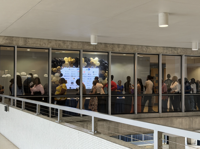
Job seekers wait in long lines during the federal job fair in Miami.
(Ivette Franco for The Miami Times)
“These aren’t all workers that are laid off,” Gilbert told The Miami Times. “Some people are looking for jobs, some people are fresh out of college, some people are just trying to change careers.”
Miami-Dade County Public Schools was among the public-sector employers recruiting at the fair. Flore Charles, a district recruiter, said openings included instructional, transportation, maintenance, security, administrative and early-childhood positions. “We do have positions open,” she said, though she did not have an exact number of vacancies available at the fair.

Miami-Dade County Public Schools recruitment materials are displayed at the federal job fair.
(Ivette Franco for The Miami Times)
Women at the job fair
Among the Black women who spoke with The Miami Times, uncertainty surfaced at different stages of their careers.
Soukaina Anjali, a recent graduate with a finance degree, has been looking for work since June. Asked what brought her to the fair, her answer was straightforward: “I needed a job.”
She found potential opportunities in her field at federal agencies, including the FBI and Department of Homeland Security. But the recent federal layoffs gave her pause.
“It’s definitely going to be harder when it comes to applying for jobs,” Anjali said. She also worried about what the changes could mean for Black women in the workplace.
“Pretty soon we are going to be going back down the ladder,” she said. “We were making so much progress already.”
Asked whether she felt optimistic about finding work, Anjali was uncertain. She graduated last year and said Miami’s competitive job market presents another challenge.
For Shirley, the uncertainty comes after a much longer search.
She arrived expecting interviews, she said, but found some federal recruiters directing candidates to websites and potential openings rather than hiring on the spot. After three years of looking for work, she is willing to take a job in either the public or private sector.
Shirley believes being a Black woman in her 50s has made finding work more difficult.
“Not only being a woman, also my race, as well as age, becomes a factor in the job market,” she said. “The moment you hit your 40s and up, the job market becomes difficult.”
Asked what comes next, Shirley paused.
“I don’t know,” she said. “As I sit here, I don’t know. It’s heart-wrenching.”