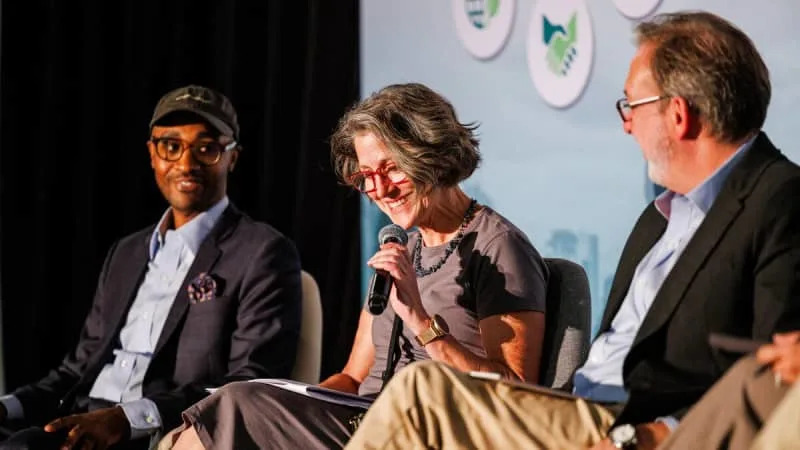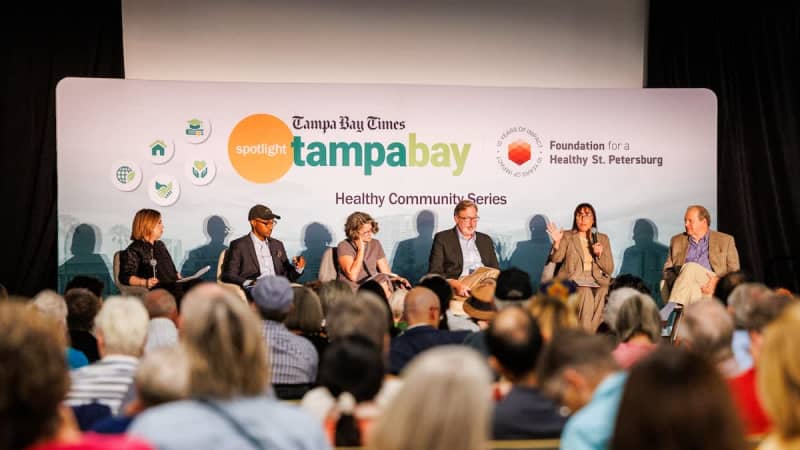
Experts on empathy, civil discourse and media literacy met Thursday evening for a panel to discuss a pertinent question: Amid growing division, how can we try to get along?
A crowd of nearly 300 attended the free event, which was held at the Foundation for a Healthy St. Petersburg’s Center for Health Equity and featured interactive experiences before the evening’s six panelists took the stage.
In a conversation led by Times’ columnist Stephanie Hayes, panelists drew on their expertise in journalism, education and religion to provide insight on how to practice empathy when intolerance might be easier and how to engage in better, more meaningful dialogue.
The panelists were author Michael Tennant; Kelly McBride, senior vice president of the Poynter Institute for Media Studies; the Rev. Russell Meyer, executive director of the Florida Council of Churches; Tammy Briant Spratling, visiting assistant professor at the University of South Florida’s College of Education; and Jeffrey Collins, interim associate director at the University of Florida’s Hamilton School for Classical and Civil Education.
They did not deny the challenges of the present moment, but they still provided plenty of recommendations.
Here are three important takeaways from the conversation.
The discussion started with grounding context courtesy of Collins, who teaches a course on civil discourse at UF.
The United States has overcome moments that tested its unity before, where beliefs grew so partisan meeting anywhere close to the middle was highly unlikely.
The 1960s, largely defined by civil rights and anti-Vietnam war movements, were an era comparable to the present day, Collins said.
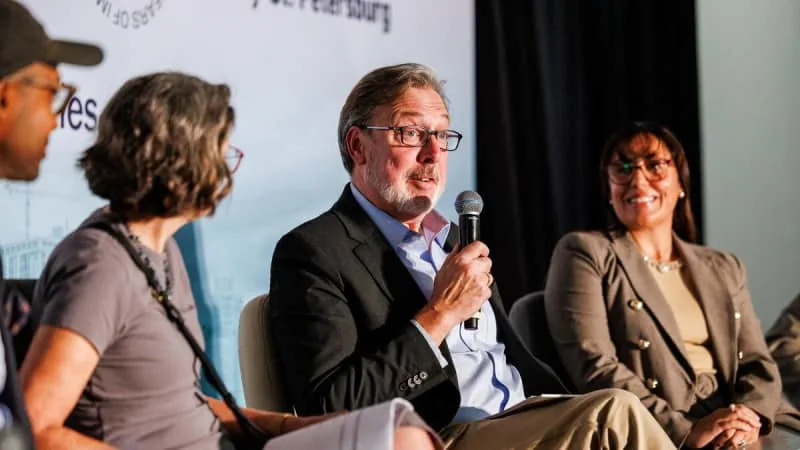
Still, a combination of technological distractions and a loneliness epidemic make our current moment different, and in some ways, more challenging.
“We have a completely collapsed associational culture,” Collins said.
Public spaces like Rotary and Elks clubs where attendees would mingle with people unlike them have effectively disappeared, while even shopping and movie watching have moved online.
Strengthening these associational institutions and fighting the comfort of isolation can help people better understand each other and practice empathy more effectively.
Doing so could prove to be an important steps towards overcoming this difficult moment, a feat history tells us is still possible.
As NPR’s public editor, McBride is adept at differentiating between communication with a desire for dialogue and rants uninterested in a response. She receives approximately 750 weekly listener emails, and responds only to the former.
With a presentation of different listener emails, McBride gave insight into the criteria she uses to select what feedback gets a response.
These standards, McBride said, are applicable beyond reading feedback. They are the skills you need to engage in genuine dialogue.
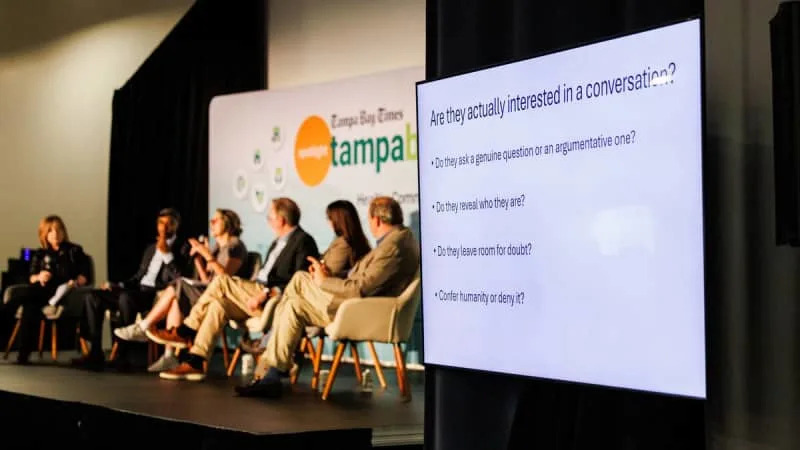
Real dialogue happens if there is purpose, mutual respect and consent between all parties, McBride said. If these elements are in place, you can discuss genuinely, not argumentatively.
You cannot approach dialogue stubbornly or steadfastly.
“Being able to articulate where you have doubts is really important,” McBride said. “More important then where you are certain is where you have doubts.”
“If you can’t muster genuine curiosity, then maybe your not prepared to be in a dialogue.”
In an era full of misinformation and disinformation, it is easy to dismiss somebody’s opinion if they cite a source that you either disagree with or know to be inaccurate.
But, McBride said, it is important to understand why somebody is choosing to believe certain narratives. You have to respect their sources, even if you disagree with them, because they are indicative of their background and the disenfranchisement they might be feeling.