
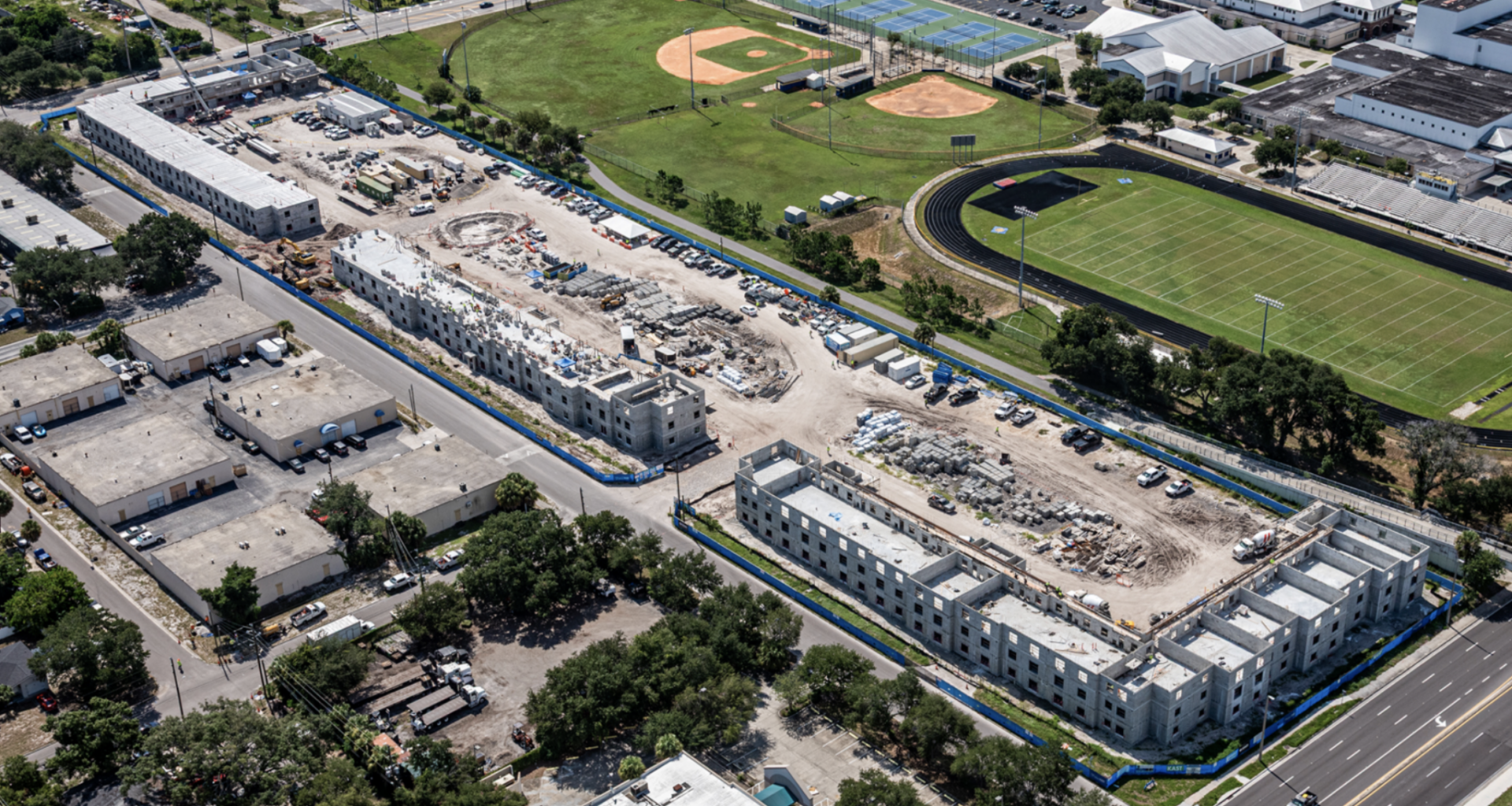
Seven months after officials broke ground on Fairfield Avenue Apartments, the 264-unit affordable and workforce housing development is shaping up in south St. Petersburg.
Construction is underway on three residential buildings and a community building at 3300 Fairfield Ave. S. Kristine Retetagos, senior vice president and Tampa division manager for KAST Construction, said the project is generally on schedule and budget, with completion expected by the end of 2027.
Fairfield will eventually be owned and operated by the Pinellas County Housing Authority. Getting there required a complicated mix of public and private financing.
“This project involves every level of government,” Retetagos said.
The roughly $94 million development includes a federal HUD loan, state involvement, $12.4 million from Pinellas County through Penny for Pinellas, roughly $9.5 million from the City of St. Petersburg and about $9 million in private equity.
Fairfield is also unusual for the range of incomes it will serve. Of the 264 apartments, 53 are reserved for households earning 50% or less of area median income, 67 for households earning up to 80% and 144 for those earning up to 120%.
“It is a true, full spectrum of AMIs, and there is not another project at this scale in the city that has 50% to 120% AMI residents,” said Angelo Cappelli of HP Capital Group, the project’s developer.
Nick Hansen, also with HP Capital, said the development reaches into St. Petersburg’s “missing middle,” including households around 90% AMI that can earn too much for some housing programs while struggling with the city’s housing costs.
But former state Sen. Jeff Brandes, who helped initiate Fairfield, sees the project as only part of St. Petersburg’s housing equation.
“It’s part of the solution for affordable housing in St. Pete,” Brandes said. “But the opportunity needs to be about homeownership.”
St. Petersburg has been bullish on accessory dwelling units, or ADUs, as one way to increase the housing supply within existing neighborhoods. Brandes believes more attention should now turn toward creating opportunities for residents across different income levels to own property.
Fairfield itself will remain rental housing. His point is what comes next.
Ownership presents a different opportunity than adding rental inventory because monthly housing payments can translate into equity and, eventually, an asset that can be passed to another generation.
Fairfield also provides an example of how far government and developers can go when existing land-use rules stand in the way of housing.
The 6.9-acre property was formerly home to Tibbetts Lumber and zoned for industrial use. State legislation opened the door for local governments to allow affordable housing on industrial land, but St. Petersburg did not yet have an ordinance in place to make that happen locally.
“There was no ordinance that existed,” Hansen said. “We had to write a new ordinance that took advantage of state law.”
Writing a new ordinance added about 10 months to the process. The project also had to satisfy requirements involving its proximity to schools, grocery stores and transportation (the property must be within a mile or half-mile proximity).
Brandes said converting the property to housing represents the highest and best use of the parcel.
Fairfield closed at a 5.99% interest rate, an important piece of the project’s financing because borrowing costs can significantly change what an affordable housing development can afford to build. Higher interest rates increase the cost of carrying debt, potentially creating financing gaps that developers must fill with additional public funding, private equity or changes to a project.
Bond markets add another variable. Interest rates and bond pricing can move while developers are assembling financing, meaning the numbers that make a project viable early in the process may look different by the time it is ready to close.
Fairfield required the development team to coordinate those financial variables with funding and approvals from several levels of government.
Brandes called it the most complicated transaction the group has undertaken.
“You are dealing with four layers of government, bond markets you don’t control,” he said. “You just watch it, but don’t affect it.”
Hansen put it this way: “Closing this transaction was like landing a SpaceX rocket in the Pacific Ocean in the middle of a tsunami on a dinghy with 12 inches of marginal error space,” he said.
The difficulty of closing Fairfield also presents a challenge for replicating it. Creating hundreds of income-restricted apartments required years of planning, a new local ordinance and money from multiple public and private sources.
For Brandes, the lesson isn’t necessarily to reproduce Fairfield piece for piece, but to bring similar ambition to the ownership side of St. Petersburg’s housing problem.
The Fairfield team will connect with the community Sept. 18 at the project site. Contractors and representatives from Associated Builders and Contractors will be available to discuss the development, construction careers and apprenticeship opportunities.