

The University of North Florida is implementing new health insurance requirements for international students, according to Ryan Dobbertien, program director of the Student Health Service.
The new insurance criteria mandates U.S.-based, Affordable Care Act-compliant coverage to eliminate medical care gaps, according to Dobbertien. However, international student Eric Rodriguez said this is “not only upsetting but also frustrating” for international students at UNF.
“I found out through the official email that they would no longer accept the International Student Organization health insurance plan and it [the UNF plan] is very expensive for us international students,” said Rodriguez.
These changes also arrive as international students face rising tuition and housing costs at UNF. Out-of-state tuition rates recently increased by 15%, while housing costs rose by roughly 5% to 10% depending on the facility per the Board of Trustees’ decision.
Financial impact and student frustration
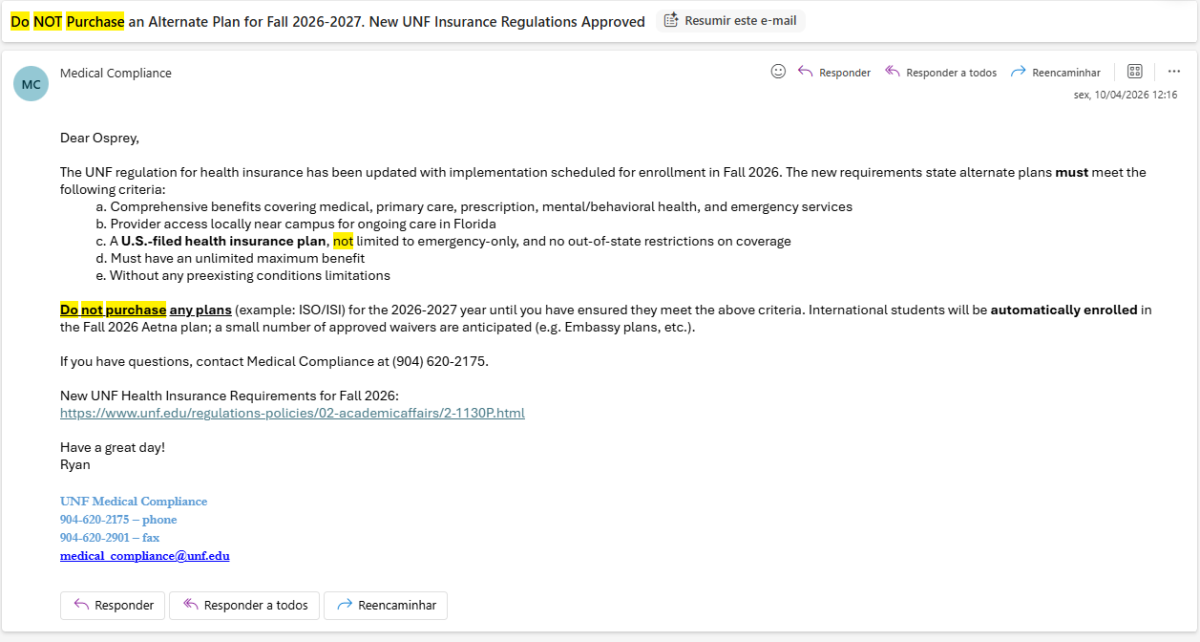
International students received an email on April 10, 2026 that said not to purchase an alternate insurance plan for the fall semester.
The policy shift, taking effect in fall 2026, has sparked confusion and anxiety among international students facing increased insurance premiums, according to Rodriguez.
All international students (F-1 or J-1 visa status) at UNF must have adequate medical insurance coverage from their first day of class through the end of the term. International students are automatically enrolled in the UNF-sponsored student health insurance plan, and registration is placed on hold until coverage is verified.
The university’s new approved student insurance plan costs approximately $1,000 to $1,100 per semester, according to the UNF website.
Previously, international students relied on offshore plans that cost around $200 per semester, but these plans are no longer acceptable under UNF’s new criteria, according to Rodriguez.
“Usually you pay like around $300 for a whole semester in ISO, and then we’re talking about $1,100 for the UNF plan,” said Rodriguez.
Rationale behind the mandate
Dobbertien, who oversees the insurance waiver process in the UNF Medical Compliance Office, said that previously accepted offshore plans frequently excluded those with preexisting medical conditions and carried dangerously low benefit caps.
“Say somebody has a $500,000 bill and then they’re stuck with a cap of $100,000, they got a $400,000 bill,” Dobbertien said. “We want to avoid that.”
Dobbertien said this change was not a response to “any single event or circumstance” on campus.
“The updated requirement was a proactive decision focused on ensuring comprehensive coverage and reducing potential financial risk to students,” Dobbertien said in an email. “The goal is to provide more comprehensive and consistent coverage while reducing the potential for substantial out-of-pocket medical expenses.”
The university finalized the decision to change insurance criteria at a Feb. 25 meeting of its Compliance, Ethics and Risk Oversight Committee, according to the meeting minutes.
One international student, who requested anonymity for fear of retaliation, said UNF did not adequately inform students of the policy changes and should have provided other acceptable insurance options, given the cost of the university plan.
“What doesn’t make sense is not telling us ahead of time,” said the student. “And also not providing other insurance options that fit the new requirements. If they know what [offshore] plans are being accepted, why not send a list, right?”
Navigating the waiver process and ‘tax traps’
According to the UNF website, students can submit waivers to bypass the UNF student plan and use an offshore plan, but it must meet the new criteria. According to the student, an offshore plan is unlikely to be approved under UNF’s criteria.
“All of the people [international students] that I spoke to, all the plans were denied, which doesn’t make sense,” said the student.
Dobbertien, however, said that certain waivers have been accepted, particularly with the Oscar plan.
“I definitely have had some get through,” he said. “There’s a healthcare.gov plan where some international students have been getting through and that one is called the Oscar plan,” Dobbertien said.
The “Oscar plan” refers to a health plan offered by Oscar Health.
International students in the U.S. can buy individual or family plans through Oscar Health if they meet state and income eligibility rules on the Affordable Care Act marketplace, according to the Oscar Health website.
However, international students often encounter a “tax trap” with these ACA marketplace plans, according to the student. Because most F-1 visa holders are considered non-resident aliens for their first five calendar years, they are typically ineligible for the ACA Premium Tax Credits used to lower monthly insurance costs.
While students can sign up for these subsidies, they are not tax-free benefits. If a student receives these credits, the IRS will detect the error when they file their annual tax return, potentially forcing them to repay the full subsidy amount, which could total thousands of dollars, according to Amerigo Education.
“If I get the Oscar plan, it’s good for now, but then when I’m submitting my taxes, I have to pay for the benefit I was given,” the student said.
As a result, many international students like herself have been forced to enroll in the UNF student plan, the student said.
“This [Oscar plan] is literally the only other plan that I’ve heard be accepted,” the student said. “I would love if people come up with more solutions cause I don’t want to pay $1,000 every semester.”
To “get through the waiver process,” Dobbertien said students could consider plans for major health insurance companies like Florida Blue, Cigna, Aetna and United, “provided that those benefits are comparable to our UNF plan.”
Criteria for alternative plans
According to the UNF website, in order to satisfy university criteria, UNF requires that any alternative plan meets several specific benchmarks, including:
Comprehensive benefits covering medical, primary care, prescription, mental/behavioral health, and emergency services
Provider access locally near campus for ongoing care in Florida
A U.S.-filed health insurance plan, not limited to emergency-only, and no out-of-state restrictions on coverage
Must have an unlimited maximum benefit
Without any preexisting conditions limitations
___
For more information or news tips, or if you see an error in this story or have any compliments or concerns, contact [email protected].