
Florida Chief Financial Officer Blaise Ingoglia, who has circled the state blasting cities and counties for what he deems as “excessive and wasteful spending,” stopped in Orlando Friday to say the city wasn’t doing too bad, actually.
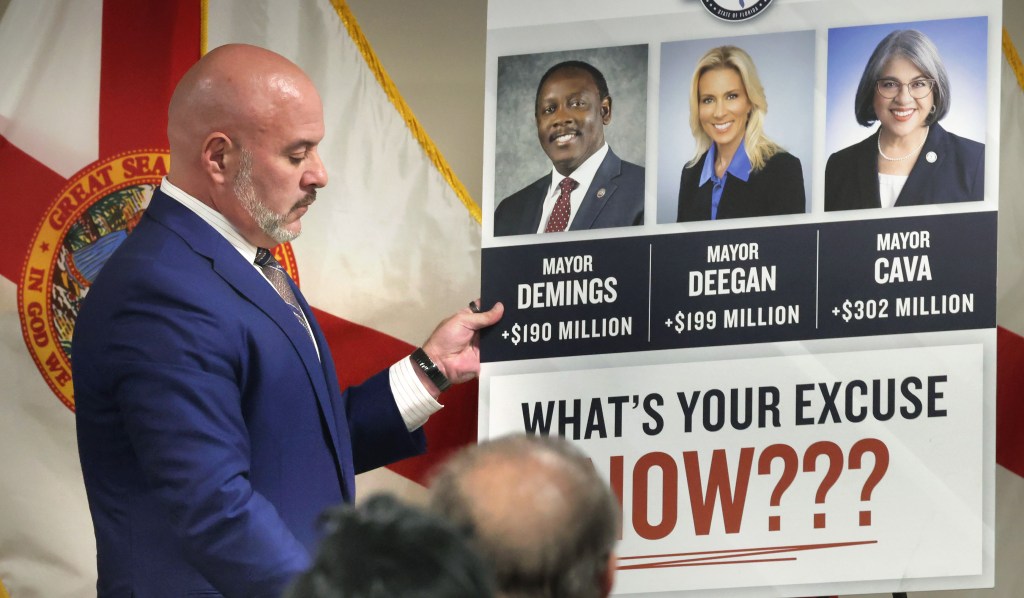
Standing next to a poster with numbers totaling $1.5 billion in alleged waste emblazoned next to the names of cities and counties, Ingoglia said his formula found Orlando’s excess spending totaled just $22.3 million.
But, he argued, that means there’s still room to shave off the property tax rate and save property owners some money on their bills.
“This is a relatively sane keel of spending in an insane spending environment,” he said. “You can cut this out of the budget easily.”
Mayor Buddy Dyer has argued that local governments feel the same burdens as families: insurance is expensive, building materials are spiking and public safety salaries are ever rising.
In a statement following Ingoglia’s remarks, he reiterated his belief that the city spends wisely.
“I’m proud of Orlando’s strong fiscal management,” Dyer said. “For more than a decade, we have maintained the same millage rate and delivered a balanced budget each year, all while meeting the needs of our growing community and the 75 million visitors who experience our city annually.”
Ingoglia has barnstormed the state since he was appointed CFO in July. First he launched audits in a selection of cities and counties as part of a Florida DOGE effort, and more recently he’s returned to outline how he believes they’re overtaxing and overspending.
His formula consists of taking a local government’s spending in 2019, adjusting it for inflation and population growth, and considering any further growth excessive.
Using that formula, he’s argued that Orange County overspends by $190 million and Seminole County by $48 million. He argued that his tempered praise of Orlando, run by a Democratic mayor and majority on the city council, is proof that his analysis isn’t made through a Republican lens.
“We’re proving today that this isn’t partisan,” he said.
State Rep. Anna Eskamani, D-Orlando, sat in the second row of the news conference in an industrial park just west of Epic Universe. She was perhaps the only Democrat in the room of GOP party activists, who frequently intend Ingoglia’s so called FAFO events – officially “Florida Agency for Financial Oversight,” but also an open reference to the phrase, “F*** around and find out.”
Afterward, she said she didn’t find his analysis credible.
“The CFO hired a private camera crew with public money to accompany him to these kinds of events,” said Eskamani, so far the lone candidate to run for mayor of Orlando in 2027. “The CFO doesn’t have the best track record on efficiency, and the fact that he wants to spend more government money to analyze efficiency I find very ironic.”
Central Florida governments led by both parties also have largely panned Ingoglia’s method, arguing he doesn’t take unfunded mandates from the state government into account, nor the region’s need to also provide services for 75 million tourists annually.
In Orlando, the city hasn’t changed its property tax rate of $6.65 per $1,000 in taxable value in 12 years. Because of new construction and rising property values, the city is expected to rake in $21 million more in property tax revenue than the year prior.
“We continue to listen to our residents and make investments that reflect their priorities,” Dyer said in a statement. “Last year alone, the city invested $406 million in police and fire services, more than we generated in property taxes ($360 million).”
As the city moved toward approving its $1.8 billion budget, Dyer noted in an interview that cities and counties feel the strain of rising costs on everything from personnel wages – particularly in public safety – to equipment and construction costs.
“When I started out, a fire station cost about a million and a half, and now we’re talking $12 million or $13 million for a fire station,” Dyer said at the time. “So the cost of things has gone up substantially.”
Ingoglia already took aim at some specific line items in Orlando’s budget at a news conference in Jacksonville last month. He blasted a $6,000 stipend for the city’s poet laureate program, as well as $70,000 on hot yoga for employees and $500,000 to “count trees.”
Soon after, a city spokesperson said the city inventories its trees to treat for damage and disease – and that program is funded by money from a state grant, and a fund paid into by developers of new construction, not from property taxes.
The spokesperson said yoga is provided as part of the city’s Employee Wellness Program, which helps create a healthier workforce and leads to lower costs for health care and risks associated with workplace accidents.