
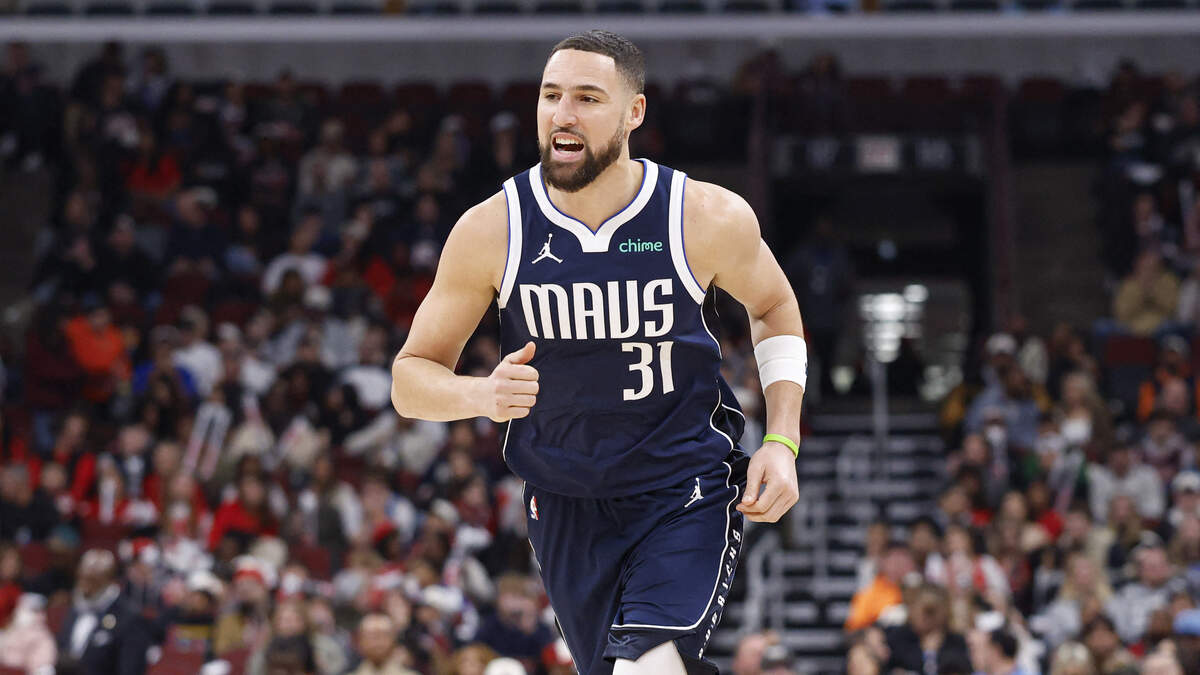
In officially agreeing to join the Miami Heat on Sunday, Klay Thompson — one of the most accomplished shooters in NBA history — joins a long list of NBA stars who have chosen to spend the autumn of their careers in South Florida.
Heat president Pat Riley has long believed the teams with championship aspirations need older veterans around their core, players with the savviness, mettle and experience to thrive during harrowing postseason moments.
Thompson certainly fits that bill; his key role on four championship teams, combined with his still-exceptional distance shooting (he’s fourth all time in three pointers converted) made him the Heat’s first choice to fill out its perimeter rotation and help spread the floor around Giannis Antetokounmpo and Bam Adebayo.
The Heat has been here before, of course. In fact, the 36-year-old Thompson — who committed to a two-year, $11.48 million deal, with a $5.6 million salary in year one and a $5.88 million player option in Year 2 — becomes the 23rd former All-Star player who was acquired by the Heat at age 33 or older.
All 23 joined Miami since Riley left the Knicks for the Heat 31 years ago, just before the Heat’s eighth season.
And that list of 23 doesn’t even include mid-‘30s pickups who were never All-Stars previously, a group that included major success stories Shane Battier, Anthony Mason (his only All-Star invitation came during his one season with the Heat) and P.J. Tucker and more forgettable marriages with Kendall Gill, Erick Dampier, Trevor Ariza and others.
Nor does that list of 23 include distinguished players who joined the Heat before they were 33 but played into their mid-30s here, a group including Tim Hardaway, Goran Dragic and Dan Majerle.
If this goes as planned, Thompson would follow in the footsteps of Dwyane Wade, whose Heat preretirement reunion was a rousing success, or Ray Allen, who was a key component on a Heat team that won a title and another that made the NBA Finals.
But there have also been many mid-30s former All-Stars who couldn’t muster anything remotely close to greatness during their twilight tours with the Heat.
Which category Thompson will fall under is the question. One scout said he’s still a very good shooter and effective ball handler, but his defense has regressed, even though he held opponents to 43.6% shooting last season (compared to the 46% those players shot overall).
Thompson — whose total salary from the Heat and Mavericks is about $4 million less than the $17.5 million he would have earned without the buyout — averaged 11.7 points and shot 38.3 on threes, but just 41.8% on two-pointers, well below his 48.5 career average. His rebounds and assists per 36 minutes were his lowest in a decade.
“Klay is one of the most iconic players to ever suit up in the NBA,” Riley said. “A four-time battle tested World Champion who will fit perfectly into his role as an all-around player at both ends of the court. We all talk about his shooting skill, but there is so much more he brings to the game. We are blessed that Klay chose the Heat in our quest to challenge for championships.”
Here’s a look at the other 22 former All-Stars added by the Heat at age 33 or older, broken down into categories:
Smashing success stories
▪ Wade: His 93 games in his second tour with the Heat, at ages 36 and 37, were a success on many levels: It extinguished any remaining animosity lingering from his financially driven decision to leave for the Chicago Bulls two years earlier. It also gave him the full-circle Heat career denouement that he richly deserved. But Wade also was still really good, averaging 14 points on Heat teams otherwise lacking star power.
▪ Allen: There would have been no second consecutive championship in the Big 3 era without Allen’s last-gasp three-pointer that sent Game 6 of the 2013 Finals against the Spurs to overtime and allowed Miami to win that game, and Game 7 two nights later. Allen played a second season in Miami, and his overall work here, at ages 37 and 38, was very good (10.3 points per game, 39.8% three-point shooting).
▪ Alonzo Mourning: After kidney disease temporarily derailed his career, and after playing 30 games over parts of two seasons with the Nets, Zo got the storybook ending he deserved, playing a key reserve role behind Shaquille O’Neal on the Heat’s first championship team and contributing his usual ferocious defense, and more, during 66 starts and 186 appearances during his four final NBA seasons (ages 34 to 37).
▪ Gary Payton: Yes, there was friction and clashes with teammates (including a verbal altercation with Wade) during that 2005-2006 title season and the year that followed. But Payton’s edginess at times could galvanize the team, and he could be a buffer between Riley and the players when needed.
Most importantly, he achieved what he came here to do at ages 37 and 38: Contribute ball-handling, veteran leadership and defense to an NBA champion. His numbers in 149 games and 53 starts were middling — 6.6 points, 41% percent — but the overall contribution was not.
Helpful components
▪ Andre Iguodala: He gave the Heat very good moments in several of its 25 playoff games during the NBA Finals run at the Disney bubble amid the COVID pandemic. He averaged just 4.4 points and shot 39.6% in 84 games and five starts over two seasons here, at ages 36 and 37.
▪ Kevin Love: Averaged 7.8 points, hit some timely threes, threw some beautiful outlet passes and was a locker room favorite in 99 games and 31 starts over 2 ½ seasons here, at ages 34 to 46.
▪ Terry Porter: He was very good in 50 appearances during his one year as the Heat’s backup point guard, averaging 10.5 points and shooting 41.1% on threes, at age 35, during the height of the Knicks-Heat rivalry (1998-99).
▪ Rod Strickland: At 35, the veteran point guard averaged 10.4 points and 6.1 assists in 76 games and 64 starts for a bad Heat team in 2001-02. He went on to play three more seasons elsewhere.
Helpful and yet disappointing
▪ Kyle Lowry: You also can put Lowry in the “it’s complicated” category. He accomplished more than Iguodala and Love here, and his overall work statistically exceeded Payton’s, but the 2 ½ seasons didn’t come anywhere close to fulfilling expectations of the three-year, $85 million contract and reflected an immense regression in production from his Toronto tenure.
Playing here between ages 35 and 37, Lowry averaged 11.4 points and 5.8 assists, and had some good moments in the playoffs, while appearing in 155 games and starting 142.
▪ Joe Johnson: After joining Miami following a February buyout with the Nets, the seven-time All-Star was a huge help during 24 late-season starts in 2015-16, averaging 13.4 points and shooting 51.8% from the field. The disappointment was the seven-game Eastern semifinals loss to Toronto, in which he shot 3 for 23 on threes. He signed a two-year, $22 million contract with Utah two months later.
Modest or negligible impact
▪ Eddie Jones: His second tour with the Heat, at age 35, was underwhelming. Signed in February 2007 after a Grizzlies buyout to fill in for the injured Wade, Jones averaged 9.5 points in 27 starts but just 2 for 9 in a first-round playoff sweep by the Bulls. He played one more NBA season, for Dallas.
▪ Chris Gatling: He filled the boxscore during his first half season tour with the Heat six years earlier, in 1995-96. But his short second stint with Miami produced modest returns (6.4 ppg in 54 games, 1 start) at age 34.
▪ Steve Smith: Like Jones and Gatling, he also returned for a final act in South Florida, finishing his career by averaging 1.8 points in 13 games for Miami at age 35, while playing sparingly in that 2004-05 playoff run that ended in a Game 7 Eastern finals loss to Detroit.
▪ A.C. Green: The NBA ironman averaged 4.5 points and 3.8 rebounds in 82 games (one start) for the Heat in 2000-01, at age 37.
▪ Rashard Lewis: Played here the final two seasons of the Big Three era, at ages 33 and 34, and was an asset at times the first year, but overall averaged just 4.8 points in 115 games and 15 starts.
▪ Juward Howard: The off-court contributions and veteran voice during the Heat’s Big 3 era should not be glossed over, but the on-court opportunities and production (2.2 points in 92 games and two starts) were minimal during his three years here (ages 37 to 39). Erik Spoelstra later hired him as a coach.
▪ Zydrunas Ilgauskas: Followed LeBron James to Miami but averaged just 5.0 points and 4.0 rebounds in 72 games and 51 starts in his single season here, and his diminished footspeed at 35 left him out of the rotation during the second round and Finals loss to Dallas.
▪ Amar’e Stoudemire: Signed in July 2015 at age 33, he averaged just 5.8 points and 4.3 rebounds in 52 games and 36 starts and was benched for the final two games of the Heat’s seven-game Eastern finals loss to Toronto. He never played in the NBA again, though he suited up for three years in Israel.
▪ Otis Thorpe: The respected power forward signed with the Heat in the summer of 1999 at age 37, averaged just 5.5 points and 3.3 rebounds in 51 games and one start and was traded to Charlotte in the Eddie Jones/Jamal Mashburn deal.
Utterly forgettable
▪ Penny Hardaway: Attempting a comeback after two seasons away, he reunited with Shaquille O’Neal in Miami before the 2007-28 season, at age 36, averaged just 3.8 points on 36.7% shooting in 16 games and eight starts, and was waived Dec. 12 to make room for Luke Jackson. The four-time All Star never played again.
▪ Jeff Malone: Finished his distinguished career with seven unremarkable games for Miami at age 34, in Riley’s first season here (1995-96).
▪ Jerry Stackhouse: Signed days before the first regular season game of the Big 3 era, Stackhouse, at 36, averaged 1.7 points in seven games and was waived exactly a month later to make room for Dampier. He played 67 more NBA games, for the Hawks and Nets.
News note
The Heat has room under the hard capto fill its 14th and 15th roster spots at any time. Miami will look to add a power rotation player with the 14th spot (ex-Bulls center Nick Richards remains a strong consideration) and likely will be patient with the 15th spot.
This story was originally published August 23, 2026 at 8:05 PM.

Miami Herald
Barry Jackson has written for the Miami Herald since 1986 and has written the Florida Sports Buzz column since 2002.