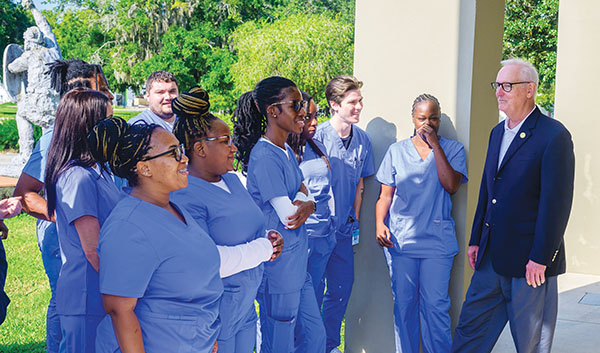
St. Johns River State College President Joe Pickens, right, meets with health sciences students Monday during the first day of fall classes at the Palatka campus. (PETER WILLOTT/Palatka Daily News)
Students returned to St. Johns River State College on Monday for the start of the fall semester, arriving at an institution that continues to grow in size, programs and ambitions.
With major construction underway or planned, an expanding list of bachelor’s degrees, student housing and enrollment that has climbed sharply in recent years, SJR State is a significantly different institution from the community college President Joe Pickens took over nearly 18 years ago.
And Pickens believes the transformation is far from finished.
“We’ve grown, frankly,” Pickens said. “It is a source of pride for me. And it should be, I hope, for the community.”
Pickens became president in November 2008, succeeding longtime President Robert McLendon, who oversaw much of the creation and physical expansion of the college, including the Orange Park and St. Augustine campuses.
Pickens said his role has been different.
“My job is to make sure that that represents stability but not stagnation,” he said.
That philosophy is visible throughout the Palatka campus.
The Florida School of the Arts is emerging from a major renovation and expansion, a student housing facility opened in 2025 and additional improvements are planned. Pickens said about $28 million in new construction for science, technology, engineering and math facilities is preparing to move forward.
Together, he said, the projects reflect his vision of preserving the college while preparing it for future students.
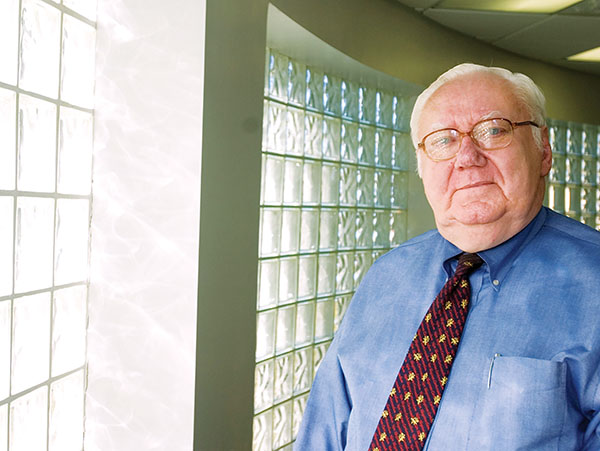
St. Johns River Community College President Robert L. McLendon Jr. is pictured in 2008. (File photo by PETER WILLOTT)
The transformation is perhaps most visible at the Florida School of the Arts.
Pickens said the college invested about $16 million in the renovation and expansion, money the college largely assembled itself rather than relying on a state Public Education Capital Outlay allocation.
“That’s money that we saved and cobbled together, and we did that on our own,” Pickens said. “I think all of us here are very proud of the fact that we were able to come together and decide that that was a priority and do it and make it happen.”
FloArts is also celebrating its 50th anniversary during the 2026-2027 academic year.
Pickens hopes the combination of renovated facilities, expanded programs and student housing will increase enrollment at the arts school, which draws students from around Florida.
“We are blessed to have it,” Pickens said. “As long as we’re going to have it, then we are going to try to make it, as best we can, unique.”
Student housing is another important part of that strategy.
Beck Hall, a residential facility for SJR State students, opened in 2025 on the Palatka campus. The $20 million residence hall is named for Carl Beck, the former CEO of Beck Automotive Group, who also served as a college trustee and St. Johns River State College Foundation chairman emeritus.
Beck died Aug. 11, 2021, at age 81.
The facility provides on-campus housing for students, including student-athletes and Florida School of the Arts students who come to Palatka from outside the area. Pickens said he hopes the combination of housing, new facilities and expanded programs will help FloArts enrollment grow.
“I’m looking forward to seeing what kind of growth we can effectuate there,” he said.
The college’s physical growth has been accompanied by a major change in academics.
When Pickens arrived, the institution was still St. Johns River Community College and did not award its own bachelor’s degrees. Today, it offers 10 bachelor’s programs in areas including education, nursing, business, criminal justice, technology and the arts.
That change is particularly personal for Pickens.
Before becoming college president, he served in the Florida House of Representatives from 2000 to 2008 and was involved in legislation that allowed Florida community colleges to begin offering workforce-focused bachelor’s degrees.
“For me to be involved in that as a policymaker and then get to come home and implement that policy here at my college, in my home, has been one of the most rewarding parts of my career,” Pickens said.
Despite becoming a state college, Pickens said, SJR State has not abandoned its original mission.
“We will always be the community’s college, and we will never lose sight of that,” he said.
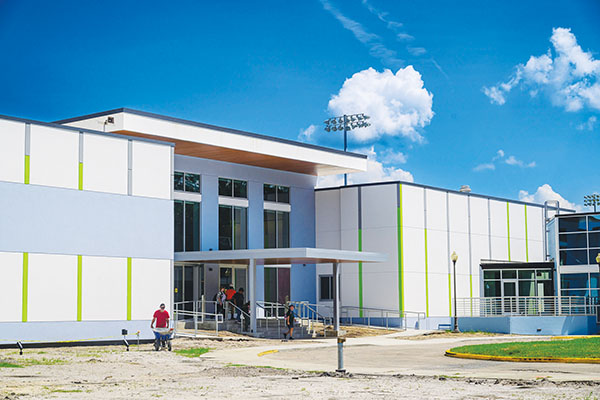
The newly renovated and expanded Florida School of the Arts building stands on the St. Johns River State College Palatka campus. The approximately $16 million project is part of the college’s continuing investment in arts education and campus growth. (PETER WILLOTT/Palatka Daily News)
Its bachelor’s programs are intended to meet workforce needs, allowing students to earn four-year degrees while remaining closer to home.
Pickens said proposed programs must demonstrate employer demand and enough potential students to sustain them.
“We don’t just offer them because we think that’s a good degree to offer,” he said. “The ones that we offer are because there is a demonstrable need for that in our service area.”
The college also continues to offer law enforcement and corrections training, as well as emergency medical technician and paramedic programs. Pickens said fire training is among the areas college officials have discussed for possible future expansion.
Pickens said the college entered the fall semester with about 8,700 students, including 1,250 students at the Orange Park campus, 1,800 at the St. Augustine campus, 1,400 dual-enrollment students and about 4,000 students taking classes online. The Palatka campus has about 650 students, including roughly 80 student-athletes, 120 FloArts students and about 450 students from Putnam County.
That follows three consecutive years of about 10% annual enrollment growth, amounting to about a 31% increase over three years, amounting to about a 31% increase over three years.
“I think that by the time that we (get to the second half of the fall semester) … we’ll be probably slightly ahead of last year and continuing a more gradual, and I think a more sustainable, increase toward, sooner rather than later, 10,000 students total,” he said.
Much of the growth reflects changes in how students attend college, with many students taking classes online while others participate through dual enrollment programs while still in high school.
Pickens said online education has effectively become SJR State’s largest campus, something he could not have predicted two decades ago.
“The next 20 years is going to be driven by technology in ways that maybe we can’t … envision,” he said.
That flexibility, Pickens said, is part of the college’s continuing mission.
Students can attend full time or part time and take classes online, in person or through hybrid formats, making college more accessible for those balancing work and family responsibilities.
For recent high school graduates, Pickens said, the smaller environment can also ease the transition into the academic demands of college.
“The whole idea was, ‘How can we make access to public higher education in Florida better?’” Pickens said.