
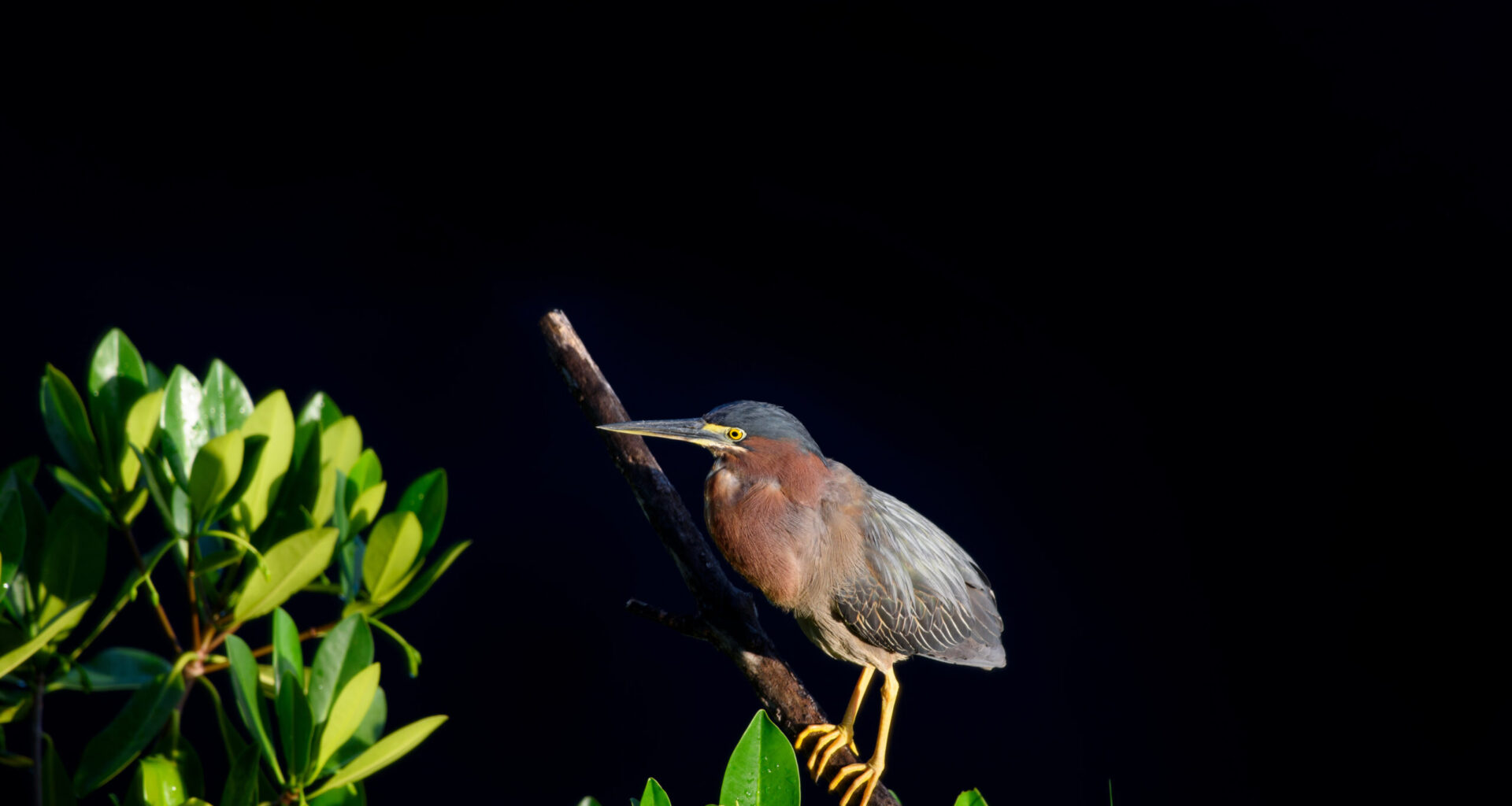
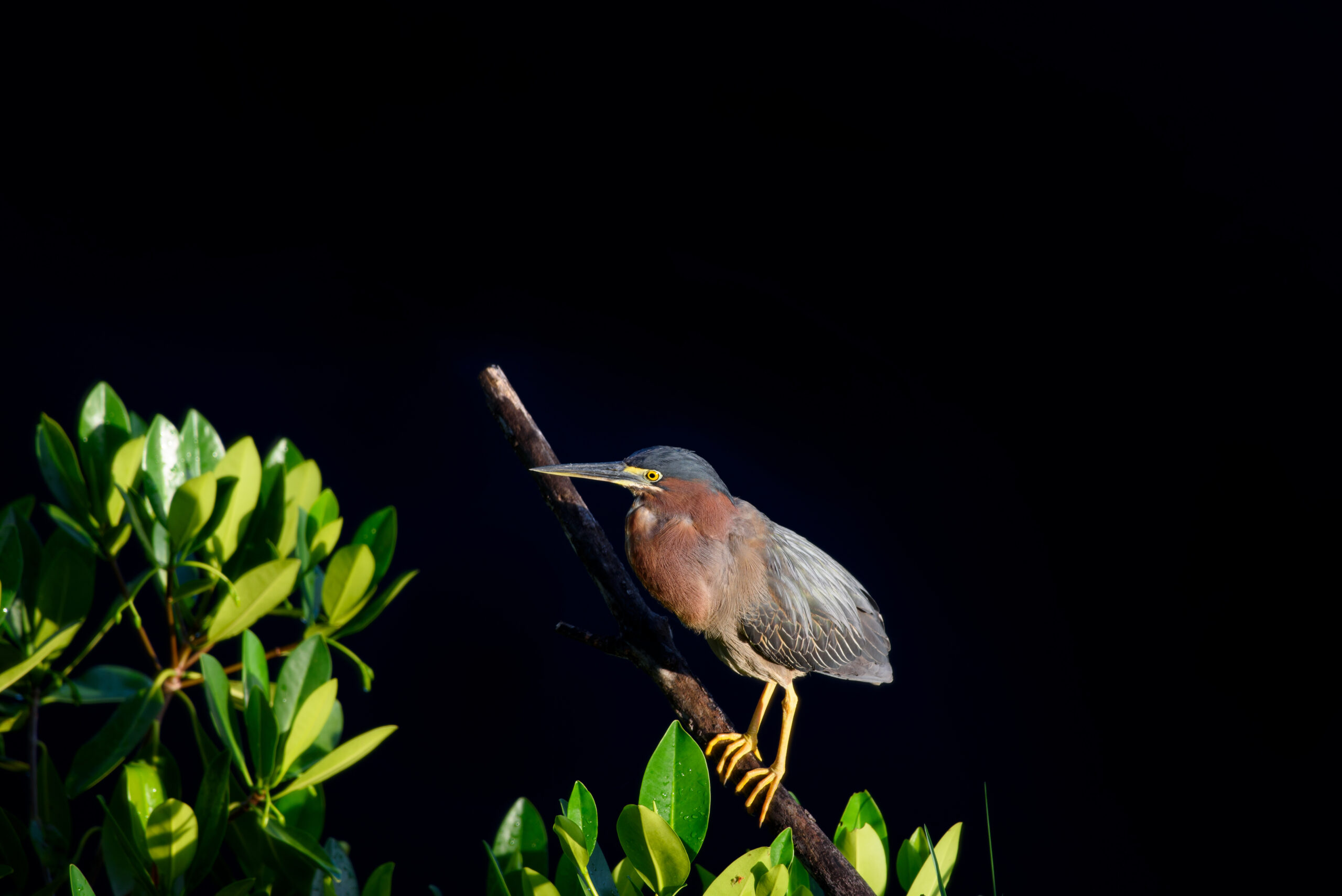
A heron perches on a mangrove. -CALUSA WATERKEEPER / COURTESY PHOTO
It was supposed to be a simple summer job. A contractor set to work clearing Brazilian pepper, Australian pine and other vegetation from the 47-acre Seven Islands development in Cape Coral.
Instead, an estimated 570 feet of red mangrove shoreline was also torn out. The developer claimed it was a mistake. The South Florida Water Management District later issued a notice of violation.
“The plan was to leave the mangroves on the spreader waterway and put seawalls upland of that,” says Jason Pim of the regional advocacy group Calusa Waterkeeper. “But, unfortunately, whoever hopped in the excavator wasn’t aware of that plan.”
The incident wasn’t the first time mangroves have been removed in Cape Coral or in the interconnected coastal system of South Florida. In 2019, workers clearing vegetation at Four Mile Cove also removed mangroves and were required to replant and mitigate the damage. Property owners in Collier County have done the same, even if on smaller tracts, in recent years.
For conservationists, the incidents raise a question that extends beyond individual cases and beyond Cape Coral: How do you protect a vital part of the coastal ecosystem when the threats aren’t always as simple as someone cutting down trees?
Across South Florida, mangroves are being pressured by development, altered water flow, boat wakes, stronger storms and rising seas. And while mangrove forests are remarkably resilient, scientists say protecting one that’s intact is far easier than rebuilding one after it’s damaged.
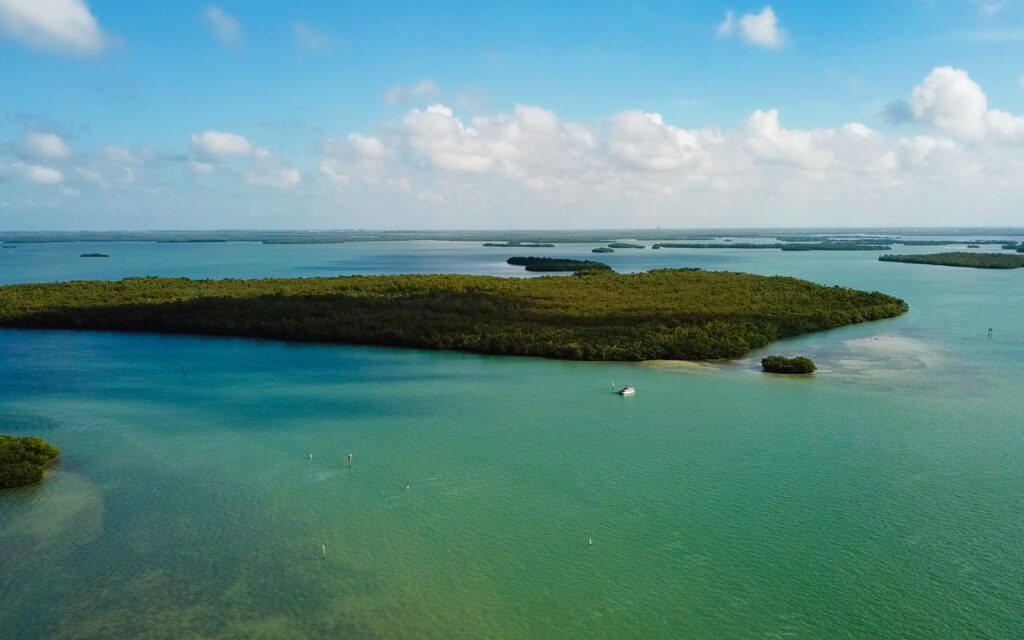
A mangrove forest in Estero. -CALUSA WATERKEEPER / COURTESY PHOTO
Land of the lost
Mangroves are among the most productive ecosystems in South Florida.
Their roots and branches provide habitat and nursery areas for fish, shrimp, oysters, crabs and other organisms.
“Even sharks and the endangered small-tooth sawfish utilize mangrove habitats as a safe place for their pups to grow,” says Ashley Cook, director of conservation at the Charlotte Harbor Environmental Center.
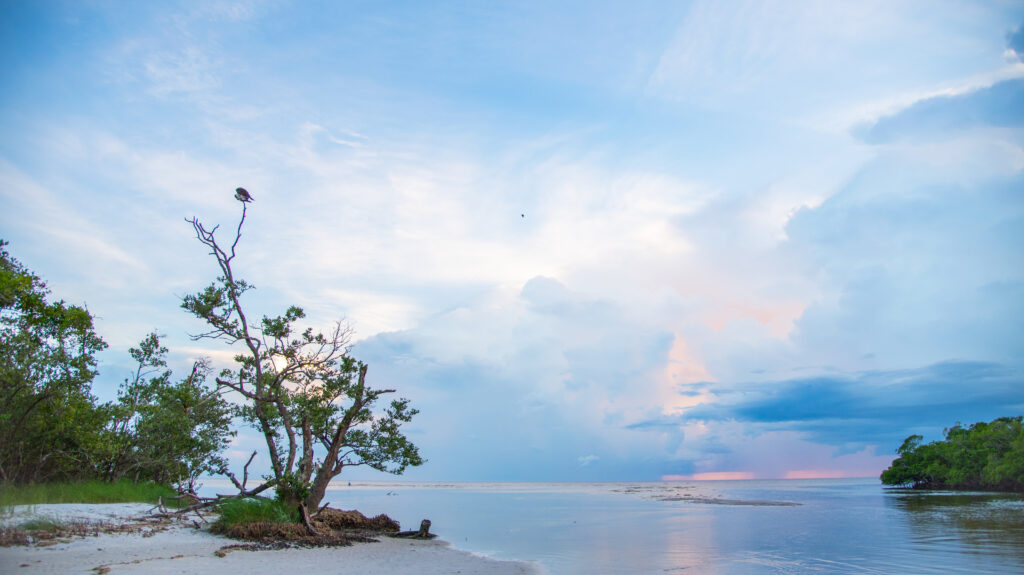
Mangroves stand sentinel on Bunche Beach at sunset. -CALUSA WATERKEEPER / COURTESY PHOTO
Their forests support complex food webs and help filter water, trap sediment and pollutants, and store carbon. The trees also serve a more immediate purpose for the people living along Florida’s coast: They provide protection from storms.
That protection can be easy to overlook when mangroves are viewed as an obstacle to a better view, a boat launch or a development project. But their extensive root systems stabilize shorelines, while the forest can absorb some of the energy from waves and storm surge.
According to Cook, Charlotte Harbor has lost about 60% of its historic mangrove habitat to development and other human causes. Hurricane Irma alone, she added, destroyed the equivalent of over 28,000 football fields of mangroves.
“So, you have strong storms, hurricanes, and development kind of knocking out these really beneficial trees,” she says.
CHEC recently began a mangrove-replanting program in storm-damaged neighborhoods.
“The more we protect the mangroves, the more we are protecting ourselves,” she says.
Mangroves’ Achilles heel
When an established forest is destroyed, its benefits are lost.
And once a mature forest is gone, replacing it isn’t necessarily a matter of planting new trees.
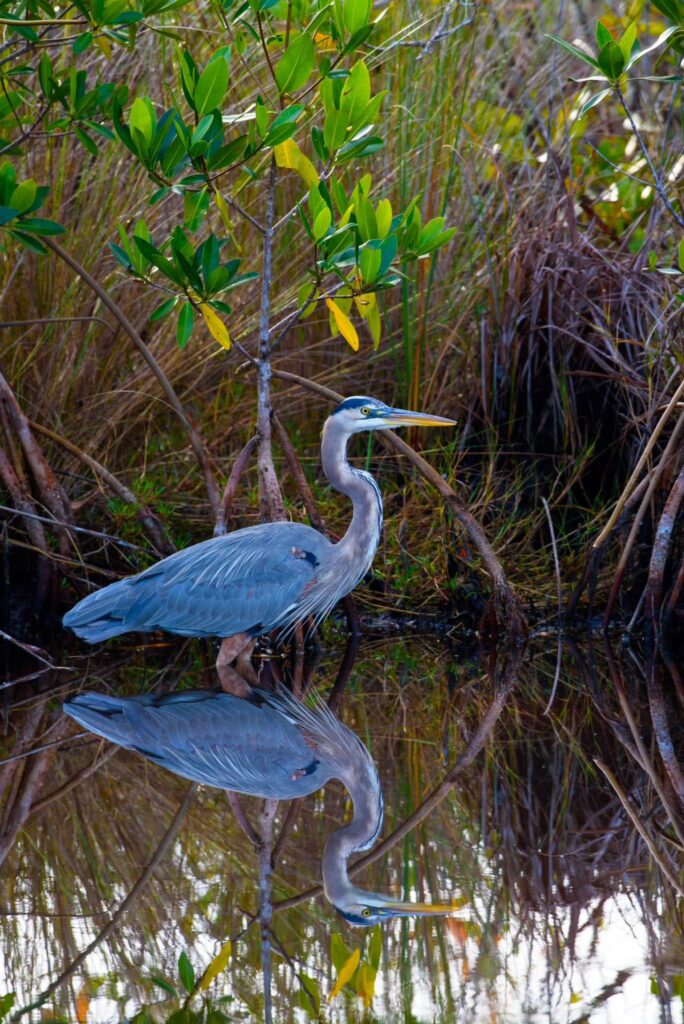
A great blue heron hangs out among the mangroves. -CALUSA WATERKEEPER / COURTESY PHOTO
“Replace is an interesting word, since you will never be able to ‘replace’ that which is lost,” says Kathy Worley, an environmental scientist with the Conservancy of Southwest Florida.
Worley says about 75% of game fish and 90% of South Florida’s commercially caught fish and prawns use mangroves at some point in their lives.
“Mangroves have proven their worth ecologically and economically,” she says.
Even when a forest successfully returns, Worley says, it can take decades to reach maturity. During that time, the ecosystem isn’t providing all the benefits of the mature forest that was removed.
There is another complication: water. “Hydrology is a mangrove’s Achilles heel,” Worley says.
Mangroves depend on the regular movement of tidal water through the forest. Clearing by heavy machinery can compact soil, leave ruts and alter the way water moves through an area. Roads and development can also change drainage and tidal exchange.
If water becomes trapped in a mangrove forest for extended periods or tidal water can no longer move in and out properly, the trees can suffer.
The conservancy’s work at Fruit Farm Creek in Collier County is an example.
Scientists have studied the area since the late 1980s, when its mangrove forest was still alive. After the forest collapsed in the 1990s, leaving an area so devoid of life that even mosquitoes stayed away, researchers investigated the cause and determined that altered hydrology associated with surrounding development was primarily responsible.
In 2010, the conservancy joined with other scientists, local governments and residents to develop a restoration program. Instead of replanting mangroves, scientists tried to restore the disrupted tidal channels and water movement.
The project showed that restoring tidal flow allowed mangroves to begin returning.
In the smaller die-off area, mangrove saplings and young trees became established, a canopy began to form, and wildlife returned. The restoration showed that a mangrove forest affected by human-caused hydrological changes can begin to recover when tidal flushing is restored.
But the larger die-off presents a bigger problem. It has remained barren since 1995. The soil has become more oxygen-deprived, and the peat has collapsed.
The lesson, Worley says, is that restoration must address why a forest died in the first place. “Restoration can only work if you identify the reason … and rectify it.” The longer a forest remains gone, she says, the harder and more expensive restoration becomes.
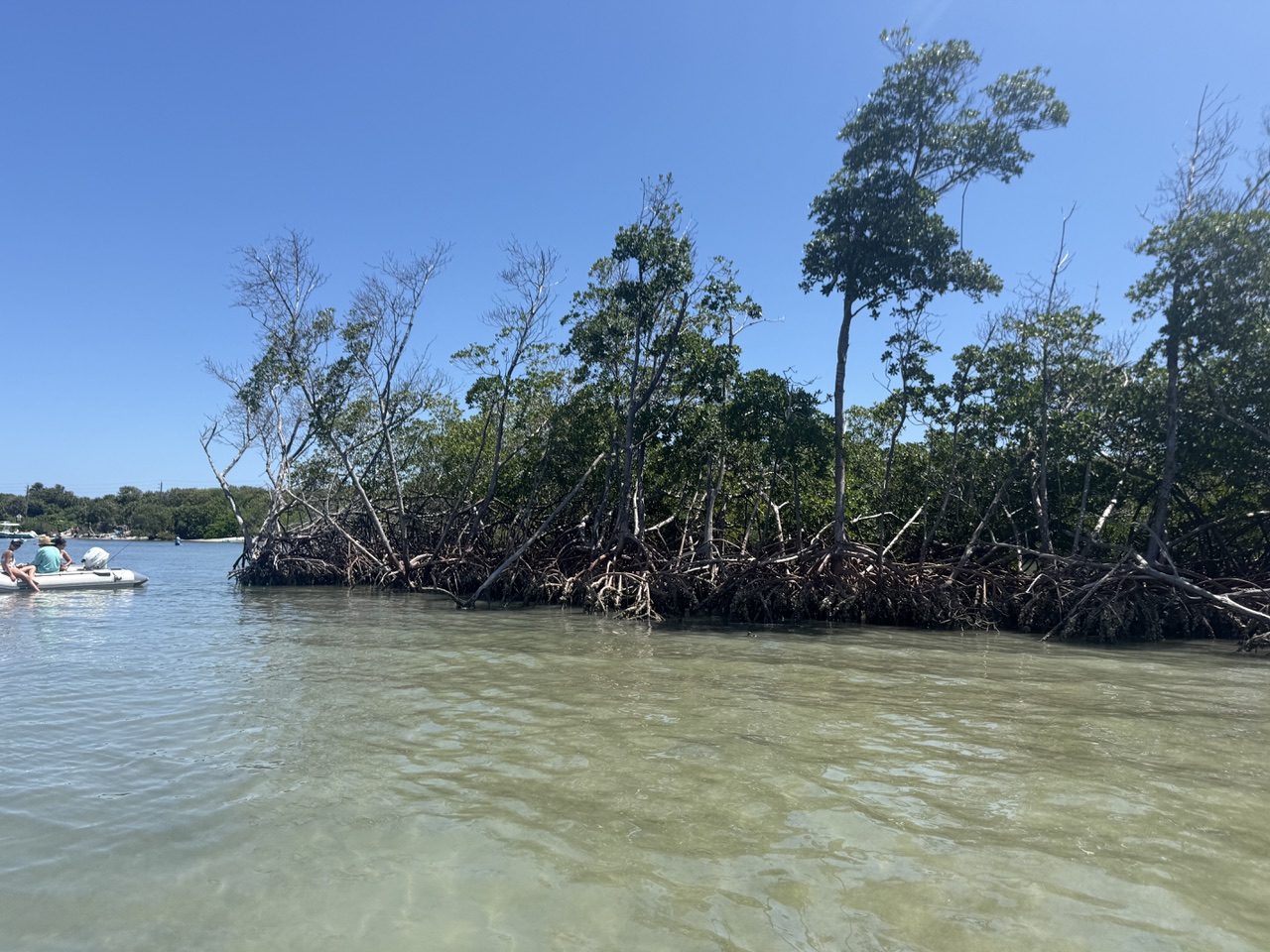
The Jupiter Narrows Conservation Alliance is trying to restore three mangrove islands. -JUPITER NARROWS CONSERVATION ALLIANCE / COURTESY PHOTO
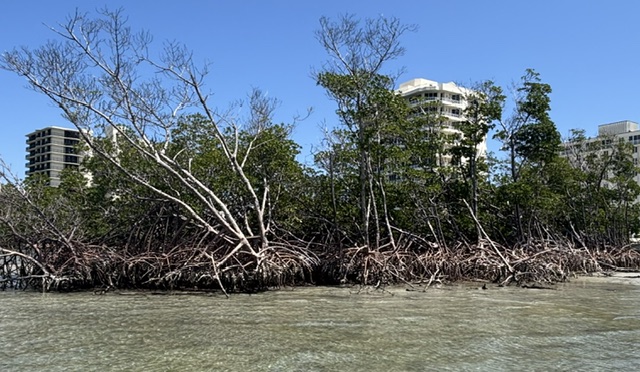
Wave action from boats has disturbed mangrove islands in the Jupiter Narrows. -JUPITER NARROWS CONSERVATION ALLIANCE / COURTESY PHOTO
A thousand cuts
Threats to mangroves aren’t always obvious. Pim describes the cumulative effect as “death by a thousand cuts.”
Development, shoreline changes, boat traffic, erosion and storms can all put additional stress on forests. “Development’s going to happen, but we can be doing it better,” Pim says.
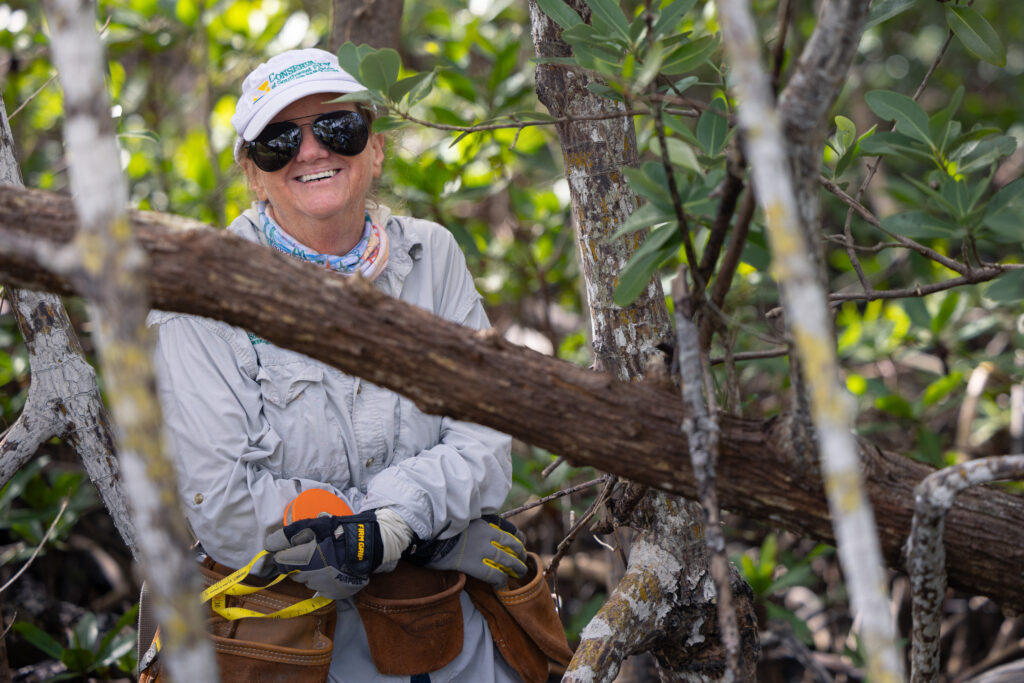
Kathy Worley, a mangrove scientist with the Conservancy of Southwest Florida. -CONSERVANCY OF SOUTHWEST FLORIDA / COURTESY PHOTO
He points to Tarpon Point in Cape Coral as an example of development that was designed to leave mangroves intact rather than treating them as an obstacle.
Boat traffic presents another kind of challenge. In Jupiter Narrows in Palm Beach County, Sue Panella has watched mangroves decline as the waterway has narrowed and become increasingly affected by boat wakes. “Development brings people. People bring boats,” Panella says.
The wakes create additional wave energy along the shoreline, contributing to erosion and damaging the mangrove habitat. Panella launched the Jupiter Narrows Conservation Alliance to address the problem with a restoration project that includes limestone breakwaters designed to reduce wave energy and the planting of hundreds of mangroves.
Through significant contributions from residents and businesses, along with a recent $260,000 from the state, the alliance is only about $150,000 shy of its $1.5 million goal. “We’re just finalizing the selection of a contractor and signing a contract, and we hope to be in the water within a month,” she said in early August.
She says a similar local seagrass project resulted in an 860% increase. “So people will see some real changes within a couple of years, and our goal is to get these back to where they were 10, 20 years ago,” she says.
She’d like to see the permitting process streamlined, though. The group spent about a year and a half obtaining permits to save three mangrove islands, Panella says, and during that time, one of the islands died.
A new strategy
Florida’s basic protections against mangrove removal have remained unchanged for years. The state’s Mangrove Trimming and Preservation Act is the primary framework governing mangrove trimming and alteration, with the Florida Department of Environmental Protection and delegated local governments handling permitting and enforcement responsibilities in applicable areas.
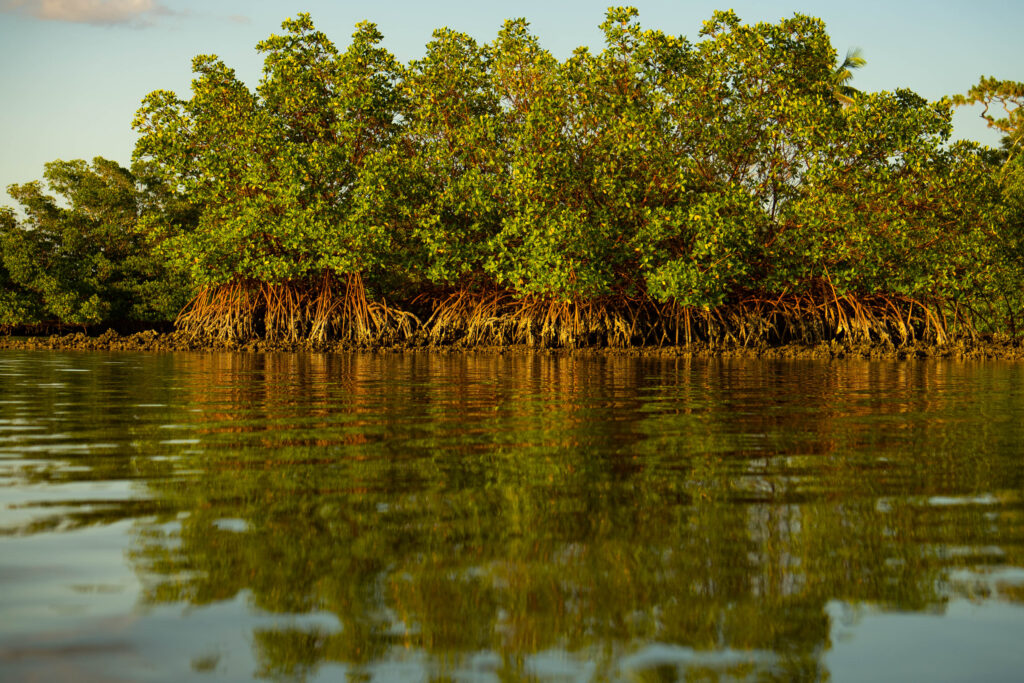
Mangroves in Collier County. -CONSERVANCY OF SOUTHWEST FLORIDA / COURTESY PHOTO
But the state did make a significant change this year in its approach to coastal resilience.
A law signed in March directs DEP to develop statewide standards for nature-based coastal resilience and, by January 2027, begin rulemaking for a more consistent permitting process for projects such as living shorelines, vegetation and seagrass planting, wetland restoration and wave-attenuation devices.
The law also calls for identifying and monitoring threats to mangroves, addressing mangrove and hydrological restoration, and considering the protection of barrier and spoil islands.
The legislation does not replace the state’s existing mangrove protections.
At Clam Bay in Collier County, Conservancy biologists have monitored 12 mangrove plots annually since 1999 to track the health of the forest and identify deteriorating conditions. The system has been affected by altered hydrology, stormwater runoff, impoundment, dredging and other human impacts.
Then came Hurricane Irma in 2017, followed by Hurricane Ian in 2022.
Ian made landfall roughly 40 miles from Clam Bay and brought a powerful storm surge to the Naples area. Worley estimates that Pelican Bay experienced a surge of 6 to 8 feet, while the surge within the Clam Bay mangroves reached 8 to 10 feet. She argues that the mangrove forest helped slow the storm’s force before it reached the community.
This is the paradox facing Florida’s mangroves: The forests are being counted on to protect communities from increasingly powerful storms, even as development and other pressures make them more vulnerable.
Worley is particularly concerned about what happens as sea levels rise.
Mangroves can migrate inland as conditions change, but development and other barriers can prevent that movement, creating what scientists call coastal squeeze. Fragmented forests may have less ability to adapt to changing conditions.
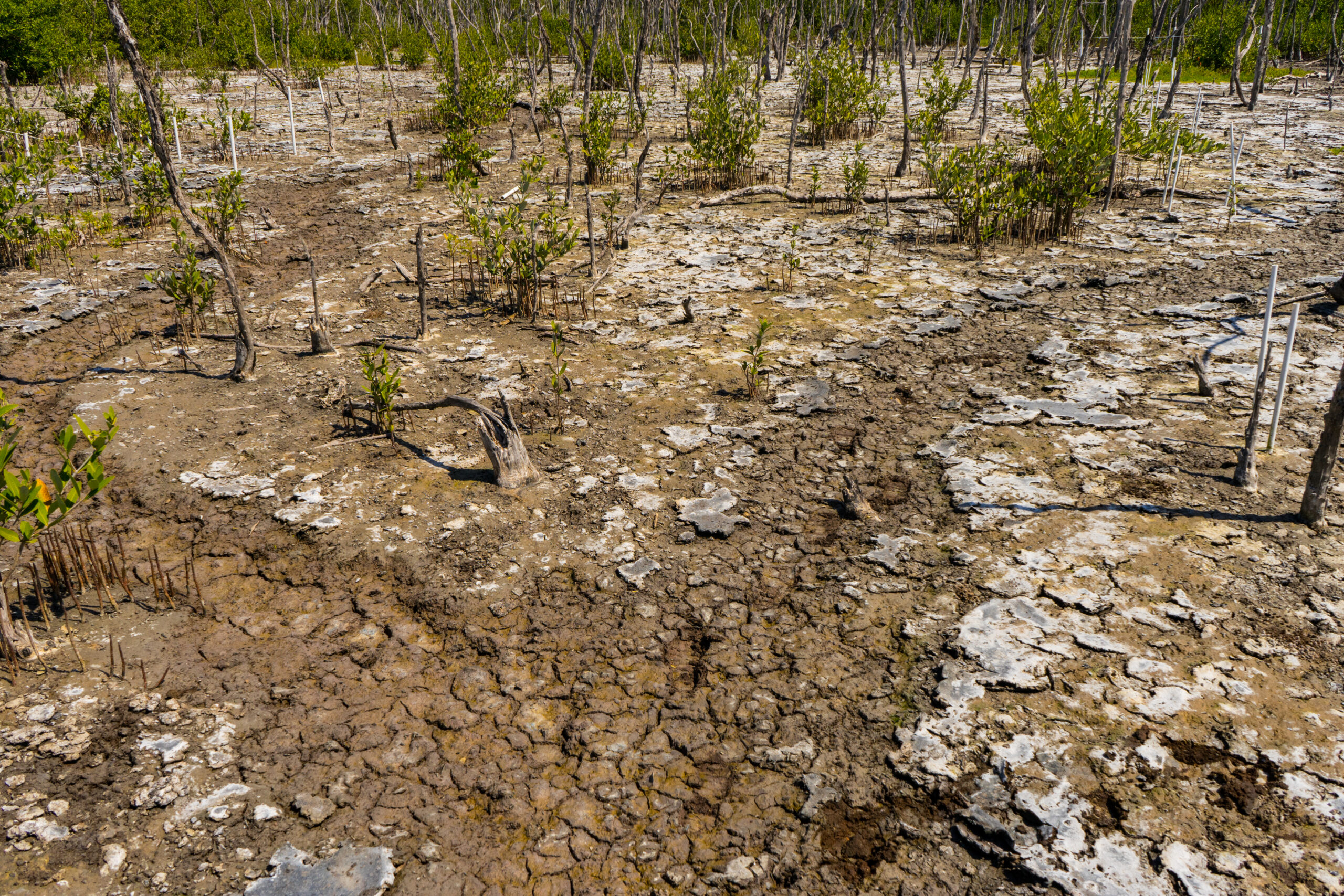
The Fruit Farm Creek mangrove die-off. -CONSERVANCY OF SOUTHWEST FLORIDA / COURTESY PHOTO
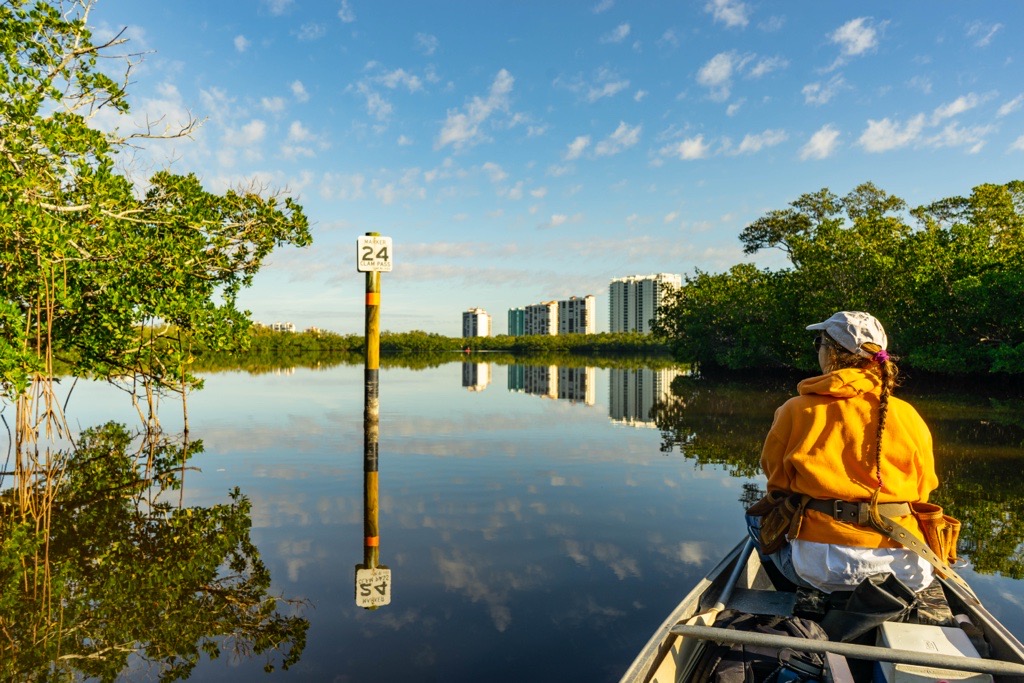
Kathy Worley of the Conservancy of Southwest Florida examines the mangroves of Clam Pass. -CONSERVANCY OF SOUTHWEST FLORIDA / COURTESY PHOTO
Mangroves have historically built soil elevation at rates that generally kept pace with sea-level rise. But if sea levels accelerate and major storms become more frequent, forests may have less time to recover between disturbances.
“If people know that mangroves are something that could potentially save their home or their life, that goes to people gaining a better appreciation for them,” Cook says.
Mangroves can recover and, under the right conditions, be restored. But rebuilding a mature forest takes time. Still, the easiest forest to restore is the one that was never destroyed.
As Pim put it. “Replanting and mitigation are nice, but the most important thing you can do to protect mangroves is to not harm them in the first place.”
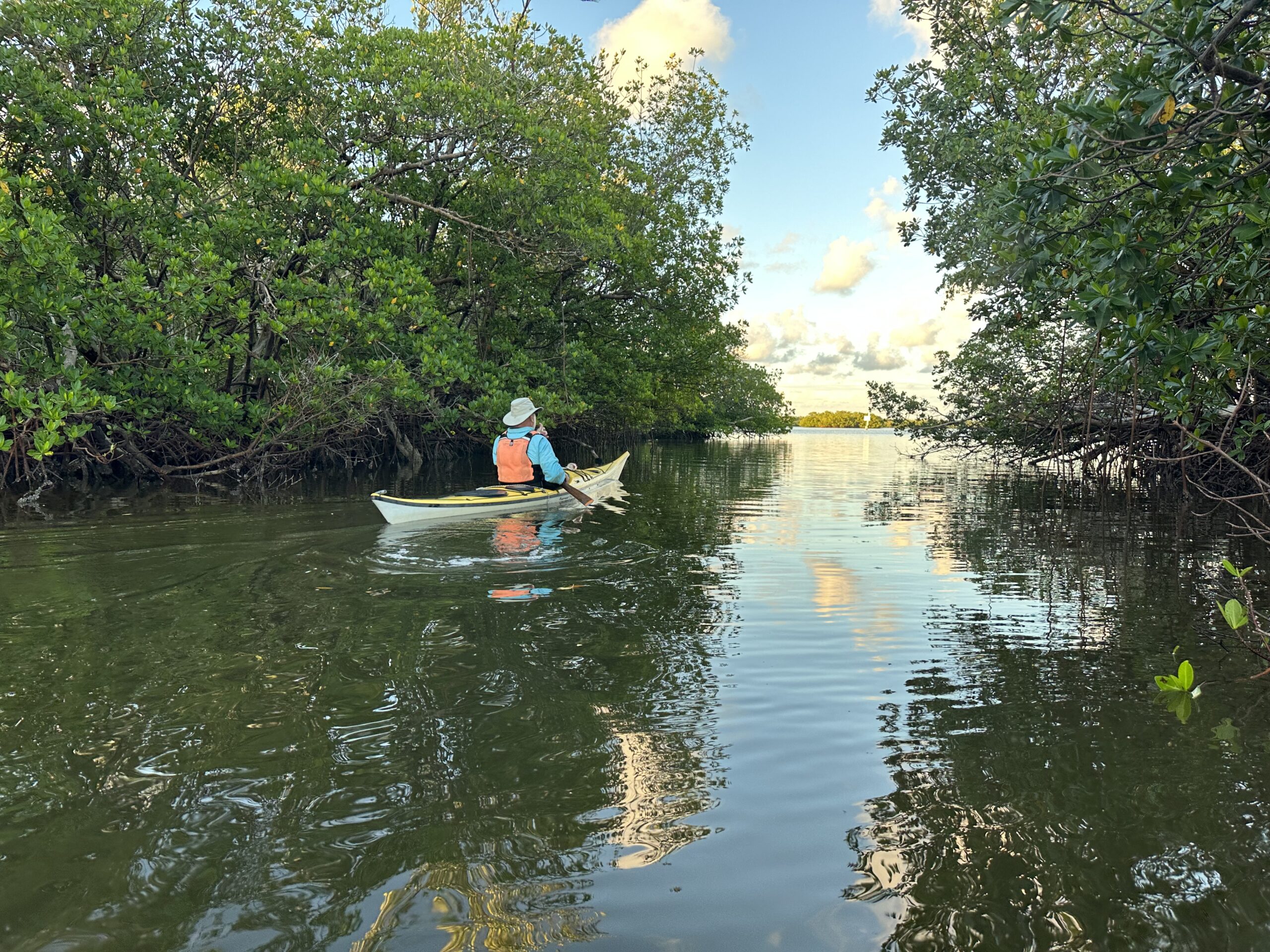
Marine biologist Tom Long provides kayak tours through mangroves, including glowing night tours with bioluminescence, through Rookery Bay in Naples. -KELLY J FARRELL / FLORIDA WEEKLY
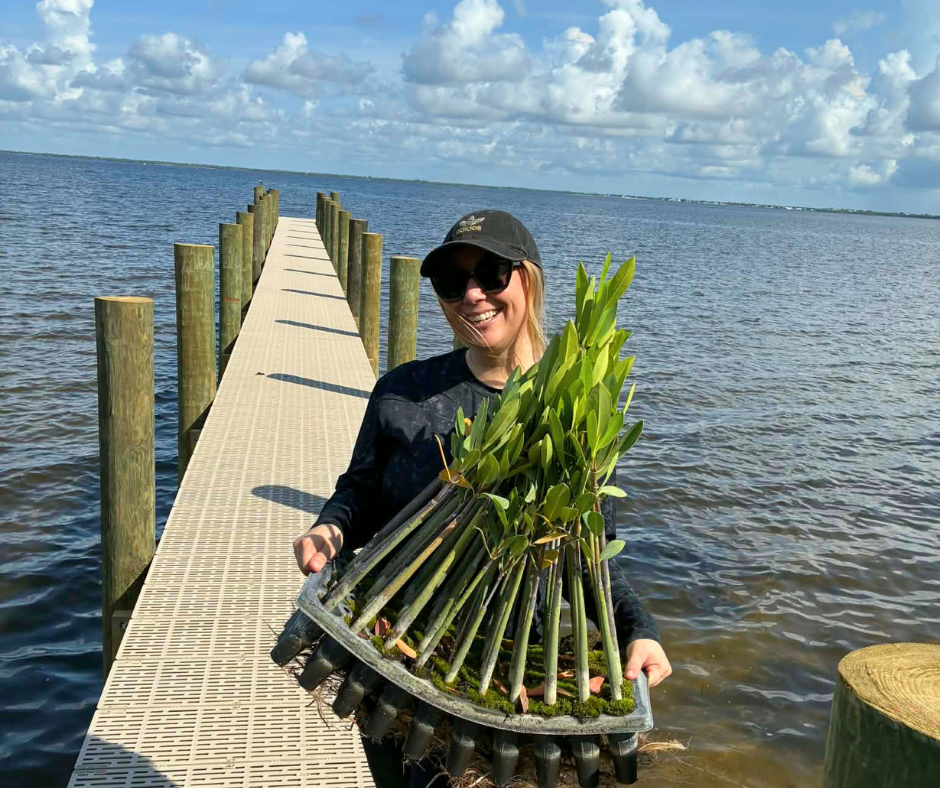
Ashley Cook from the Charlotte Harbor Environmental Center with mangrove propagules. -CHARLOTTE HARBOR ENVIRONMENTAL CENTER / COURTESY PHOTO
In The KNOW:
Support mangrove health
Follow state trimming laws, including compliance with the 1996 Florida Mangrove Trimming and Preservation Act to never cut or alter mangroves without a permit.
Reduce chemical and plastic usage.
Volunteer with environmental groups and coastal cleanups.
Adopt a mangrove through organizations such as Sanibel-Captive Conservation Foundation, ccf.org/adoptamangrove/
Volunteer with Rookery Bay National Estuarine Research Reserve, rookerybay.org.
Participate in beach cleanups through Keep Florida Beautiful, with branches in Collier, Lee, Charlotte and Palm Beach counties, among others. KeepFloridaBeautiful.org.
Keep Collier Beautiful seeks volunteers, group leaders and cleanup request sites for the beach cleanup planned Saturday, Sept. 19. Visit KeepCollierBeautiful.com.
Calusa Waterkeeper –calusawaterkeeper.org
Charlotte Harbor Environmental Center – checflorida.org
Conservancy of Southwest Florida-conservancy.org
Jupiter Narrows Conservation Alliance-jupiternarrowsconservation.org

Mangroves span about 110,000 acres in Rookery Bay, one of the last remaining mangrove forests in North America, stretching from Gordon Pass in Naples all the way to the border of Everglades National Park. -ROOKERY BAY RESEARCH RESERVE / COURTESY PHOTO