
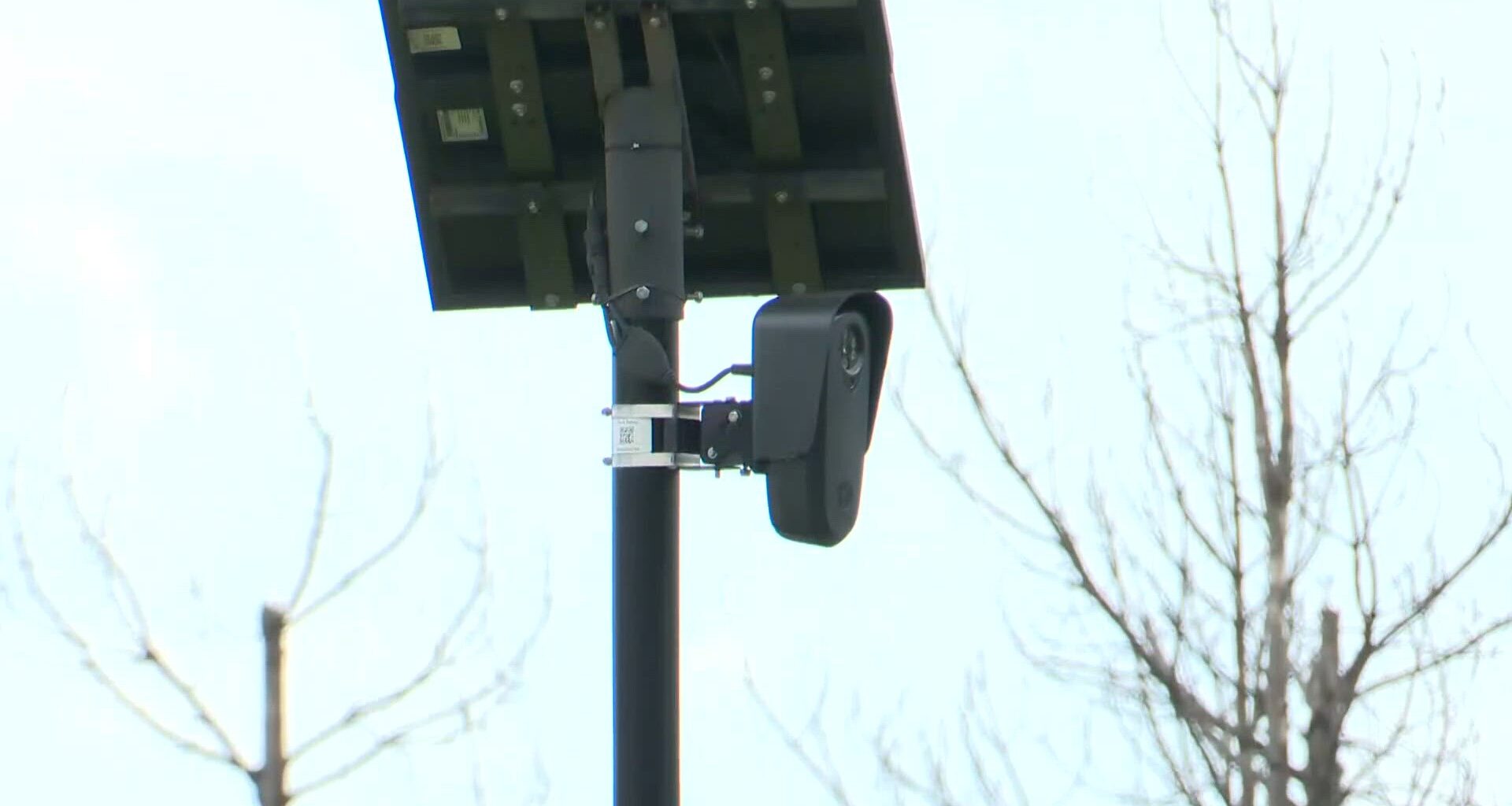
Supporters say the cameras help solve serious crimes, while critics argue they threaten privacy and constitutional rights.
JACKSONVILLE, Fla. — A growing debate over privacy and public safety is playing out in Jacksonville as residents and city leaders weigh the use of Flock cameras, automated license plate readers used by law enforcement to investigate crimes.
Supporters call the technology an important crime-fighting tool. Critics say the cameras amount to government surveillance and threaten residents’ privacy.

This story continues below.
The issue came before the Jacksonville City Council as Council member Jimmy Peluso considers legislation that could change how automated surveillance equipment is regulated and give neighborhoods more input.
“This is a really big deal and it’s a big deal to people,” said Dragon Belloit, “Big deal to everyone.”
Dragon Belloit has been speaking out against Flock cameras for months. She said she believes residents should be able to trust law enforcement without having their vehicles captured by automated license plate readers.
“We should be able to trust police to do their job without having to rely on tracking every single resident of Duval County,” Belloit said.
Belloit said a petition she started opposing the cameras has received more than 600 signatures in Duval County.
Casey Jones also spoke against the technology.
“Y’all were solving crime before you had this, so let’s go back to the old way of solving crime and not violating everybody’s rights,” Jones said.
For Lastasha Hobbs, the issue is personal.
Her son, Maurice Hobbs, was fatally shot in 2017, two days before his 18th birthday. Hobbs said families waiting for justice need investigators to have access to tools that can help solve cases.
“My son deserves justice,” Hobbs said.
Hobbs said she believes Flock cameras can benefit Jacksonville if they are used transparently and responsibly.
“These cameras are being used for the good and I think as long as we use them effectively, transparently, I think this is a great benefit for the city of Jacksonville,” Hobbs said.
Jacksonville Sheriff T.K. Waters has also defended the technology.
Waters previously told First Coast News that Flock cameras are a search tool, not a system designed to track people.
“It’s an amazing tool. It’s a search tool. It’s not a tracking tool,” Waters said.
Waters said the technology has helped the Jacksonville Sheriff’s Office solve 15 murders, 17 kidnappings and 172 missing-person cases since 2024.
Peluso said he plans to introduce legislation addressing concerns he has heard from the community.
“There’s going to be a piece of legislation that I do intend to file,” Peluso said.
He said one possibility would be creating a process for neighborhoods to request that cameras near their communities be removed.
“If certain communities, certain neighborhoods want to remove the cameras nearby, I think there should be a process for that,” Peluso said.
At the same time, Peluso acknowledged that some neighborhoods may want to keep the cameras as an additional safety measure.
“Some neighborhoods may say, you know what, this may be a good thing. We want the additional safety measure,” he said.
Peluso plans to hold a public meeting at 10:30 a.m. Friday at Jacksonville City Hall to discuss automated surveillance equipment more broadly, including policies, regulations and a possible temporary moratorium.