
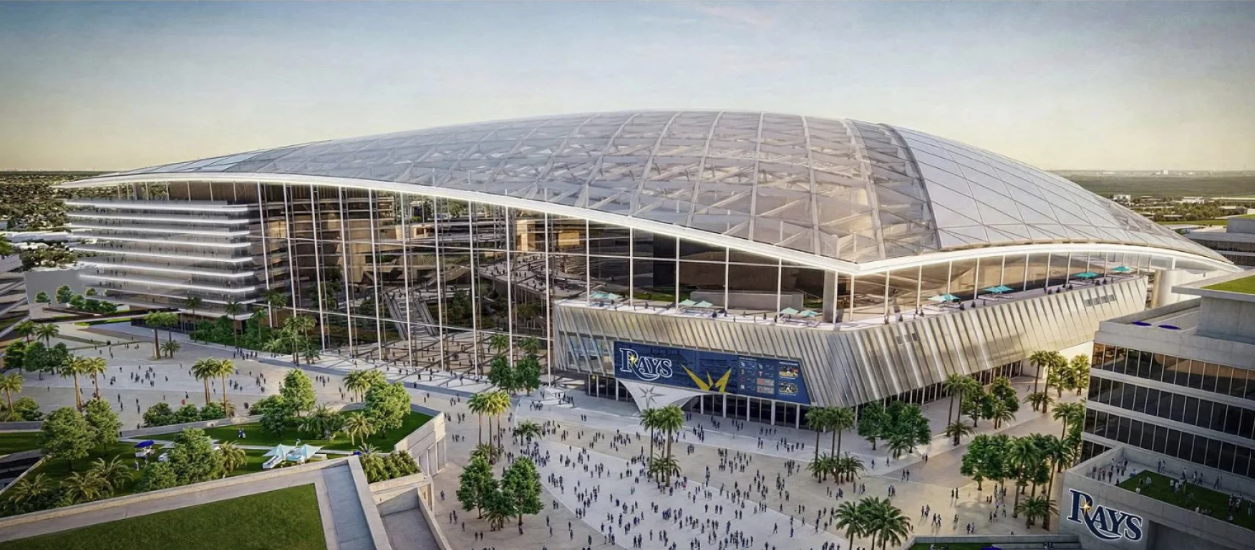
Hillsborough County released revised definitive documents on the Tampa Bay Rays stadium late Tuesday, clearing the way for Tampa City Council and county commission to meet this week and decide on whether to move forward with the project.
In addition, the Rays released details of the proposed Community Benefits Agreement, laying out the team’s commitments for affordable housing, jobs, youth, small-business and transportation and more.
The timing of the release reflects negotiations that ended hours before the city council meets at 9 a.m. Thursday. If there is approval, the county commission will hold a special meeting at 9 a.m. Friday to vote. Both will include time for public comment.
A version of the definitive documents was posted Friday at 5 p.m., a deadline to place the issue on Thursday’s city council meeting agenda. At the time, however, the county administrator sent a memo to commissioners that said there were “outstanding issues which we are continuing to address, and these documents are not the final documents.”
ALSO READ: Final agreement reached on Rays stadium. Next up: votes by city and county
The Rays want to build the $2.3 billion stadium on 21.5 acres of a 115-acre parcel now used by Hillsborough College’s Dale Mabry campus. A privately funded multi-use development would go up around the ballpark over the 35-year lease.
Per the agreement, the city and county would contribute no more than $876 million toward the stadium project, while the Rays will cover more than $1.3 billion and all cost overruns.
The city contribution is capped at $80 million and the county contribution at about $796 million, including $360 million from the Community Investment Tax, $263 million in Tourist Development Tax-backed funding, $103 million from other county funds and $30 million in federal disaster-recovery money.
Over the past several months, local officials have done exactly what taxpayers elected them to do. They pushed back. They negotiated. They challenged assumptions. They forced changes. The final agreement reflects that work.
Specifics on CDD, CRA changes
The latest changes primarily involve creation of a Community Development District (CDD) for the stadium development, which would include the ballpark and multi-use development. There are also specifics on the tax increment financing (TIF) within the CDD and protections for the county before funding is released.
Also added are specifics on amending three of Tampa’s Community Redevelopment Areas, overlay districts in blighted areas that pump future property tax growth into public projects within the boundaries.
The CRA changes will require separate action by local governments and the CRA Board, which is also scheduled to meet Thursday.
ALSO READ: Tampa council, still awaiting final documents, sets a Rays stadium vote for Aug. 27
The most significant is a “carveout resolution” to remove the stadium district from the Drew Park CRA. There is also a pledge to extend the CRA, an item accidentally omitted from the original document, said Councilman Bill Carlson, who helped negotiate many of the city’s terms over the past few weeks.
There are also commitments to extend the East Tampa CRA to 2044 and West Tampa CRA to 2055, and modifications to county participation during those extensions.
In addition, the agreement proposes halving TIF revenue from the city’s Downtown CRA but does not direct where the retained funds go. Their use would be determined through separate CRA and city approvals. According to Carlson, they would go toward a new trust fund to pay for citywide infrastructure improvements.
The revised document proposes changes intended to give the county significantly more procedural safeguards before public dollars are committed.
There are requirements before county funds can be released, including validation of bonds, validation of the CDD structure, execution of the Ballpark Operating Agreement, approval of the Community Benefits Agreement, completion of specific land-use actions and amendments to existing deed restrictions.
‘Continuous discussions’ as clock ticks
The county also added protections allowing a reduction of its CIT contribution if the state does not deliver the pledged $100 million for Lithia Pinecrest Road improvements and expanded its ability to delay certain bond issuances if bonding capacity or rating concerns arise.
Ostensibly, Tuesday’s version – which was accompanied by a copy with changes red-lined – is the one commissioners and councilors will act on, as the Rays face a September deadline to begin construction in time to open the stadium by the 2029 baseball season.
ALSO READ: Rays select AECOM Hunt and Turner to oversee Tampa stadium construction
In an email accompanying the agreement, County Attorney Julia Mandell thanked commissioners for their patience and said the county had been in “continuous discussions” with the Rays and Tampa representatives before the documents were finalized.
Some pieces remain unfinished, she said. The Team Guarantee and Non-Relocation agreements are still under discussion with Major League Baseball, while the Community Benefits Agreement and Ballpark License and Use Agreement require additional approval.
Separately, the Rays released the framework of a Community Benefits Agreement, “driven by the Rays and Hillsborough County, with significant support from the city of Tampa,” according to a news release.
The team commitment includes affordable housing and anti-displacement efforts, local hiring, minority- and women-owned business enterprises, small-business and workforce development, veterans’ engagement, transportation, youth programs and field improvements, literacy programs and complimentary tickets for families and community organizations.
Per the final documents, the Rays would provide 65% of the benefits to Hillsborough and 35% to Tampa.
To ensure transparency and accountability, the Rays said they would establish an advisory committee and publish regular public reporting, including a community report card tracking progress against their commitments.
ALSO READ: Hillsborough College president urges project support
Final obligations, definitions, implementation schedules, reporting requirements and enforceable terms will be governed by the final documents, the team said.
“A constant and important theme over the past year has been that the Forever Home must be about more than baseball,” Rays CEO Ken Babby said in the release. “Specifically, it must also be about how this project can serve the Tampa Bay community the Rays have called home since 1998, and plan to call home forever.”
Rick Mayer is a reporter with WUSF, the bay area’s NPR affiliate.