
Pinellas County commissioners are preparing to formally state that large, standalone data centers are not allowed in unincorporated areas and that they do not intend to allow them.
Commissioners gave staff the go-ahead Tuesday to begin preparing a resolution putting that position in writing. The county is taking a different approach than Pinellas Park, which imposed a one-year moratorium earlier this month after plans surfaced for a roughly 17,000-square-foot data processing facility.
The possibility of a similar moratorium came up during Tuesday’s County Commission meeting. County Attorney Jewel White said Pinellas County is in a different position because its development code does not allow standalone data centers as a primary use.
“I would be hesitant to enact a moratorium on something that is not currently allowed because I feel like that would give the impression that it is in fact allowed,” White said.
White recommended a resolution instead. Commissioners could use it to state that standalone data centers are not allowed under the existing code and that the board does not intend for them to be allowed. Unlike an ordinance changing the development code, a resolution could come directly before commissioners without going through several rounds of review and public hearings.
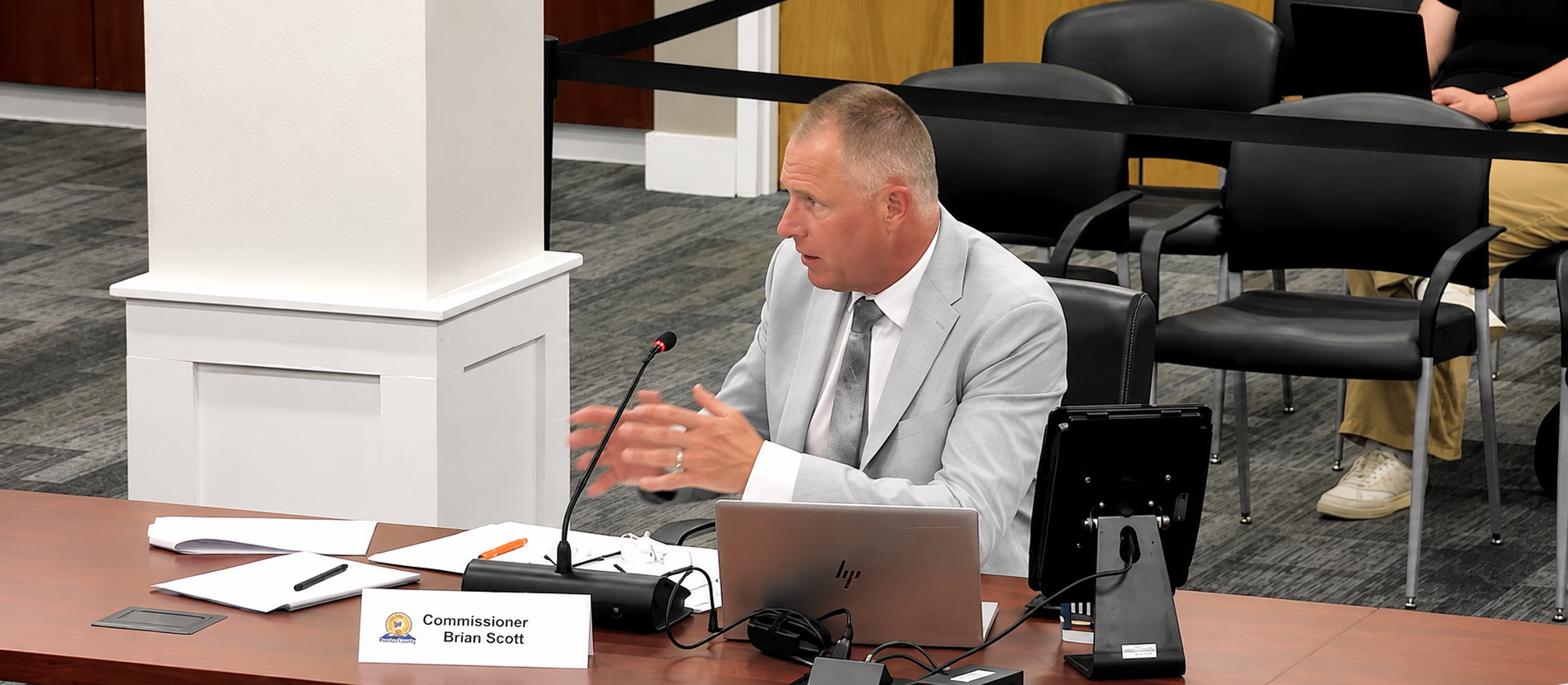
Commissioner Brian Scott said commissioners have received emails from residents and groups pushing the county to impose a moratorium. Without one, he said, some residents fear a developer could find another way to get a large project approved.
“I think if we were to do a resolution that just, you know, laid out our intent, I think that would just go a long way to building some trust with the public,” Scott said.
Much of the local concern has centered on American Tower Corporation’s proposal for an approximately 17,000-square-foot data processing facility at 10700 76th Court N. in Pinellas Park. Plans called for replacing an existing light-industrial building while leaving a communications tower on the property.
Pinellas Park did not have specific review standards for data centers. Residents raised concerns about utility use, noise and other potential impacts, and the City Council unanimously approved a one-year moratorium Aug. 11. City staff will use that time to study the issue and develop regulations for future projects.
Pinellas County has also fielded an inquiry about a potential data center in an unincorporated area. County officials said Tuesday that two inquiries helped bring the issue forward, one involving unincorporated Pinellas and another involving Pinellas Park. Neither became a formal application.
Commissioners are not looking to prohibit every facility that houses computer infrastructure. Hospitals, law enforcement agencies and other institutions already use smaller data operations to support their work.
Scott drew that line during Tuesday’s discussion, saying those facilities are different from the large, standalone operations that have generated concern.
“There’s a big difference … about defining what a data center is,” Scott said. “A Google or an Amazon or a Microsoft data center that takes up acres and acres and acres … is a lot different than a data center that the sheriff’s office uses or a hospital uses.”
White said the county may eventually need to clarify those definitions in its development code so smaller operations tied to another use remain allowed while standalone facilities do not. Changing the code, however, raises another issue for the county.
Senate Bill 180 restricts certain moratoriums and more restrictive local land-use changes in Florida communities covered by federal disaster declarations for hurricanes Debby, Helene and Milton. Commissioner René Flowers asked Tuesday how Pinellas Park and other governments had moved ahead with data center moratoriums despite those restrictions.
White pointed to Hillsborough County, which deferred action because of SB 180. She said other governments may have different development codes or may simply be willing to accept the legal uncertainty of moving forward.
“It’s a risk,” White said. “I think that some folks are just taking a risk analysis and deciding that it’s worth it for them because perhaps their codes do not already prohibit them.”
Meanwhile, Forward Pinellas has been working on a countywide approach since this summer. The planning agency began studying data centers after the Pinellas Park proposal raised questions about how the facilities fit into existing land-use rules.
During a July 8 Forward Pinellas board meeting, members backed further research and work toward common definitions and standards that local governments could use when considering future projects. Scott, who also sits on that board, suggested during that meeting that water and electricity use could help determine when a proposal requires additional scrutiny.
“If we’re going to get an application for something that’s going to use, pick a number, X amount of water or X amount of electricity,” Scott said at the July 8 meeting, “there’s a level of accountability and process that has to go through that.”
Commissioner Kathleen Peters said during Tuesday’s County Commission meeting that the Forward Pinellas work could be ready as soon as October. The agency can establish a broader planning framework, but individual cities and the county would still be responsible for putting restrictions into their own development codes.
Joe Hamilton, founder of the Artificial Intelligence Center of Excellence (and publisher of the St. Pete Catalyst), cautioned against long-term restrictions as the county considers its approach.
“Data centers should be judged on their value versus their cost, and that equation is changing quickly,” Hamilton said. “AI will likely help solve many of the energy and water challenges they create. Communities that impose long-term barriers today risk limiting their options as data centers become more efficient and more valuable.”
Commissioners decided Tuesday that the county’s resolution does not need to wait for that work.
Chair Dave Eggers asked his colleagues whether they were comfortable having staff prepare the measure and bring it back to the board. Commissioners agreed, and staff said they could move quickly.
“I would like it sooner than later,” Eggers said, “because we’ve been talking about this for a long time.”