
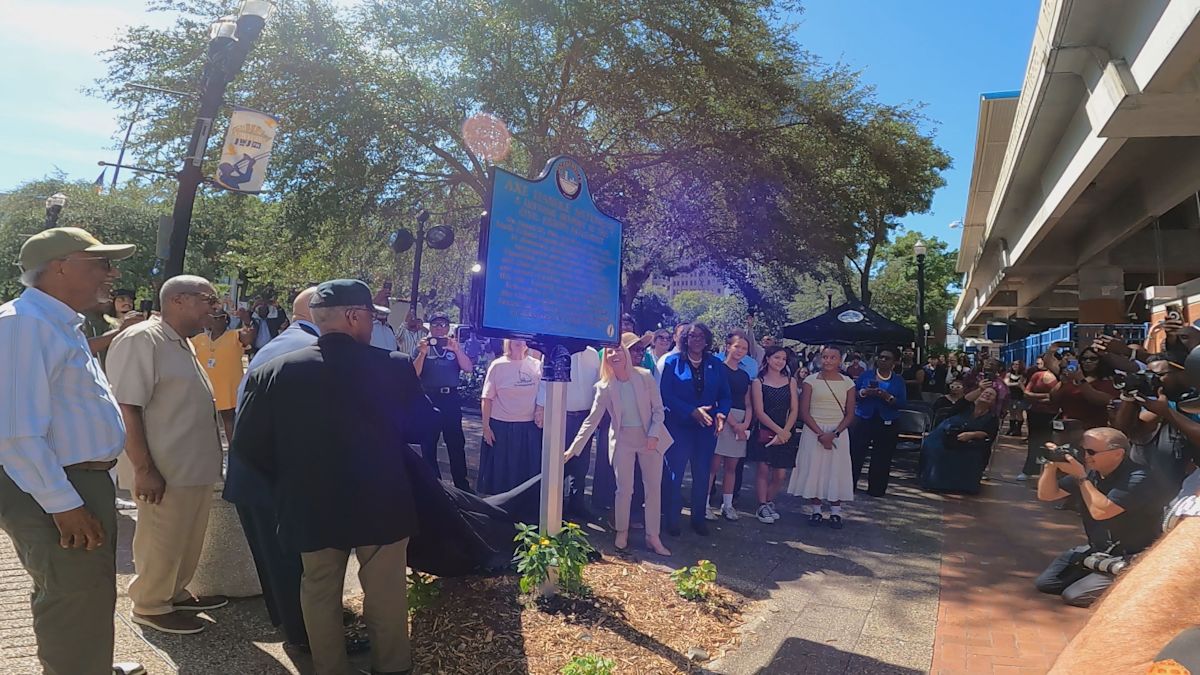
A new plaque for an old event sits in James Weldon Johnson Park, acknowledging a push for equality, a horrific attack and the change that followed.
Jacksonville leaders unveiled a historical marker for Axe Handle Saturday, which happened 66 years ago Thursday.
Any visitors to downtown Jacksonville can stop at the new plaque to read about what happened at the park in front of city hall in 1960.
It’s a story one Jacksonville activist says he’ll keep telling so the history isn’t forgotten.
“This is an opportunity for us to recognize history and understand that you cannot change it,” said Civil Rights Activist Rodney Hurst. “It’s not an urban legend.”
Hurst said he and his fellow NAACP Youth Council members could tell something was brewing outside May Cohens, what is now Jacksonville City Hall, while his group conducted a sit-in for about an hour at the segregated lunch counter.
“They were passing out ax handles by this very corner by city hall, but we decided to sit in anyway because it was more important that we be a part of the solution than part of the problem,” said Hurst.
Hurst said his group was attacked by 200 people with axe handles and baseball bats.
Fortunately, he wasn’t physically hurt.
“We ran and young ladies who were sitting-in with us, we pushed them back into department stores on Adams Street and they were locking their doors,” said Hurst. “Any black person downtown was being attacked.”
The City of Jacksonville is commemorating the effort Hurst and his group made that day and the change it brought about.
“A place that once witnessed a painful moment in Jacksonville’s history is now a place of community and connection,” said Jacksonville Mayor Donna Deegan. “That is change.”
The new marker is one of a handful that have popped up around Jacksonville over the last six months or so, acknowledging key moments in the Civil Rights movement.
“Even though it seemed like it happened long ago, it can still be used to teach younger and older generations,” said Isabella, a student from the LaVilla School of the Arts.
That’s part of the reason why Hurst is willing to relieve his experience from that Saturday each year, so the message isn’t lost.
“That’s what the movement was all about, human decency and respect, which is why I always say the struggle continues,” said Hurst.
Jacksonville was picked to join the U.S. Civil Rights Trail earlier this year and an organizer said they plan to eventually have 40 of the Civil Rights Trail markers placed around the city.