
ORLANDO, Fla. — For Tampa Bay developer and Property Scholars CEO Khalil Majied, the affordable housing challenge can be summed up in one number.
“There are only 25 available units for every 100 extremely low-income renters,” said Majied.
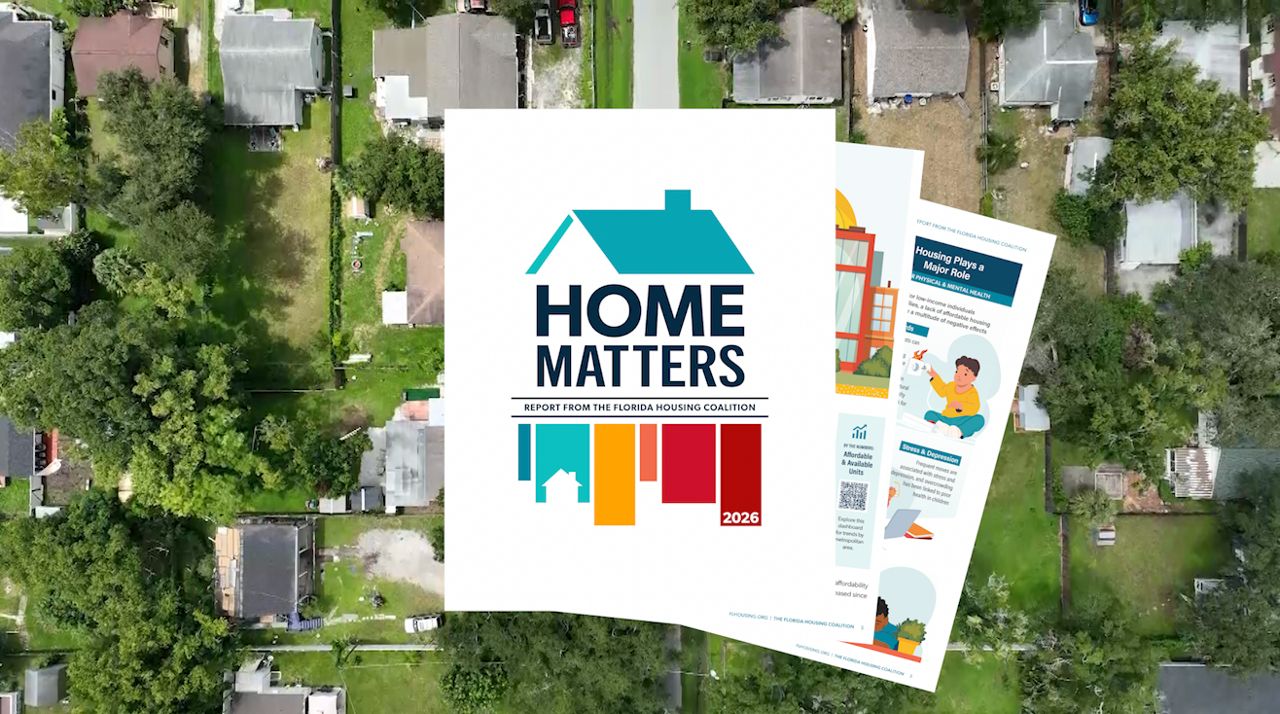
Majied was among more than 1,400 housing leaders and professionals who gathered in Orlando for the Florida Housing Coalition’s annual affordable housing conference, which wrapped up with the release of its Home Matters 2026 report.
The report examines housing affordability across Florida, including rental availability, home prices, cost burdens, homelessness and the supply of affordable housing.
Millions of households are cost-burdened
The report finds that more than 2.5 million low-income Florida households spend more than 30% of their income on housing. Of those, 1.4 million spend more than half their income on housing costs.
Ashon Nesbitt, executive director of the Florida Housing Coalition, said the annual report is intended to track the state’s progress — and challenges — on housing affordability.
“So every year we post the Home Matters report, and it really talks about how we’re doing in Florida as it relates to housing affordability,” Nesbitt said.
He said the issue is particularly acute for households with the lowest incomes.
“Over two million households that have low incomes are paying more than 30% of their income towards housing costs. It’s even more acute as we look at those that are very low income,” Nesbitt said.
Fewer lower-cost homes
The affordability challenge also extends to people trying to buy a home.
Homes selling for less than $200,000 accounted for 26.5% of Florida home sales in 2019. By 2025, that share had fallen to 6.2%, according to the report. At the same time, homes selling for $500,000 or more grew from 11.4% of sales to 35.4%.
That shift has made the traditional path to homeownership more difficult, particularly for first-time buyers looking for a lower-cost starter home.
The report also identifies a preservation challenge. More than 30,000 privately owned affordable housing units are at risk of being permanently lost from the state’s affordable housing stock by 2034.
Nesbitt said continued monitoring is necessary as housing conditions change.
“This is a constant thing that we need to keep track of. And there’s a lot of dynamics related to that. But this is something that we track. We also look at the number of folks that are experiencing homelessness,” Nesbitt said.
Housing is a statewide economic issue
Nesbitt said the housing challenge should not be viewed solely through the lens of low-income households.
“It’s a community-wide issue. It’s an economic development issue. And so, I really think that that is so important and that we have such a diverse group here,” he said.
The report also notes that Florida’s housing challenges affect the state’s workforce, as many common occupations do not pay enough for workers to comfortably afford housing.
State housing programs
Florida lawmakers fully funded the State Housing Initiatives Partnership program, known as SHIP, which helps local governments provide affordable housing assistance, including programs such as down payment assistance and home repairs.
The state also fully funded the State Apartment Incentive Loan program, or SAIL, which helps finance affordable rental housing. Both programs received full funding for a sixth consecutive year.
The state also approved $50 million for the Hometown Heroes program.
However, Innovative SAIL, a program created under the Live Local Act to support additional affordable rental housing, received no funding this year.
The Florida Housing Coalition reported that overall state housing funding was significantly lower than the previous year.
Tampa Bay developers focus on homeownership
For Majied, the goal is to connect affordable rental housing with a longer-term path to homeownership.
“While I primarily focus in home ownership opportunities, we switched our focus to affordability and really trying to create a workaround or wraparound around our low-income renters to get them on a path to homeownership,” Majied said.
The Home Matters 2026 report also highlights the Tampa Bay Partnership’s Housing Equation, a regional housing needs effort covering Hillsborough, Pinellas and Pasco counties.
For housing leaders, the challenge is not simply adding more units, but creating and preserving housing that Florida residents can afford — while maintaining a path toward stable housing and, for some renters, eventual homeownership.