
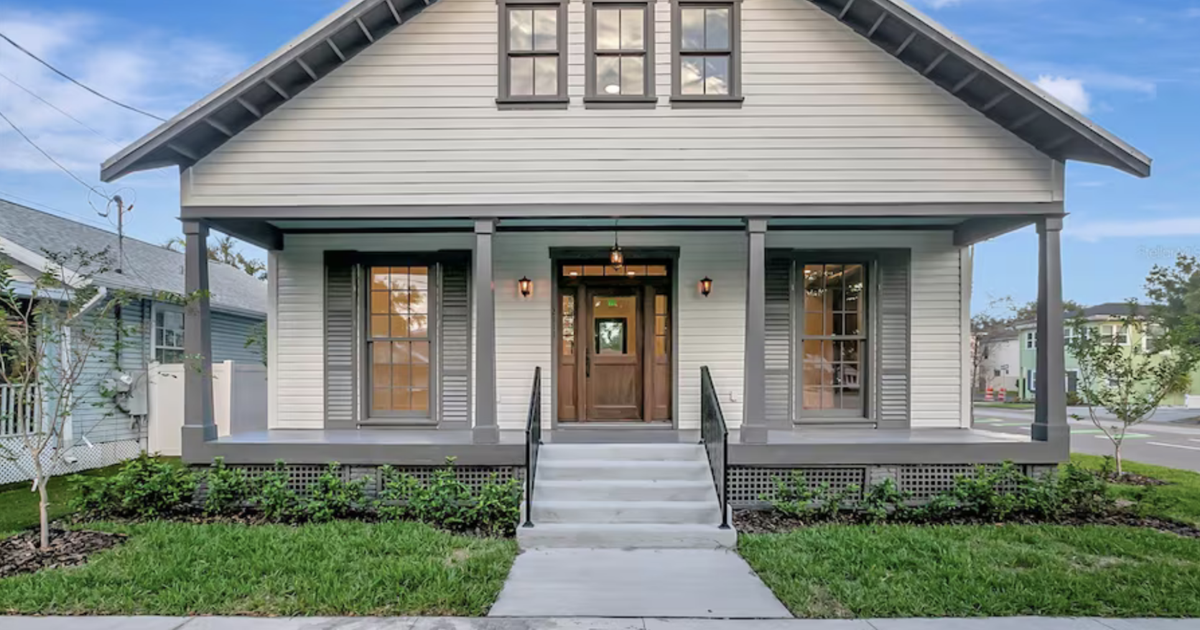
Over the course of its nearly 200-year history, the oldest house in Tampa has narrowly escaped destruction at every turn.
It’s been converted from a family home to a boarding house to an office, changed locations twice and was even caught up in a Ponzi scheme.
Now it’s on the market again for $1.8 million.
Built in 1842 by physician Sheldon Stringer, the 2,120-square-foot bungalow fell into disrepair in the 1980s but has since been fully restored as a two-story commercial office.
“This house went through the Civil War,” Stephen Gay, the listing agent with Smith & Associates Real Estate said. “Think of how many things it’s seen in its lifetime, how much Tampa has changed since then.”
The home is now located at 2111 W Cleveland St. in Hyde Park.
It was originally built downtown on Jackson Street. In 1914, city officials decided to erect a new city hall on that site, so the bungalow had to go.
Local feed store owner Imboden Stalnaker bought it, disassembled it and shipped it by train to what was then a farm town called Gary, located just south of Ybor City.
Eventually the home became a low-income boarding house, though it’s not clear when. It changed hands at least six times since 1987, according to records from the Hillsborough County Property Appraiser.
Several tried and failed to restore the building, which suffered significant damage over the years.
In 2016, the hedge fund EquiAlt bought the home for $55,000. It paid another $215,000 to move it by truck to its current address in Hyde Park.
The company planned to renovate and use the building as its headquarters. That never happened.
Federal investigators accused EquiAlt of running a Ponzi scheme in 2020. The court auctioned off the historic home and nearly 300 others owned by EquiAlt in an effort to recover funds lost by hundreds of investors.
Stress Free Construction LLC closed on the home in 2022 for $460,000. The owner spent thousands to make the property useable again, completing the foundation work and adding in new plumbing, roofing, electrical, air conditioning and a wheelchair lift.
The first floor includes a bathroom, two offices, an executive suite with its own bathroom, a glass-walled conference room and a kitchenette break room. Upstairs there’s another office, common space for cubicles, storage areas and a third bathroom.
One of the original wood beams has been exposed to showcase the home’s historic charm. Much of the original wood was salvaged and incorporated throughout in the form of accent walls.
“Most people would’ve probably never gone through the trouble to do that,” said Gay. “The home is not protected. That’s the crazy thing, it could have just been demolished.”