
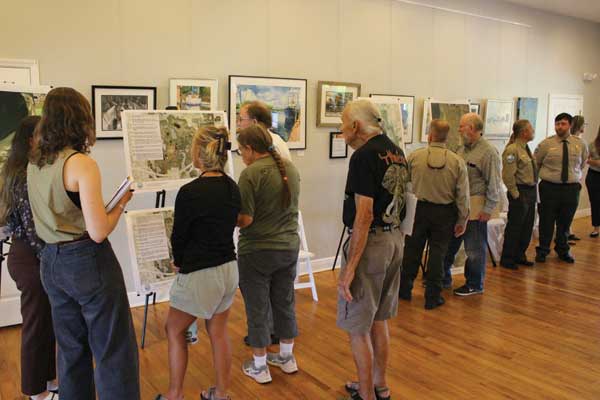
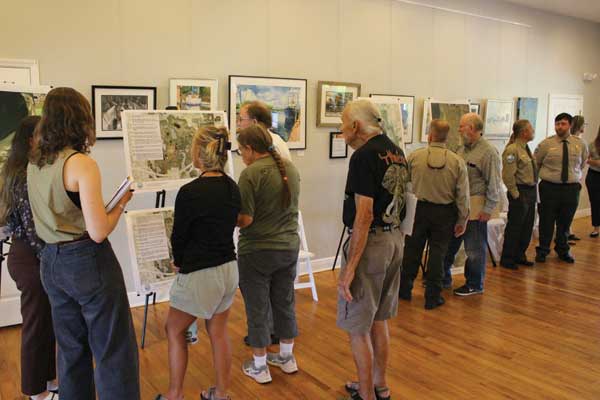
Attendees review maps and informational displays Aug. 26 during a Florida Department of Environmental Protection open house at Palma Sola Botanical Park in Bradenton on a proposed update to the Terra Ceia Aquatic Preserve Management Plan. Islander Photo: Robert Anderson
The state is proposing its first update in 17 years to the management plan for the Terra Ceia Aquatic Preserve, bringing new attention to environmental and developmental pressures following a year of heightened public interest in protecting the preserve.
The Florida Department of Environmental Protection hosted an open house Aug. 26 at the Palma Sola Botanical Park, 9800 17th Ave. NW, Bradenton, to gather public input on the draft plan for the 20,394-acre preserve.
The update places increased emphasis on water quality, hard-bottom and seagrass habitat, vessel impacts and pressures from development in the surrounding watershed. It also incorporates state restrictions enacted earlier this year on dredging and filling within the preserve.
Suncoast Waterkeeper executive director Abbey Tyrna said she attended to learn about the changes DEP is proposing and whether the updated plan includes measures needed to protect the preserve.
“It sounds like they’re making great progress,” Tyrna said.
She said an important component is improving documentation of the preserve’s resources and environmental conditions, including water quality and fisheries.
“We need to know what’s there,” she said.
The work comes months after a proposed cruise terminal near the preserve galvanized residents, commercial fishers and environmentalists around the protection of Terra Ceia Bay.
Plans involving the developer, SSA Marine and Slip Knott LLC, which owns the 328-acre Knott-Cowen tract near the Sunshine Skyway Bridge, surfaced publicly in January that proposed a cruise ship terminal near Rattlesnake Key.
The proposal prompted concerns about dredging and potential impacts to water quality, seagrass, fisheries and other natural resources and led to the formation of a grassroots environmental group, People Protecting Terra Ceia Bay.
State Sen. Jim Boyd, R-Bradenton, spearheaded legislation during the 2026 session that restricts dredging and filling of submerged lands within the preserve. Gov. Ron DeSantis signed the bill March 19, creating an obstacle to the large-scale dredging that would be needed for the proposed terminal.
The restrictions were incorporated into the DEP’s draft management plan.
The plan limits dredging and filling within the preserve to specified circumstances approved by the Florida Board of Trustees of the Internal Improvement Trust Fund.
Exceptions include public navigation projects and minimum dredging and filling associated with marinas, public boat ramps, piers and docks when the work would not adversely affect water quality or the preserve’s utility.
Beyond dredging restrictions, the draft calls for expanded monitoring and protection of sensitive, submerged habitats.
The DEP identifies extensive hard-bottom habitat within the preserve, including areas offshore of Rattlesnake Key, where exposed limestone supports algae, sponges, soft and hard corals, fish and other marine life.
Seagrass protection also figures prominently in the update. The DEP says seagrass can be damaged by dredging and filling, increased turbidity, propellers and anchors, with scars sometimes taking years to recover.
The draft proposes identifying areas where boating is damaging seagrass and hard-bottom areas and studying measures including pole-and-troll or no-motor zones, limited-access areas, additional signage and increased enforcement.
Water quality represents another major component. The DEP proposes expanded long-term monitoring and efforts to identify sources of nutrients, pollution and turbidity while working with other agencies to address stormwater and other activities in the watershed that could impact preserve waters.
The plan also calls for aquatic preserve staff to remain involved in reviews of projects that could affect submerged resources.
The DEP notes that staff have participated in pre-application discussions for large projects in the past, allowing potential environmental impacts to be identified before proposals are fully developed.
The draft remains subject to public review before a final management plan is adopted.