
Artificial intelligence is not just an emerging technology. It is changing how people learn, work and create. However, AI’s adoptability has led to a key question: What are the ethical complications?
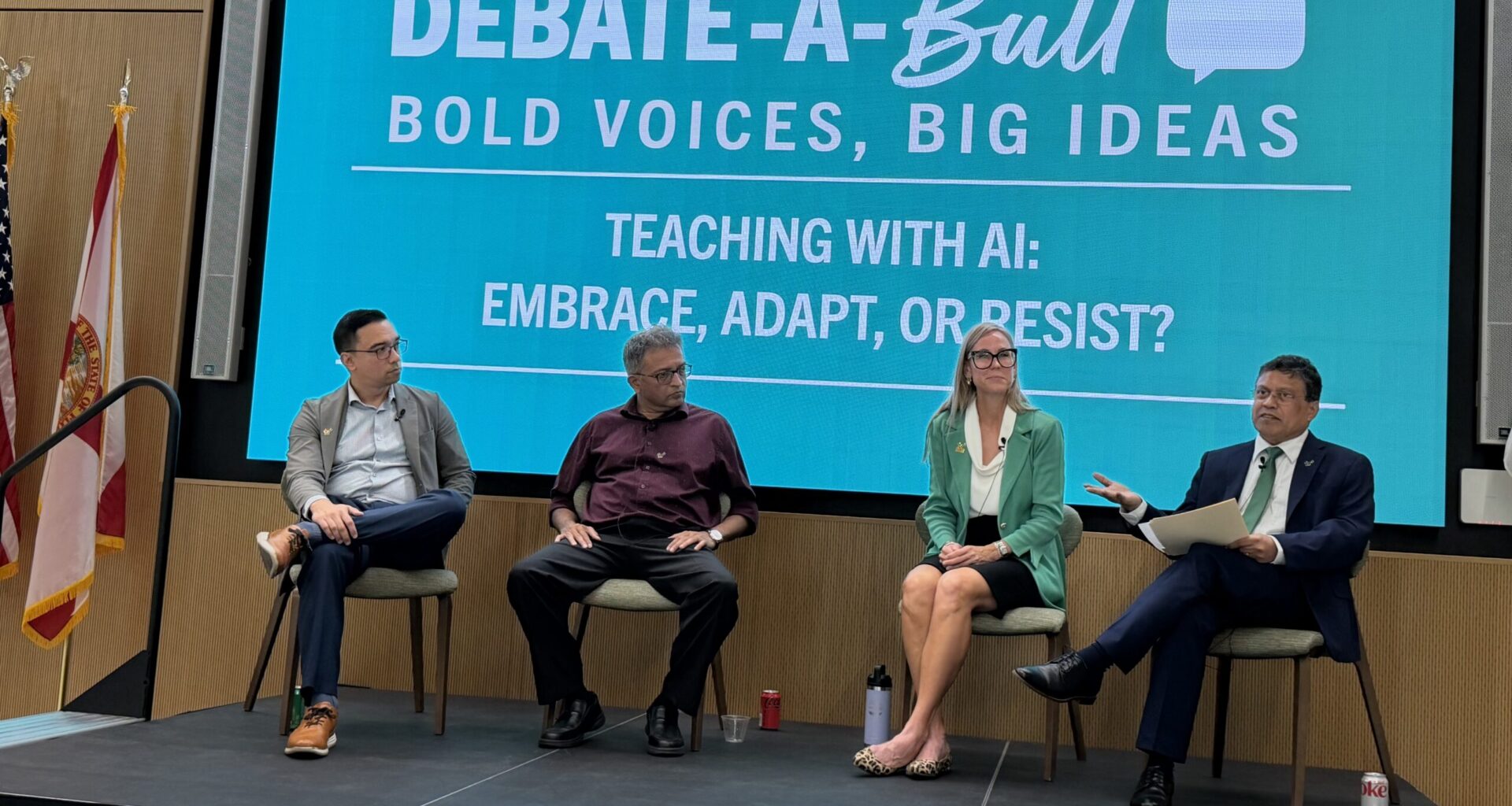
University of South Florida staff and community members came together Monday for the “Teaching with AI: Embrace, Adapt or Resist?” panel discussion. Held at the educational institution’s Tampa campus, the event focused on how AI is transforming the educational industry.
John Licato, associate professor in the Bellini College of Artificial Intelligence, Cybersecurity and Computing, Deepak Singh, affiliate faculty member in the Judy Genshaft Honors College and Stephanie Arthur, assistant professor of instruction in the College of Education, were the panelists. Prasant Mohapatra, USF provost and executive vice president, moderated the conversation.
Licato and Arthur were mostly optimistic about the technology. Singh expressed that he does not support the use of AI.
“AI is here,” Arthur said. “It’s not going anywhere and we already recognize that our students are using it. There’s no way we can put that toothpaste back in that tube. So, we are going to need to go ahead and move forward with understanding and building foundations of AI literacy in our classrooms.”
However, she emphasized that it’s essential to leverage “that human-centered control for privacy and security and voice.”
Licato explained that AI is another tool computer science students can use to innovate and create software. For example, one of Licato’s Ph.D. candidates recently developed their own text editor. This can save time and money.
AI can help teachers adapt to different learning styles, Arthur added. Lesson plans will not address the needs of every student. As an example, the technology can be utilized to help create content for individuals who do not speak English as a primary language.
Singh, who teaches writing, believes that passion can encourage individuals to create work without any assistance from AI. He argued that people should not have to delegate a task that they enjoy doing.
“To assume that human intelligence is inferior to an artificial one is quite demeaning,” Singh explained. “It’s like saying eat this artificial orange when the original orange is sitting right next to it. You can use your own brain. We are being so pessimistic about human intelligence.”
He said that culture can play an essential role in a student’s beliefs, especially in the arts and literature. This brings “different personalities into the writing.” Singh believes that an author’s voice “can be flat” if they use AI in the creative process.
When learners actually take the time to master the content, he argued, this can be invaluable. If a student uses a generative AI tool like ChatGPT to seek information, they will be less likely to remember what they read.
Licato added that one of the key drawbacks of AI is that it “can replace talking to each other.” This can be especially challenging when students are working on software design. He explained that when individuals develop software in the real world, the process requires extensive testing and refinement. The professor believes that AI systems cannot replace human feedback.
Licato and Arthur agreed that the technology should be utilized in a thoughtful way.
“The guardrails around the purpose of the course itself have to be made even clearer than they were before,” Licato said. “If AI changes the purpose of your course, then shouldn’t we at least think about that?”
Arthur argued that learners should be brought into the conversation for establishing AI policies. She believes that undergraduate and graduate students “are very interested in sharing their voices” and “want to be heard.” Arthur emphasized the importance of a “discussion based environment” that fosters community, collaboration and knowledge building.
Assignments will have to change, she said. Teachers have a responsibility to model how to properly and ethically use AI. Arthur believes that the technology should be discussed in a classroom setting as early as first grade.
“This isn’t new,” she added. “We have been addressing new technologies for decades. So, we’re here again. What we learned from the last time around was that every voice should be represented.”
AI is not only shaping education, but employment as well. Arthur believes that if students can leverage emerging technologies, this can help prepare them for jobs once they graduate. She argued that this can make learners “more competitive.”
“Just because it is really easy to take AI and use it to do the kind of skills that you usually give to junior employees doesn’t mean you should,” Licato said. “There’s a phenomenon where AI is being used to write computer code. The people who are senior programmers, who’ve been doing it for 20 years, use these AI tools and they’re able to crank out just amazing things super quick.”
“The junior programmers come in and see that and they think ‘oh, I can do that too. It’s magic,’” he continued. “But what they don’t realize is the senior programmers are able to do that because they’ve spent so much time writing the code themselves and debugging and finding the errors. When the AI spits out code, they kind of know where to look and find the bugs.”
Licato believes that it is essential to put junior employees in a position where they can make mistakes, learn and grow.